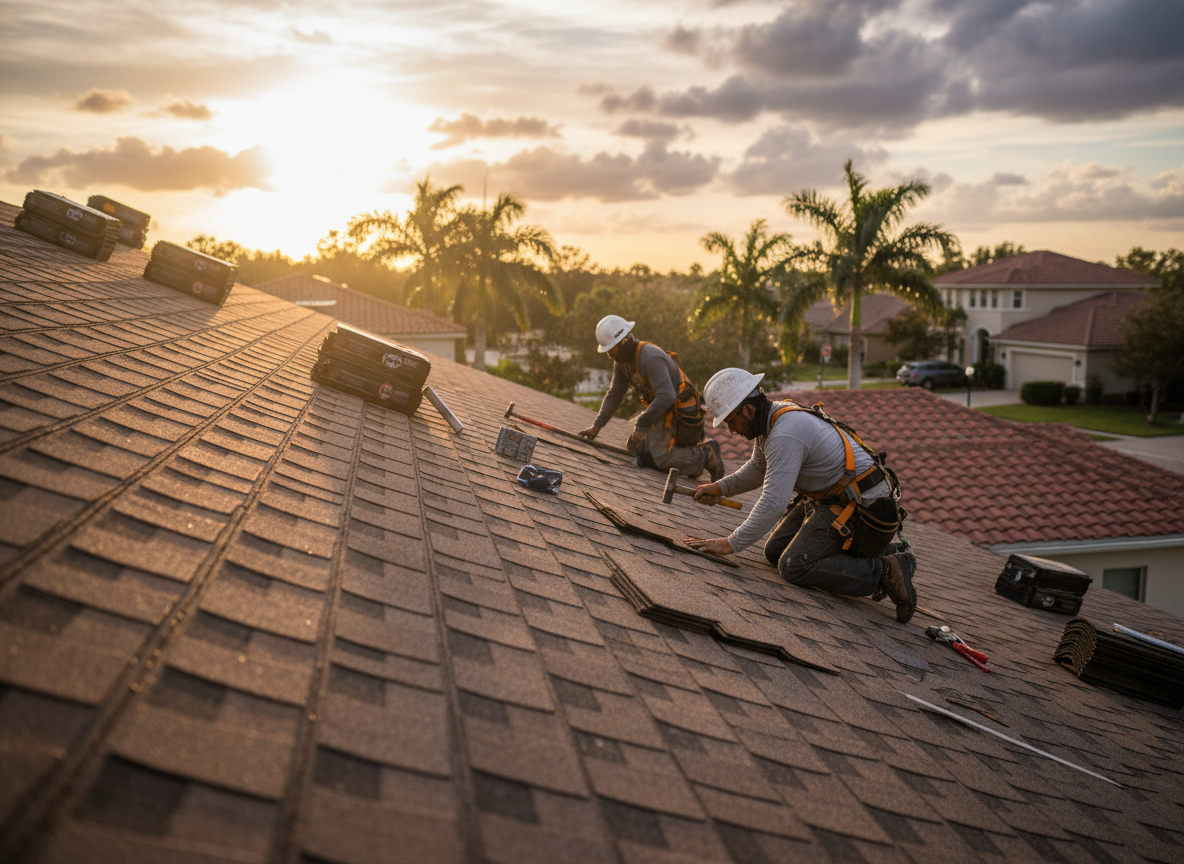
Tampa Bay and the Gulf Coast run from Tampa and St. Petersburg through Clearwater, Bradenton and Sarasota, and the roofing problems here are driven by the water rather than by the sun alone. Salt air attacks every exposed metal fixing. Gulf-facing elevations take wind-driven rain at an angle that finds details a straight-down shower never touches. And the housing stock changes every few kilometres, from 1920s bungalows in St. Petersburg to 1990s tile subdivisions in Sarasota.
Which Cities Do We Cover Here?
Tampa, St. Petersburg, Clearwater, Sarasota, Bradenton and Brandon, plus the communities between them. Our office is in Orlando, and this is one of the five regions in Florida we work across. There is no branch office in Tampa Bay: if a job is here, the crew travels from Orlando and the same phone number arranges it.
What Makes a Gulf Coast Roof Different?
Salt. Airborne chloride settles on every surface and attacks fasteners, flashing, metal panels and air conditioning equipment. On a metal roof it shows at cut edges and screw heads first. On a tile roof it attacks the metal fixings under the tile, which is why a coastal tile roof can lose its hips while the tile itself looks sound.
Wind-driven rain is the second factor. A west-facing elevation in Clearwater takes rain at 40 mph several times a season, and water pushed at that angle gets behind coverings, under flashings and into wall cavities. The leak then appears at a ceiling line inside, well below the entry point, and the roof covering is often intact.
Permits and Code Along the Gulf Coast
Roofing work is permitted by the local building department under the Florida Building Code. In this region that means the city or county that covers the address: Tampa and unincorporated Hillsborough County are different jurisdictions, and so are St. Petersburg, Clearwater, Bradenton, Sarasota and their surrounding counties. The High-Velocity Hurricane Zone applies in Miami-Dade and Broward, not here, but the wind provisions of the Florida Building Code apply everywhere and the design wind speed for a coastal site is higher than inland.
Product approval still matters. Roof coverings and their components are approved products in Florida, and the approval specifies the fastening pattern. On a coastal site, the corrosion resistance of those fasteners is part of whether the roof performs.
Roof Types Across the Region
Concrete and clay tile is common on the coastal subdivisions built from the 1980s onwards, particularly around Sarasota, Bradenton and the Clearwater beaches. Asphalt shingle dominates the inland and northern parts of Hillsborough and Pasco. Metal has grown on both, in standing seam on newer builds and exposed-fastener profiles on older and agricultural buildings. Low-slope membranes cover the commercial stock and the 1950s and 1960s residential flat sections in St. Petersburg and Tampa.
Each covering fails in its own way, and treating them as one product is how a homeowner ends up with the wrong repair. A tile roof here fails at the membrane and the hip fixings. A shingle roof fails at the underlayment and the seals. A metal roof fails at the fasteners and the cut edges. A flat roof fails at the seams and the drainage.
What to Have Ready When You Call
The address, because it decides the permit office. The covering type, or a photograph of it from the ground. The age of the roof if you know it, and whether it has leaked before. And the reason for the call: a leak, storm damage, an insurer's letter, or a plan.
From that, the visit can be planned rather than improvised. Florida Roof Repair Pros, 4720 Millenia Blvd, Suite 175, Orlando, FL 32839, (407) 557-4529.
Around Tampa Bay & Gulf Coast
We regularly work near:
- 📍Tampa International Airport
- 📍Bayshore Boulevard, Tampa
- 📍Clearwater Beach
- 📍The Ringling, Sarasota
- 📍Sunshine Skyway Bridge
Roofing Company in Tampa Bay & Gulf Coast — Local Notes
- •Salt air attacks fasteners, flashing and metal panels before it attacks the covering
- •Gulf-facing elevations take wind-driven rain that reaches wall junctions and soffits
- •Housing stock ranges from 1920s bungalows to 1990s tile subdivisions within a few kilometres