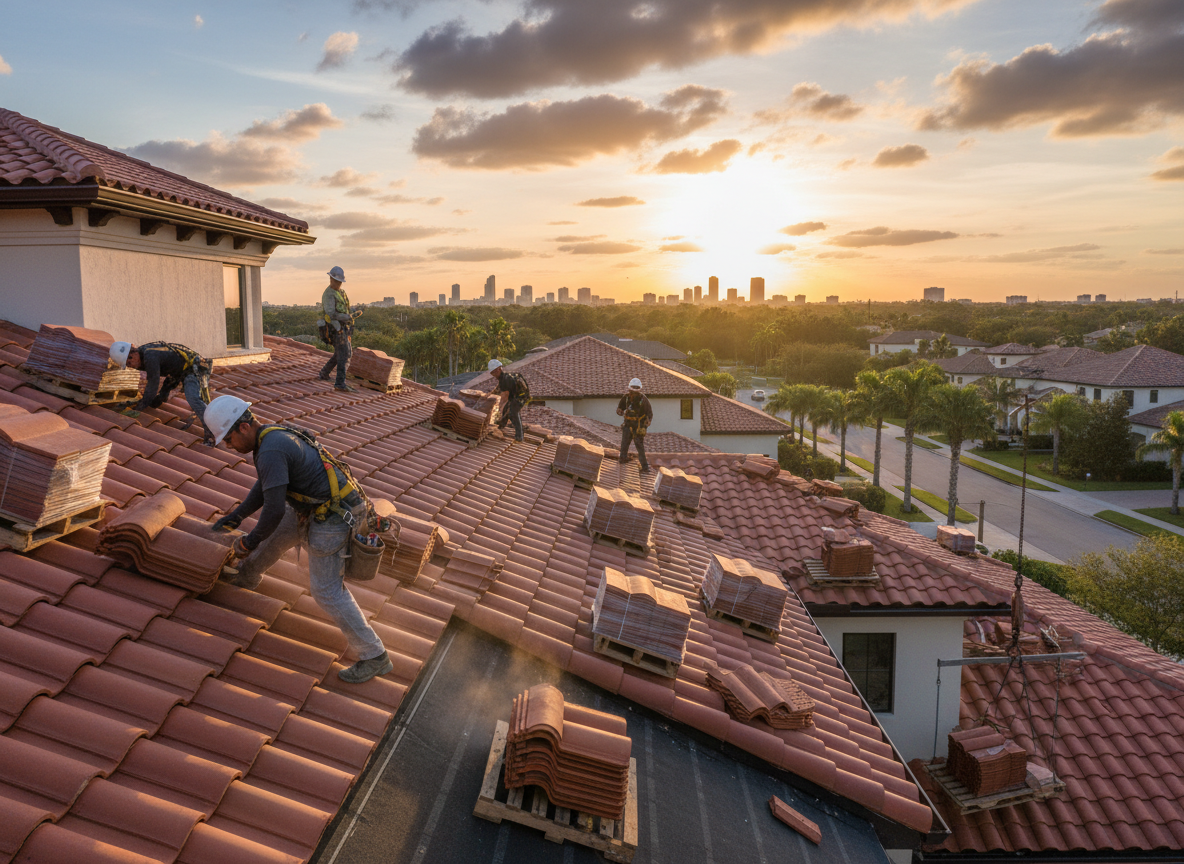
Altamonte Springs filled up quickly. The city incorporated in 1920 but most of what stands today was built between the 1960s and the 1980s, in a burst that produced apartment complexes, condominium towers, townhome clusters and single-family subdivisions along the State Road 436 corridor and either side of Interstate 4. That building boom is why roof work here looks different from roof work in a newer suburb: the covering on a large share of the buildings is low-slope membrane rather than shingle, the buildings are often owned by an association rather than a household, and the decision about who pays for a roof is sometimes harder than the work itself. Roof repair in Altamonte Springs, FL therefore begins with two questions that have nothing to do with tools: who owns the roof, and what covering is actually up there.
Who Owns the Roof
In a condominium, the roof is usually a common element, which means the association is responsible for it and the cost is shared through assessments. In a townhome development it depends entirely on how the declaration was written: some treat the roof as common, some make it the owner's, and some split it by building type. A single-family house is straightforward — the owner decides.
This matters before anything is surveyed. If the roof is an association responsibility, the work needs a board decision and usually more than one written proposal, and the scope has to be written in a way a board can compare. If it is the owner's, the decision is quicker. Getting this wrong wastes everybody's time, so the first question on a multifamily call is which document governs, not which covering is on the roof.
There is also a practical issue in shared buildings: a leak that appears in one unit may originate three floors up and forty feet sideways, and the repair may be in a common element while the damage is inside a private unit. Tracing it properly is part of the job.
The 1960s to 1980s Stock
The apartment and condominium buildings from that era share a set of characteristics. Roofs are often low-slope, framed in concrete or steel with insulation board and a membrane on top, and the original membrane has usually been recoated, patched or partially replaced at least once. Where the roof is pitched, it is typically asphalt shingle on truss framing, and on townhome clusters the pitch is often steep enough that access is the main constraint on the work.
The single-family subdivisions from the same decades are shingle, mostly, with hip and gable geometry and a garage roof that was added to the plan in the 1970s. Those roofs are now well past the age at which the original covering was expected to last, and many have been re-covered once. What is under the second covering is the question.
Newer infill and the redevelopment around the city centre add flat-roofed mixed-use buildings and metal accents, but they are a small part of the total. The city's roof stock is largely a 1960s-to-1980s problem.
Low-Slope Roofs and What They Actually Need
A low-slope roof is a drainage system as much as a covering. Water is meant to leave it, and every failure begins with water that did not. On the buildings in Altamonte Springs the usual culprits are drains and scuppers that have settled slightly high, seams that have opened where the membrane turns up at a wall, and penetrations from air-conditioning units that were added after the roof was laid.
Repair is possible and often sensible: a membrane patch over a localised failure, a rebuilt drain sump, a new termination bar at a wall. Where the insulation below the membrane has been wet for a long time, patching becomes pointless, because the water is already in the assembly and will find another way out. The test is straightforward — open the roof at the suspect area and see what is underneath.
Coating is a middle path that is often appropriate here. A sound membrane with a weathered surface can be cleaned, prepped and coated, which renews the surface and reduces heat gain without rebuilding the roof. It is not a repair for a failed membrane, and it does not fix ponding. It is a way of extending the life of an assembly that is still doing its job.
Weather Along the I-4 Corridor
Altamonte Springs sits inland, north of Orlando, and its weather is the Central Florida pattern: heavy afternoon storms from June into September, occasional severe wind, and the hurricane risk that comes with the peninsula. Hurricane Charley crossed the region in August 2004 and caused widespread damage across Seminole County; Hurricane Irma crossed inland in September 2017 with a longer period of wind and rain.
On low-slope buildings the failure mode in those events is different from a pitched roof. Wind does not lift shingles so much as it peels at edges and corners, and where a membrane termination is marginal the wind gets under it and takes a section. On pitched roofs, the damage is at ridges, rakes and the windward corners, and it is often invisible from the ground because the shingles lift and settle back.
Age makes both worse. A membrane at the end of its life and a shingle roof on its second covering do not need an extreme event to fail; a strong afternoon storm is enough.
The Work We Do Here
The full range applies, and the survey decides which part. Leaks are roof leak repair, traced from the entry point. Where a storm has opened a roof, emergency roof tarping keeps water out of the building until a permanent repair is arranged, and emergency roof repair handles damage that can be closed in one visit. Storm and hurricane damage repair covers the wider assessment across a building or a cluster of buildings.
Roof repair is often the right answer on these roofs, particularly where the failure is local and the assembly is otherwise sound. Roof replacement is the answer when the insulation or deck has been wet long enough that patching is pointless. Roof installation covers new buildings and additions. The coverings are shingle roofing on the pitched buildings, tile roofing where it appears on later infill, metal roofing on accents and canopies, and flat roof repair and roof coating on the low-slope stock, which is where most of the work is. Roof inspection is what a board should commission before deciding between repair and replacement, because it turns a argument about opinions into a description of condition.
Permits and Inspections
The City of Altamonte Springs issues roofing permits for addresses inside the city; Seminole County handles unincorporated property around it, including several of the communities that carry an Altamonte Springs mailing address. That distinction catches people out, because the postal address and the jurisdiction are not always the same thing.
Work is permitted under the Florida Building Code. Central Florida is outside the High-Velocity Hurricane Zone, which applies only to Broward and Miami-Dade counties, but the wind provisions still govern the fastening and the product approval for whatever covering is specified. On a low-slope commercial or multifamily building the application usually carries more detail about the assembly than a house does, because the layers matter — deck, insulation, cover board, membrane.
On association work there is a second layer of paperwork: the board's approval, the scope it approved and the record of the completed inspection. Keeping those together is what makes the next roof decision easier.
How a Job Runs, and Where We Cover
The survey comes first: the roof walked or accessed by the appropriate means, the underside inspected where there is access, drains tested, and photographs taken of every termination, penetration and seam. On a multifamily building, part of the survey is establishing how many separate roof areas there are and which of them are failing.
The written scope describes each area separately, names the materials and states what is being done about the deck and insulation. The permit follows, then the work, then the inspection. Sign-off is a walk of the roof with the owner or the board's representative, with the inspection record and photographs handed over.
Within about ten miles: Casselberry to the east, Longwood to the north, Maitland and Fern Park to the south, Winter Springs to the northeast, Forest City and Wekiwa Springs to the west, and Apopka at the outer edge of the radius. Each has its own permit authority.
Calling About a Roof in Altamonte Springs
For a house, the age and covering are enough to start. For a condominium or townhome, it helps to know whether the roof is a common element before the first visit, because that decides who is commissioning the work. Florida Roof Repair Pros, 4720 Millenia Blvd, Suite 175, Orlando, FL 32839, (407) 557-4529.
Coating, Restoration and Their Limits
Coating is the most misunderstood option on a Florida low-slope roof, and Altamonte Springs has a great many low-slope roofs. It is worth being precise about what it does.
A coating is a surface treatment. It is applied to a clean, sound membrane or metal roof, it renews the weathered top layer, and on a white or reflective product it reduces the heat the building absorbs. What it does not do is bridge a membrane that has failed, seal a seam that has opened because the sheets have moved, or fix water standing on the roof.
So the first question is not which coating but whether the assembly is sound. That means checking the membrane for blisters and splits, checking the terminations at parapets and curbs, checking the drains, and checking whether the insulation below has taken water. Where the membrane is intact and the surface has simply aged, coating is a reasonable way to extend the life of the roof and reduce heat gain. Where water is already in the assembly, coating seals it in and the problem reappears.
On a multifamily building, the practical value of coating is that it can be done in phases around occupied units, and it does not require the roof to be stripped. That makes it attractive to a board managing a budget. The trade-off is that the underlying assembly is not being renewed, so the decision has to be made with an honest description of condition rather than an optimistic one.
Metal roofs on the same buildings are a different case. A sound metal roof with surface corrosion can be prepared and coated, and the work is worthwhile where the panels still have section. A metal roof with perforated panels cannot be coated into service.
The test in both cases is the same: is the material below the surface still doing its job? If it is, coating buys time. If it is not, coating hides the problem for a season.
Around Altamonte Springs
We regularly work near:
- 📍Cranes Roost Park
- 📍Lake Lotus Park
- 📍Little Wekiva River
- 📍State Road 436 corridor
- 📍Altamonte Springs downtown redevelopment area
Roofing Company in Altamonte Springs — Local Notes
- •Built up mostly between the 1960s and 1980s
- •A large share of roofs are on multifamily buildings
- •Association and owner responsibilities differ by building type