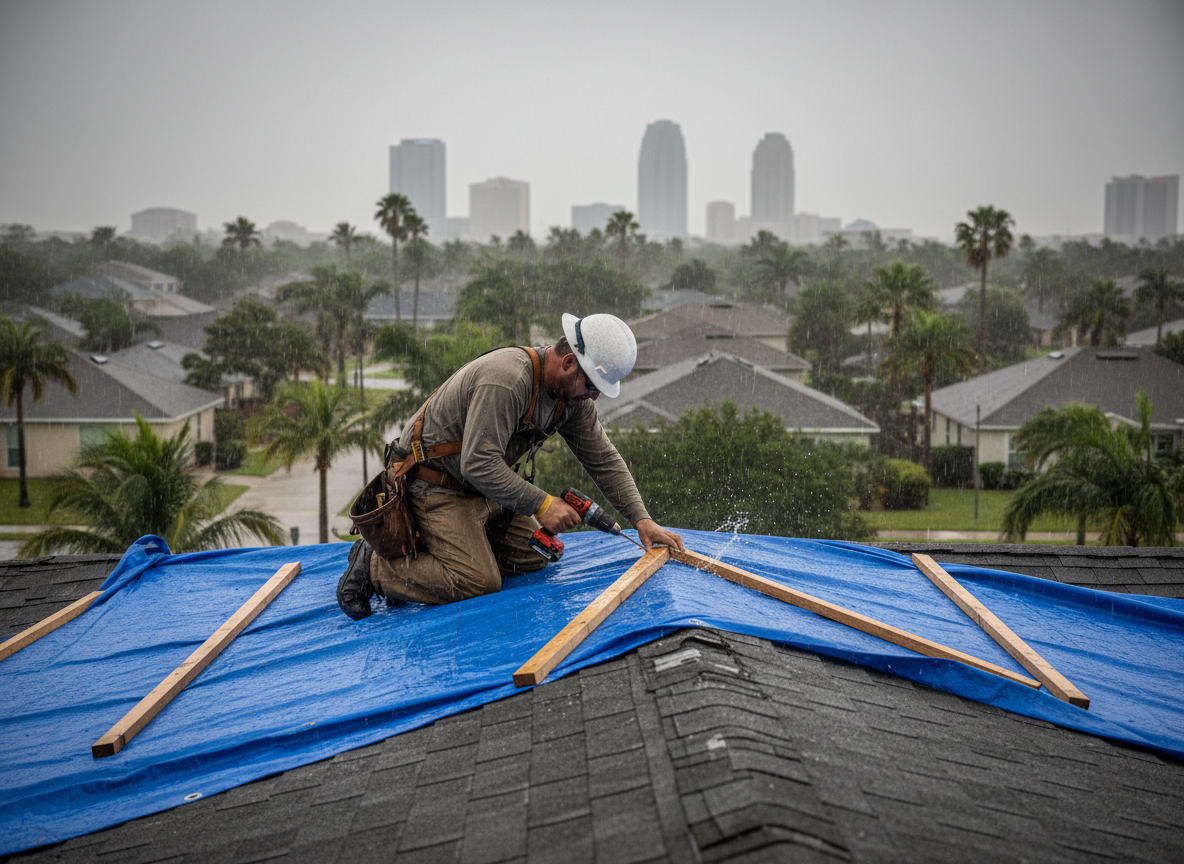
A storm takes a section of covering off a roof and the forecast has three more days of rain in it. A tarp is the difference between a roof opening that gets wet for three days and one that gets wet for three months, because the permanent repair needs a permit, materials and a dry deck. Emergency roof tarping is temporary protection, and doing it properly in Florida is a different job from throwing a blue sheet over the ridge. The cover has to survive wind, sun and the next storm, and it has to come off again without adding damage. Call (407) 557-4529.
What Does a Tarp Actually Do on a Florida Roof?
It keeps rain out of an opening and holds the damaged area in the condition the storm left it, so the repair can be planned from evidence rather than memory.
That second part is undervalued. Once a homeowner or a well-meaning neighbour drags a cover over a damaged section, screws it down and sweeps up, the arrangement of what failed is gone. Fastener patterns, the direction the covering lifted, and whether the underlayment was already torn are all visible only in the first hours. A tarp installed after a photograph and a written note preserves that evidence; one installed in a hurry destroys it.
A tarp also buys time for the right sequence. In Florida, most permanent roof work needs a permit from the local building department, and materials for tile and metal profiles are not always on a shelf locally. A cover that holds for weeks means the repair can be done once, correctly, instead of being improvised between rain bands.
What a tarp does not do is repair anything. It does not restore waterproofing under the covering, it does not stop water entering at a wall or a window head, and it does not fix a roof failing across its whole area. If the water is coming in somewhere other than the opening, covering the opening will not help.
Why Can't the Cover Wait Until the Adjuster Has Been?
Because the next rain does not wait for the paperwork. Every storm that passes over an open roof adds interior damage, and interior damage is the expensive half of the loss.
Florida's rain does not arrive politely. Between June and November the state runs on convective storms that can put down an inch in twenty minutes, plus whatever a tropical system brings. An open roof section one square metre wide can pass hundreds of litres into a ceiling cavity across a week of afternoon storms. The ceiling board softens, the insulation stays saturated, and the timber above it starts to hold moisture.
There is also a documentation argument for covering early. A cover installed the day after the storm, with photographs before and after, shows an insurer exactly what the roof looked like at the time of loss. That is a stronger record than a claim submitted weeks later with the damage weathered by three more storms and a debris layer on top.
And there is the hazard argument. A displaced ridge cap, a loose fascia board or a sheet of metal trim hanging over a driveway is a danger to anyone walking below. Covering and securing those items is not optional maintenance, it is making the property safe.
What Should a Tarp Job Include Beyond the Plastic?
A written record, a fastening plan, and a date on the cover.
Ask for photographs of the opening before the cover goes on, taken close enough to show the failed detail and wide enough to show where on the roof it sits. Ask what the cover is fastened to and how, because the answer determines whether it survives the next windy day. Ask for the date the cover was installed to be written on it or recorded, so its age is known when it is removed.
Ask, too, what will happen at the edges. The failure mode of nearly every amateur tarp is at the perimeter: the cover flaps, the fastening pulls out of the deck, and the whole thing peels back in the first gust. A cover tight in the middle and loose at the edge is a cover that will be gone by morning. Ours is documented the same way on every job: Florida Roof Repair Pros, 4720 Millenia Blvd, Suite 175, Orlando, FL 32839, (407) 557-4529.
The Tile Roof Where You Cannot Drive a Single Nail
This is where a general handyman tarp goes wrong, and it is common across Florida's tile roofs.
A squall line crosses the state and takes out a run of barrel tiles along one hip of a 1990s house. Underneath, the underlayment is exposed. The homeowner's first instinct, and often a neighbour's, is to lay a tarp over the ridge and nail or screw it down along the edges. On a tile roof that creates a second problem: the fasteners go through the tiles that survived, cracking them, and they punch holes in underlayment that was still intact.
What a tile roof needs is a cover held by weight and tension rather than by penetration. That means running battens or strapping across the tile field and anchoring to something structural, or using sandbags and weighted tubes along the perimeter while the cover is tensioned over the ridge. It also means padding anything that touches the tile, because a rope under tension on a barrel tile edge will break it.
The same logic applies to metal. A cover fastened through a standing seam panel creates a leak where none existed, and the hole is in a panel that has to be replaced as a unit. Exposed-fastener metal can sometimes be used as an anchor point, but only at the fastener line, never through the pan.
Then there is the removal. A tarp left on a tile roof through a Florida summer will bake, and sheeting flexible in October can be brittle and shedding by May. When it comes off it has to be lifted rather than dragged, or the tile field underneath gets cracked in the process.
Finally, plan the re-check. A cover is not a set-and-forget item. After every storm that passes, somebody has to look at it: is the tension still there, has anything chafed through, is water pooling in a fold. A tarp that pools water weighs more than a tarp that sheds it, and a sagging cover pulls its own fastenings out.
What a Covered Roof Involves
Cover Materials That Survive the Sun
Standard woven polyethylene sheeting is the usual choice, and the heavier the weave the longer it lasts. In Florida sun a light sheet can degrade within weeks.
Reinforced covers with a woven scrim inside hold their shape under wind load far better than plain film, and they resist tearing at the fastening points. White or light-coloured covers reflect heat rather than absorbing it, which matters on a roof deck in July.
Whatever is used, the material should be rated for temporary roof use rather than bought as a groundsheet. The difference shows up on the first windy night.
Fastening Without Making New Holes
Every fastener is a decision. A screw into a sound deck is a small, repairable hole. A nail driven through a tile is a broken tile and a hole in the waterproofing.
The best fastening uses what is already there: battens, purlins, fascia, or the structural members visible at the roof edge. Where nothing structural is available, weighted tubes and sandbags along a folded hem can hold tension without penetration, provided the cover is large enough to overhang.
Anything driven into the roof should sit where the permanent repair will remove it, so the fastening is inside the future work area rather than outside it.
Re-Checking a Cover Between Storms
A cover needs an inspection after every significant wind event, and a written note of what was found. Chafing is the usual first failure: the cover moves a few centimetres, the edge rubs, and a hole opens at exactly the point that was meant to be protected.
Check the tension first, then the perimeter, then the high points where wind gets underneath. If a cover has loosened, re-tensioning is a small job. If it has torn, patching with a compatible material and fresh tension is better than adding a second cover on top, which doubles the wind load on the same fastenings.
What Should You Have Ready Before the Cover Goes On?
Clear the area below. If the opening is above a ceiling, move furniture and anything on the floor out from under it, and put sheeting down. If water has reached a light fitting or a switch, switch the circuit off at the breaker first.
Photograph the roof from the ground on every side, with the date visible, before anyone goes up. Then photograph the opening itself once the cover is back off at the edges, if that is safe to do. Those two sets of images, before and after, are the record.
Have the property details to hand: the covering type, roughly when it was last replaced if you know, and the address as the county records it. That is what determines the permit office for the permanent repair, and it is worth knowing before the repair is scheduled rather than after.
Expect a conversation about what the cover will and will not do. A tarp over a field opening stops rain entering that opening. It does not stop water entering at a wall junction, a window head or a valley, and it does not dry anything already wet. If the interior is still getting wet after a cover is installed, the entry point is somewhere the cover is not, and that is worth saying out loud on the call.
Then arrange the permanent repair, and ask for the written scope before the cover comes off. Doing those in the other order is how a roof ends up exposed for a week between the tarp being removed and the work starting. Florida Roof Repair Pros works from 4720 Millenia Blvd, Suite 175, Orlando, FL 32839, on (407) 557-4529, across the state.
Emergency Roof Tarping Services We Offer
✓Storm Opening Cover
Tensioned cover over lost covering, with the perimeter weighted or strapped rather than nailed through sound material.
✓Tile and Metal Safe Covering
Non-penetrating installation over barrel tile, flat tile and standing seam so surviving covering is not cracked or pierced.
✓Cover Maintenance Check
Re-tensioning, patching and documenting a cover that has been through further wind.
How it works
- 1
Photograph before covering
Every opening is recorded close-up and in context before anything is laid over it.
- 2
Choose the fastening
Whatever is structural and already there: battens, purlins, fascia. Penetration only where the permanent repair will remove it.
- 3
Tension the perimeter
A tight field with a loose edge is the usual failure, so the edge gets the attention.
- 4
Date the cover
The installation date is recorded so its condition is known when it comes off.
- 5
Plan removal with the repair
The permanent scope is written before the cover comes off, so the roof is not left open in between.
Pricing
Cover work is scoped on the roof: the covering type, the size of the opening and how it can be fastened safely all change the job. The written note separates materials from labor, and the permanent repair is scoped separately once the roof has been inspected.