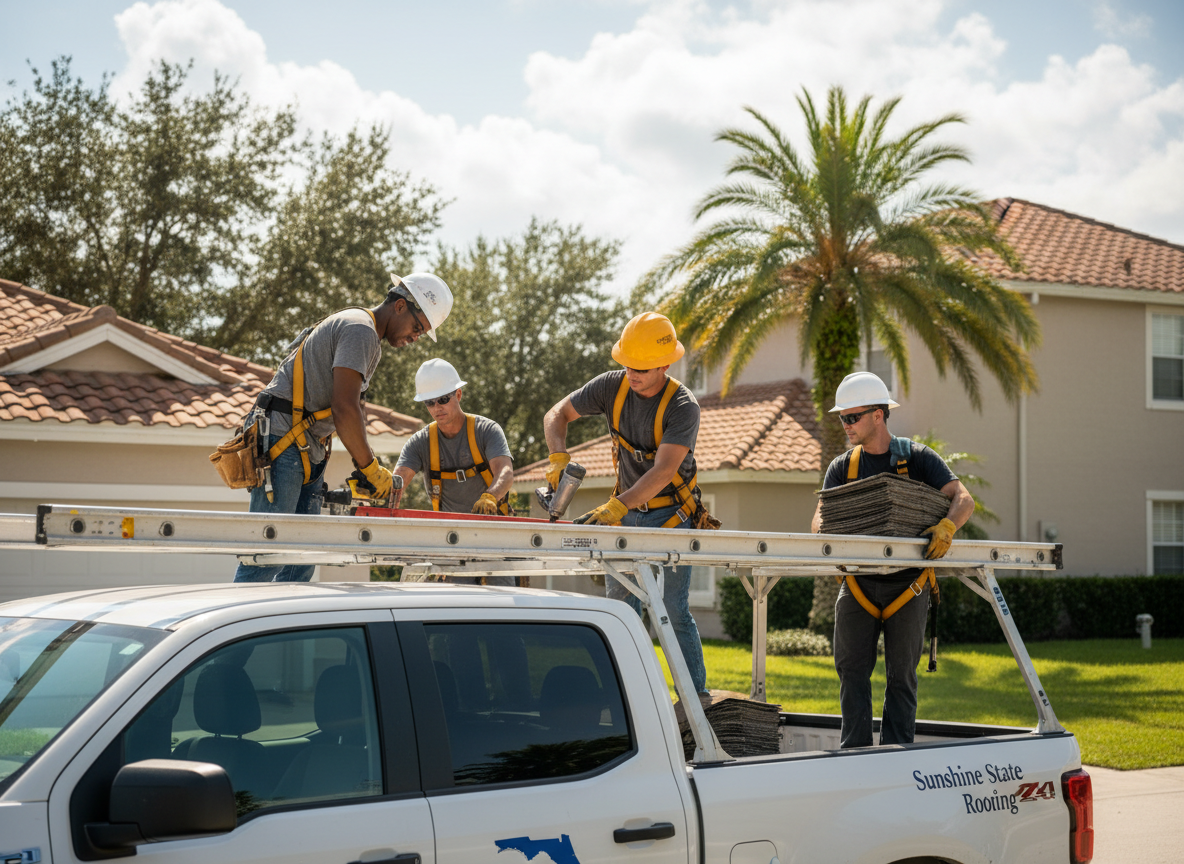
Winter Park is a small city with an old roof stock and an unusual amount of tree cover, and those two facts explain most of the roof work done here. The city was laid out in the 1880s, built up through the 1920s, and much of what stands on the blocks around Park Avenue and the lakes dates from that period. Live oaks were planted along the same streets and are now mature enough to close over the roadway. The result is a housing stock where the roof is shaded for much of the day, covered in debris for part of the year, and built to details that predate every modern roofing standard. Roof repair in Winter Park is a different craft from roof repair in a 2005 subdivision, and the difference is mostly in what you find once the surface is opened.
A Separate City Inside Orange County
Winter Park is its own municipality, not a neighbourhood of Orlando, and it runs its own building department. An address inside the city goes to the city for a roofing permit; an address in unincorporated Orange County a mile away goes to the county, and the two have different application portals, different review and different inspection scheduling. That is the first thing to establish, because everything else in the job follows the permit.
The city also has a preservation framework for its historic areas. On a house inside a designated district, an exterior change may be reviewed for its effect on the streetscape, and a roof covering is part of what is visible from the street. That review is separate from the building permit, and on a street of 1920s houses it usually comes down to whether the new covering reads as the old one did. Checking it early avoids the situation where materials are ordered and then questioned.
Because the city is small and the streets are narrow, access is a genuine planning issue. A truck and a materials delivery on a brick street with parked cars and low branches is not the same operation as a driveway in a subdivision, and it is worth deciding where the dumpster goes and how the bundles are staged before the first morning.
What the Oak Canopy Does to a Roof
Shade is the defining condition. A roof under a live oak dries out slowly after rain, and in a Florida summer it may not dry at all between afternoon storms. Damp shingle slopes grow algae and lichen; damp tile holds moisture against the underlayment; damp wood in a valley or behind a dormer cheek is where rot starts. Homeowners here often notice that one plane of the roof is failing while the rest looks fine, and the difference is usually how much sun that plane gets.
Debris is the second condition. Oak leaves, twigs and the small hard catkins collect in valleys and behind chimneys, and a valley that stays full of organic material stops draining. Water backs up under the covering, and the leak appears at the ceiling below the valley rather than at the point of entry. Gutters fill faster than anywhere else in the region and overflow at the fascia, which is where a lot of the rot on these houses begins.
Limbs are the third. A mature oak over a roof drops branches in every storm, and a limb that lands on a tile roof can crack tiles without moving them out of place, which is why a leak can appear with no visible damage from the ground.
Tile, and the Long Game Underneath It
Winter Park has a concentration of concrete and clay tile roofs, many on Mediterranean-style houses from the 1920s and 1930s and more on later infill. Tile is the most misunderstood covering in Florida. It is extremely durable, it does not wear out in the way shingle does, and it will usually outlast the roof it sits on.
The underlayment is the roof. It is the membrane under the tile, and it has a finite life in this climate: heat from above, moisture from below and the shade that keeps everything damp all shorten it. When it fails, water reaches the deck and the ceiling while the tile above still looks perfect. That is why a tile roof here is judged by lifting tiles and inspecting the membrane rather than by looking at the surface.
Repairs follow from that. A localised failure can be repaired by lifting the tile in one area, replacing the underlayment, and relaying the original tile — which is usually possible, since tile is salvageable and only the broken pieces need replacing. A whole-roof failure means the tile comes off, the underlayment is replaced across the roof, and the tile goes back down. Both are tile roofing jobs; neither is a shingle job with tile-shaped pieces on top.
Older Houses, Narrow Slopes and Additions
The 1920s houses themselves need reading. Many were framed with board decking, and most have at least one addition — a rear extension, a screened porch, a garage converted decades ago — where the roof was tied into the original in a way that satisfied the builder of the day. Those junctions are where the water gets in now. A dormer cheek that meets the main slope with a short piece of flashing, a porch roof that relies on a bead of sealant, a skylight added in the 1980s with a curb that has since moved: each is a small detail that has a long life as a leak.
Pitch matters too. Several of these roofs run at a lower slope than modern shingle products are rated for, which is why some of them carry metal or a low-slope membrane over part of the house. When a covering is replaced, the product has to be rated for the pitch it is going on, and the transition between a low-slope section and a steeper one has to be detailed rather than improvised.
Where Water Shows Up
The usual entry points here are valleys choked with oak debris, gutters overflowing at the fascia, dormer cheeks, chimneys, porch roof tie-ins and skylights. Water then travels, so the stain on a ceiling is a symptom rather than a location.
The Work We Do in Winter Park
All of the services on this site are available here, and which one applies is a survey decision. A leak after a storm is roof leak repair, traced from the entry point. Where a limb has opened the roof, emergency roof tarping holds the weather out until a proper repair is arranged, and emergency roof repair closes the cases that can be finished in one visit.
Storm and hurricane damage repair is the wider assessment, and on this housing stock it involves distinguishing new damage from old wear — which matters when a tile roof has been patched several times. Roof repair or roof replacement is the next decision, and it is worth resisting the easy answer: a tile roof with a failed section is a repair, not a replacement, if the rest of the membrane is sound. Roof installation covers additions and new builds. The coverings are shingle roofing, tile roofing, metal roofing and flat roof repair for the low-slope sections, with roof coating for sound metal and membrane surfaces. Roof inspection is the service that answers the question most Winter Park owners actually have, which is whether the roof in front of them has years left or months.
How a Job Runs on a Brick Street
The survey starts on the roof and continues in the attic. On a steep tile roof that means access equipment rather than a ladder, and on an old house it means looking at the deck and the framing as well as the covering. Photographs of every junction are taken before anything is proposed.
The written scope names materials, states what happens to the deck and describes how each junction will be rebuilt — valley, dormer cheek, chimney, skylight, porch tie-in. The permit application is built from that scope, and the preservation review, where it applies, runs in parallel. Work is sequenced so the house is never open to the weather overnight, which on a Winter Park block also means planning where materials sit without blocking the street.
Sign-off is a walk of the property with the owner, with the inspection record and photographs handed over at the end.
Ten Miles Around Winter Park
Within about ten miles: Maitland to the northwest, Eatonville and Fairview Shores immediately west, Fern Park and Casselberry to the north, Goldenrod to the east, Altamonte Springs at the northern edge, and downtown Orlando to the south. Each address is checked against its own jurisdiction before a permit is prepared.
Calling About a Winter Park Roof
The useful things to have ready are the age of the house, whether the roof is tile or shingle, and where the water is showing inside. On a tile roof, a photograph from the ground is less informative than you would hope, which is why the survey matters here. Florida Roof Repair Pros, 4720 Millenia Blvd, Suite 175, Orlando, FL 32839, (407) 557-4529.
What Lifting a Tile Actually Tells You
A tile roof is inspected by taking up a small number of tiles rather than by looking at them. The tiles at a valley, at a wall junction and at a lower corner are lifted carefully, the membrane beneath is examined, and the tile is set back. What that reveals decides the whole conversation.
The first thing to look for is the condition of the underlayment at the point where it is most stressed: the valley, the wall transition, the bottom edge of a slope. A membrane that is still pliable and intact at those points is doing its job, and a leak is probably coming from a single detail rather than from the roof as a whole. A membrane that has dried out, cracked or delaminated across a wide area is not going to be saved by patching one spot.
The second thing is the fixings. On older Winter Park roofs the tile may be held by mortar, by wire, by nails or by a combination, and the method tells you what will survive being lifted and relaid. Tile that has been fixed with mortar at the head is the slowest to work with and the most likely to break.
The third is water staining under the tile. A dark tide mark on the membrane or on the battens shows where water has been travelling, and often it points to a detail that is not where the ceiling stain is. On a shaded roof under oaks, the staining frequently runs sideways along a batten before it drops.
The fourth is the deck itself. Where a valley or an eave can be seen, the sheathing under the membrane is checked for softness and for the staining that indicates long-term damp. That is the finding that changes a repair into a replacement.
None of this is possible from the ground, and it is the reason a tile survey takes longer than a shingle survey. The information is worth the time: it is the difference between lifting forty tiles and stripping a roof.
Around Winter Park
We regularly work near:
- 📍Park Avenue, Winter Park
- 📍Lake Osceola
- 📍Kraft Azalea Garden
- 📍Winter Park Village
- 📍Mead Botanical Garden
Roofing Company in Winter Park — Local Notes
- •Separate city inside Orange County
- •Live-oak canopy keeps roofs damp and full of debris
- •Original tile roofs depend on the underlayment