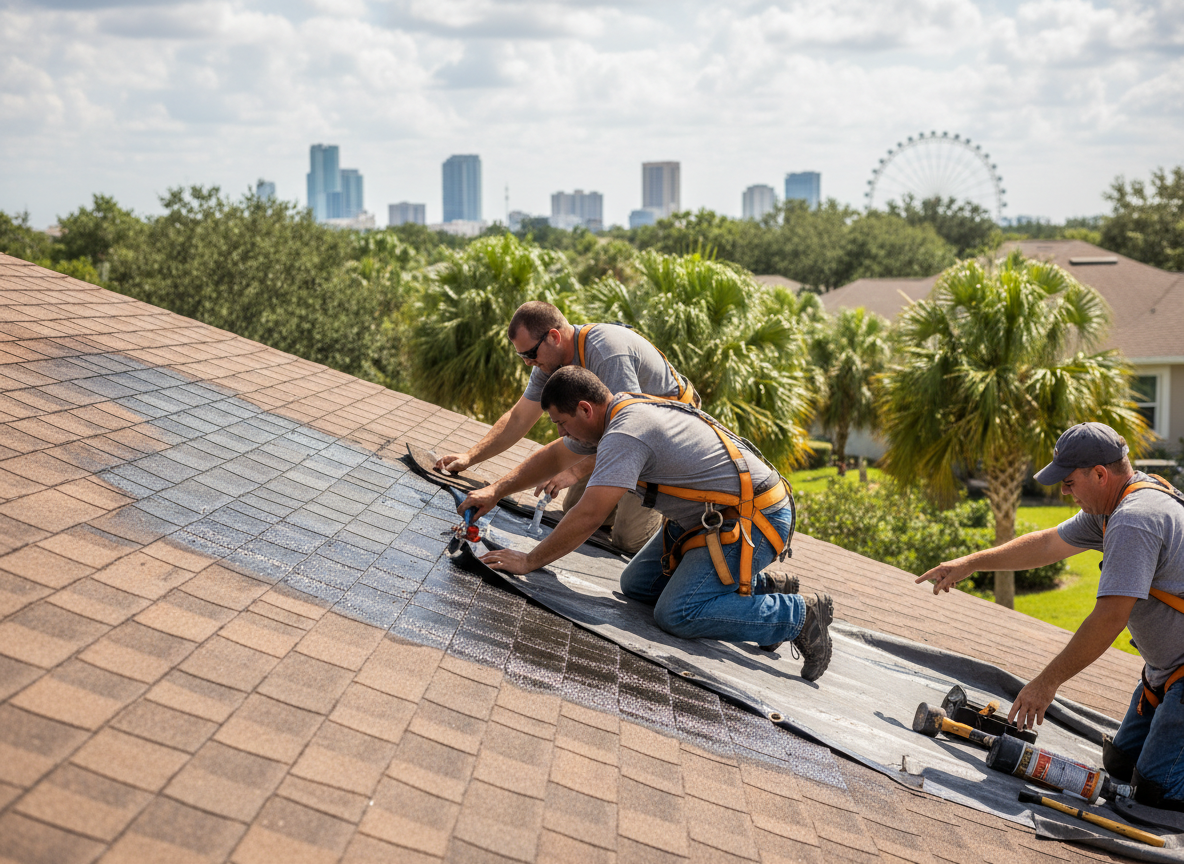
A brown ring appears on a bedroom ceiling after an afternoon storm, and a week later there is a second one in the hallway. Nothing looks wrong from the yard. That is the ordinary shape of a Florida roof leak: the water arrives somewhere you can see, having entered somewhere you cannot. Roof leak repair starts with locating that entry point, because everything downstream, from the materials to the permit to whether the repair holds, depends on getting it right. The number to call is (407) 557-4529.
How Is a Roof Leak Actually Found?
By working from the inside out, using the building's own evidence before touching the roof.
The first step is a conversation, and it is more useful than it sounds. When does the leak appear: during rain, after rain, or hours later? Does it depend on wind direction? Is it worse in a long steady rain or a short violent one? A leak that only shows in wind-driven rain points at a wall or a penetration, not at the field of the roof. A leak that appears a day after the rain points at water travelling slowly through a cavity.
The second step is the attic or ceiling cavity. Water leaves a trail: a dark line along a joist, a tide mark on the underside of the deck, damp insulation in one bay and dry insulation in the next. That trail usually narrows the search to a few square metres of roof, and it often contradicts the homeowner's assumption about where the hole is.
The third step is the roof surface, at the area the interior pointed to. Flashing at walls and penetrations, valley condition, the state of the underlayment under tile, the sealant life at a vent collar. Water testing can confirm a suspected detail, but it has limits in Florida: on a hot afternoon, water applied to a roof can evaporate before it has time to travel, and a test that shows nothing is not proof of anything.
What we do not do is seal every likely spot and call it fixed. A repair that covers four possibilities without identifying which one failed will hold until the next storm and then leak somewhere adjacent.
Why Does a Leak Get Worse in a Florida Summer?
The same storm that finds a small opening also loads the building with heat, and together they accelerate everything.
Florida's summer rain is intense and brief. A convective cell can deliver more water in twenty minutes than a northern city sees in a week of drizzle, and it arrives with wind that pushes it sideways into details a straight-down shower would never reach. Small openings that would stay dry for years in a gentler climate get tested several times a month here.
Heat does the rest. Roof surface temperatures in direct sun run far above air temperature, and every afternoon storm drops rain onto a hot deck. That cycle of expansion and contraction works on sealants, flashing laps and fastener washers. A bead of sealant flexible when applied can be hard and cracked two summers later, and a neoprene washer under a screw can perish in the same period.
Biological growth is part of it. In a humid climate, asphalt shingles commonly carry blue-green algae that shows as dark streaking, and damp roof surfaces hold moisture longer than dry ones. Algae does not cause a leak by itself, but it marks which slopes stay wet, and those are the slopes where sealants and fasteners fail first.
Waiting has a compound cost. The first repair is a flashing detail. Six months of a slow leak adds ceiling board, insulation and paint. A year adds the possibility that the timber above the ceiling has been wet often enough to need replacing. The leak does not grow, but what it touches does.
What Should a Leak Repair Report Contain?
A location, a cause, and evidence that ties the two together.
Ask for the entry point to be described in words you can check: which elevation, which detail, which distance from a named feature. "Flashing at the north wall where the addition meets the main roof" is a description. "Sealed a leak" is not.
Ask for photographs of the detail before and after the repair. Ask whether the repair is a section replacement or a sealant renewal, because those have very different lives: renewed sealant at a vent collar is maintenance that will be needed again, while replacing the collar is a repair.
Ask what was checked and found sound, not only what was fixed. That tells you whether the visit assessed the roof or aimed at one spot.
Ask about the permit position for the work done. In Florida, roofing work is permitted by the local building department, and whether a specific repair needs one depends on its scope and your address. Ask which office covers you and what they require.
Ours reads the same on every job: Florida Roof Repair Pros, 4720 Millenia Blvd, Suite 175, Orlando, FL 32839, (407) 557-4529.
Three Leaks in Three Rooms in Eighteen Months
This is the pattern that tells you a roof has moved from repair territory into replacement territory, and it is easy to miss while each leak is being fixed on its own.
A homeowner calls about a stain in a spare bedroom. The repair is a flashing renewal at a side wall, and it holds. Two seasons later there is a leak above the kitchen, and the answer is a pipe boot. The following spring, water appears near a rear addition. Three repairs, three different details, and no single visit looked wrong.
What connects them is the underlayment. On a tile or shingle roof the covering sheds most of the water, but the layer beneath it is what waterproofs the assembly. When that layer reaches the end of its life it fails at the weakest points first: the details, where it is cut and lapped around penetrations. Each failure looks like an isolated detail problem, and each local repair is genuinely a repair. The roof as a whole is saying something else.
The way to catch it earlier is to ask a different question at the second leak. Not "can you fix this one too", but "is the underlayment failing generally, and how much of the roof is affected?" A moisture survey across the roof, rather than at the leak, answers that. On tile, lifting a few units in different areas gives a direct read: is the underlayment dry and pliable, or brittle, torn and stained?
That survey also settles the decision. Florida law allows a roof built or replaced under the 2007 Florida Building Code or later to be repaired in sections, even past 25% of its area, with only the repaired section brought up to current code. A roof older than that may trigger wider work once the repaired area passes the threshold. Knowing which category you are in changes the arithmetic of repair against replacement, and you can only get that from looking at the whole roof rather than the current leak.
If the survey shows localised failure, repair it and keep the report. If it shows failure across most of the roof, the next leak is already scheduled, and a replacement plan is the cheaper path from there.
Where Roof Leaks Come From
Wall, Chimney and Skylight Flashing
Flashing is the material sealing the junction between the roof and something that is not the roof: a wall, a chimney, a skylight curb, a dormer. Junctions move, and flashing has to accommodate that movement while staying watertight.
Most flashing leaks come from three things: a lap that was never tall enough, sealant doing work that metal should do, and fasteners that have backed out. On a Florida wall the extra risk is stucco: the roof-to-wall junction often sits behind a stucco finish, and water that gets behind it travels a long way before it shows.
A repair replaces the detail rather than coating it: new step or counter flashing, correctly lapped, with sealant as a secondary defence instead of the primary one.
Pipe Boots and Vent Collars
Every plumbing vent, exhaust fan and attic vent that passes through a roof is sealed by a collar, usually a rubber or neoprene boot over a metal base. These are small, exposed and in full sun, which is why they fail before the roof around them.
In Florida the failure is almost always the rubber: it perishes, splits at the top where it grips the pipe, or pulls away as the pipe expands in the heat. The result is water running down the outside of the pipe into a wall or a ceiling.
Replacement is straightforward and small next to what it prevents. It is also the repair most often missed, because the boot is easy to walk past.
Valleys, Ridges and Roof-to-Roof Junctions
A valley carries the water from two roof planes into one channel, so it sees more flow than any other part of the roof. Debris collects there, the channel can hold water after rain, and the laps take the brunt of it.
Ridges and hips fail differently: the covering pieces are fixed at an angle, mortar or adhesive holds them, and that joint opens as the roof moves. In Florida, hips on tile roofs are where foam adhesive and mortar most often let go.
Both details are checked by looking for staining below the joint and lifting a unit to see the underlayment. A valley repair should restore the channel and the underlayment, not add a layer of coating over the top.
What Should You Do Before the Roofer Arrives?
Collect the pattern, not just the stain. Write down when each leak first appeared, what the weather was doing, and whether anything changed inside the house in the weeks before: a new ceiling fan, an antenna removed, a pressure-washed wall, a storm that took a branch off a tree.
Photograph each stain with something for scale and the date visible, and photograph the ceiling in daylight rather than with a phone torch. If there is an attic you can safely enter, look for the wet line and photograph that too, but do not walk on insulation or near a wiring run.
Put containers under active drips and keep them there until the roof is checked. Keep the container contents: if the water is discoloured or has grit in it, that is a detail worth mentioning, because it can point at a specific material path.
Do not seal anything yourself before the diagnosis. A bead of sealant applied above a stain hides the detail that would have explained the leak, and the leak will return somewhere nearby once the water finds the next weak point. If you have already sealed it, say so on the call; it changes where the search starts.
Expect the visit to spend more time inside than on the roof. The attic and the ceiling are where the evidence is, and the roof surface confirms what the interior suggests. Once the entry point is known, the repair is usually smaller than the stain implies, and the written scope should name the detail, the material and the permit position for your address. Florida Roof Repair Pros, 4720 Millenia Blvd, Suite 175, Orlando, FL 32839, (407) 557-4529.
Roof Leak Repair Services We Offer
✓Flashing Renewal
Step and counter flashing at walls, chimneys and curbs replaced rather than coated, with laps restored.
✓Penetration Re-Seal
Pipe boots, vent collars and masts re-sealed or replaced, including the rubber that perishes in Florida sun.
✓Valley and Hip Repair
Restoring the channel, the laps and the underlayment where two roof planes meet.
How it works
- 1
Interview the leak
When it appears, which wind direction, and how long after rain, because that decides where the search starts.
- 2
Read the interior trail
Attic or cavity evidence narrows the roof area before anything is opened.
- 3
Confirm on the roof
The suspected detail is checked at the surface, with water testing only where it can be trusted.
- 4
Repair the detail
Replacement of the failed component, with sealant as a secondary defence rather than the whole repair.
- 5
Report and record
Written water path, dated photographs, and the permit position for any permanent scope.
Pricing
A leak repair is scoped after the entry point is found, because a flashing detail and an underlayment section are different jobs. The written estimate lists materials, quantities and labor separately, and nothing is ordered before the source is confirmed.