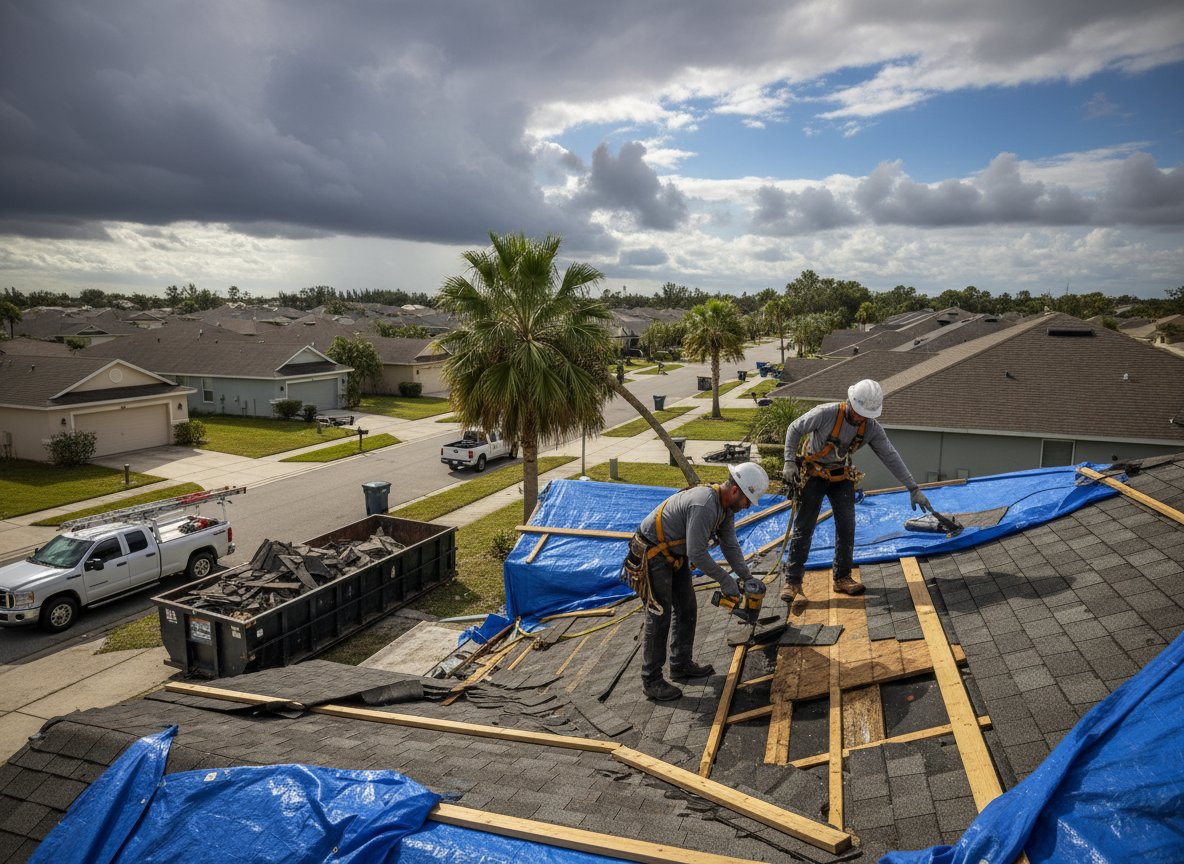
Deltona is a city that was built in one go. In 1962 the Mackle brothers bought just over seventeen thousand acres of southwest Volusia County and began selling houses on a scale nobody in the area had seen before, and the community opened that November. It became a city only in 1995, but its shape was set three decades earlier: broad boulevards, deep lots, and thousands of houses of a handful of repeated designs. The roofs that went on those houses in the 1960s and 1970s are the reason roof repair in Deltona is its own subject. Many are still original or on their second covering, and the way they were built is unlike anything put up in Florida today.
Mass Production and Its Roofs
The houses were built fast and built to a pattern. The typical Deltona house of that era is a single-storey block structure with a low-pitch shingle roof, wide overhangs at the eaves, and a carport or a screened porch that was part of the plan. Roof structures were simple: rafters, a ridge, and sheathing, with far less geometry than a modern subdivision roof. That simplicity is an advantage, because there are fewer valleys and hips to fail. It is also a limitation. A low pitch was cheap to build and sheds water slowly, and the shingle products of the 1960s were not what is sold now. Where the original covering has survived, it has survived because a later owner kept it, and where it was replaced, the replacement was often the least expensive option available at the time. The wide overhangs that shade the walls also make the roof look bigger than it is, and they collect debris along the eaves where it stays wet.
Carports, Florida Rooms and the Additions
Almost every Deltona house has been changed. Carports were enclosed to make garages or extra rooms, screened porches became Florida rooms, and rear additions went on as families grew. Those changes are where the roof problems live, because they were rarely designed as part of the original roof. An enclosed carport usually means a low-slope roof tied into the house wall, often without step flashing and sometimes without any proper termination at the wall. A Florida room under its own shallow roof meets the main roof at a junction that has been sealed rather than built. Over thirty or forty years, sealant fails, the junction opens, and water runs into the wall. The other common alteration is a second layer of shingle laid over the first, which was normal practice in the 1980s. That leaves two layers of covering on a low-pitch roof, more weight on the frame, and no way to see the deck without stripping both.
What the Deltona Roof Does in a Storm
Volusia County sits on the state's east side and takes its weather from both directions: afternoon storms off the interior in summer, and whatever comes in from the Atlantic. Hurricane Charley crossed Central Florida in August 2004 and passed through this part of Volusia on its way to the coast, and Hurricane Irma crossed the peninsula in 2017 with a long period of wind and rain. On these low-pitch roofs the wind damage is at the edges. The eave line is long, the overhang is deep, and the fascia is what the wind gets under. Once the edge lifts, water goes backwards under the shingle courses, and the ceiling stain appears a metre inside the wall rather than at the edge. The wide overhangs also mean that in a storm the roof takes water on the underside, which is how people discover that the soffit has been soft for years.
What Fails First Here
The list is short. Eave edges and fascia, because of the overhang and the wind. Pipe boots, because they perish. The junctions where carports and additions were tied in, because they were never properly built. And the shingles themselves, which on a low-pitch roof at this age have often lost their seal and their granules. Attic ventilation is the other local factor. These houses were built with gable vents or small soffit openings, and while that was adequate for the time, many attics now run hot, which shortens the life of the covering on the sun-facing slopes and makes the house harder to cool. None of this is exotic. It is the ordinary decay of a housing type that was built to a budget sixty years ago and has been adapted ever since.
The Work We Do in Deltona
The full service range applies. Leaks are roof leak repair, traced to the entry point rather than treated at the stain. Where a storm has opened a roof, emergency roof tarping holds the weather out until a permanent repair can be scheduled, and emergency roof repair closes the damage that can be finished in one visit. A storm here is assessed at the eaves as much as anywhere else, because the deep overhang is what the wind lifts and water then travels back under the courses. Roof repair is often the right answer on these houses: a failed addition roof above a sound main roof is a repair, not a replacement. Roof replacement is the answer when the main covering has reached the end of its life or when the second layer has to come off to get at a deck that is soft. Roof installation covers the new builds at the edges of the city and the rebuilds after a total loss. Most of the city is shingle, with metal chosen for longevity and lighter weight, tile on the newer and larger houses, and membrane repair for the carport, Florida room and low-slope roofs that cause most of the trouble, with coating where the surface has weathered but the assembly holds. Roof inspection is where all of it begins. Deltona has its own building department, which permits addresses inside the city; Volusia County takes the unincorporated ones. Applications go in under the Florida Building Code, carrying the design wind speed, the covering's product approval and the fastening schedule for the covering chosen. Two things come up repeatedly on this housing stock. The first is the existing layers: whether a covering can go over what is there, or whether the old material has to come off, is decided by the code and by the condition of the deck. The second is the additions, because an enclosed carport or a Florida room with a non-compliant roof-to-wall junction may need more than a re-cover to pass. The inspection sequence is standard: deck and underlayment before the covering closes on a replacement, final inspection at completion.
How a Job Runs
The survey starts at the eaves, because that is where these roofs fail. The roof is walked where it is safe, the attic is inspected where there is access, and every junction with a carport, porch or addition is photographed. The scope describes the roof in areas: what is opened, what happens to the deck, how many layers come off, and how the carport and porch junctions are rebuilt. Then the permit, the work and the inspection. The finish is a walk round the property, the photographic record of deck and flashings, and the inspection paperwork.
Ten Miles Around Deltona
Within about ten miles: Orange City to the north, DeBary and Enterprise to the northeast, Lake Helen to the east, Osteen to the southeast, and Sanford across the county line to the north-east at the edge of the radius. Each address is checked against its jurisdiction before an application is prepared.
Calling About a Deltona Roof
The age of the house and whether it still has its original roof are the two facts that matter most. After that, the additions: which ones were made, and when. Those answers decide whether this is a repair, a re-cover or a strip and replace. Florida Roof Repair Pros, 4720 Millenia Blvd, Suite 175, Orlando, FL 32839, (407) 557-4529.
Reading a 1962 House
A Deltona house of the early 1960s has to be read before it can be scoped, because six decades of changes sit on top of the original design and each one changes what the roof is doing. The first layer to identify is the deck. The original was often a board or a panel product that has since been patched, and in places it may have been overlaid. The survey checks it at the eave, at a valley and around any penetration, which is where the soft spots show first. The second is the covering history. A house that has had two re-covers has two layers of shingle, more weight, and no way to see the deck without stripping both. That history determines whether the next job is a re-cover or a strip, and it is not always obvious from the ground because the second layer may only be visible at a rake or a vent. The third is the additions. An enclosed carport, a Florida room, a rear bedroom and a utility room are all common, and each one added a roof that met the original at a junction. Those junctions are the most reliable predictor of where the house leaks, and they are what the survey spends most of its time on. The fourth is ventilation. The original roof had whatever the builder provided, and later changes often closed it up — a new soffit with no intake, insulation pushed to the edge, a ridge vent added without checking that air can enter. A roof that runs hot fails earlier on the sun-facing slopes, and no covering change fixes that on its own. Reading these four things takes an hour on the roof and in the attic, and it produces a scope that describes the house rather than a generic re-roof.
What a Re-cover Does Not Fix
A second layer of shingle over an existing roof was ordinary practice for years, and on a Deltona house it may be what is up there now. It is worth being clear about what that work did and did not do. It did not replace the deck. Anything soft under the first layer is still soft, and the new covering is now nailed through it. It did not replace the flashings at the carport and porch junctions, which were the weak points before the work and remain the weak points after it. And it did not resolve the drainage or the ventilation, because neither of those is part of the covering. What it did do is buy time on the field of the roof. That is a legitimate reason to do it, and on a roof with a sound deck it can be the sensible choice. The mistake is to assume that a re-covered roof is a new roof: the details that leak are the ones that were carried over. When a re-covered roof is opened, the survey looks at the layers, the deck, the flashings and the junctions. On most Deltona houses the answer comes down to whether the deck is sound enough to keep and whether the junctions can be rebuilt without stripping the field. Where both are true, a repair is worth doing. Where either is not, the layers come off.
Around Deltona
We regularly work near:
- 📍Lake Monroe
- 📍Green Springs Park
- 📍Deltona Amphitheater
- 📍Lyonia Preserve
- 📍Blue Spring State Park
Roofing Company in Deltona — Local Notes
- •Built out from 1962 by the Mackle brothers
- •Low-pitch roofs with deep overhangs
- •Additions and carport enclosures drive most leaks