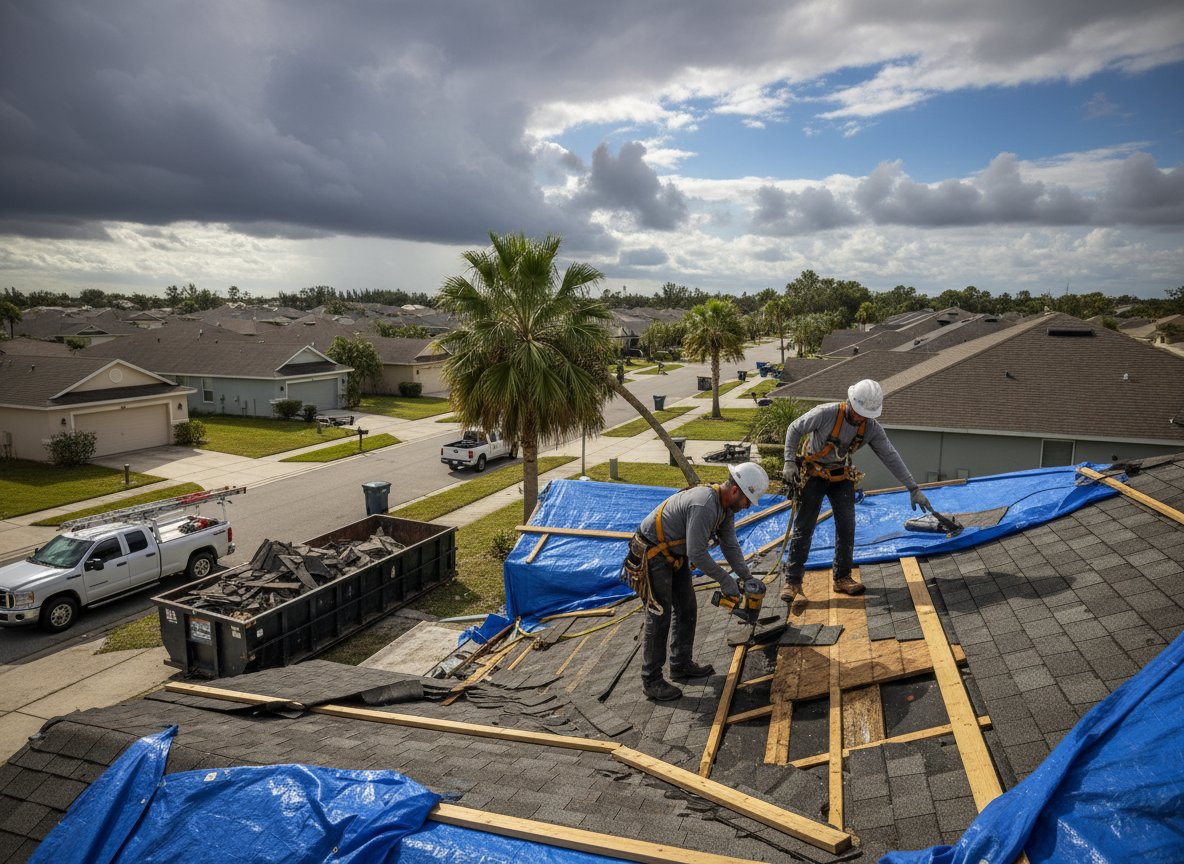
A tropical system crosses the state overnight and in the morning the roof looks almost normal from the street. A few tiles are out of line on one slope, a ridge cap is sitting crooked, and there is a wet patch on a ceiling that was dry the day before. Storm and hurricane damage repair in Florida begins with a question that decides everything after it: what did the wind do, and what was already worn out before the storm arrived? The answer is a matter of evidence, not opinion. Call (407) 557-4529.
How Do You Tell Storm Damage From Wear?
By looking at the type of failure, its pattern across the roof, and the date it appeared, in that order.
Wind damage leaves signatures. Covering lifts at edges and corners where pressure is highest. Fasteners pull through or back out. Ridge and hip pieces shift because they present an edge to the wind. Debris impacts leave punctures and bruising in a scattered pattern that follows the wind direction. Damage is clustered on the elevations the wind hit, and it is sudden: the roof was intact before the storm and is not intact after.
Wear leaves a different signature. Sealant at a vent collar has cracked uniformly. Underlayment under tile has gone brittle across a whole slope. Granules on a shingle roof have thinned evenly, and the mat is showing at the same height on several shingles. There is no directional pattern, and the deterioration has been happening for seasons.
Most real roofs after a storm have some of both, and that is where honesty matters. A repair scope should say which damage is wind-caused and which is deterioration, with photographs of both, because the two are treated differently by an insurer and they are repaired differently. A roofer who labels everything as storm damage is doing you no favours: the claim gets disputed, and the actual wear stays on the roof.
Why Repair Storm Damage Before the Next System?
Because a storm-damaged roof is a roof with reduced resistance, and Florida's season runs for six months.
The Atlantic hurricane season runs from 1 June to 30 November, with the statistical peak from mid-August to late October. A roof that has lost covering in June faces the busiest part of the season already compromised. Lifted covering flaps in wind, and flapping covering works its fasteners loose and abrades the underlayment beneath it. A small loss becomes a progressive failure.
There is also a water argument. Where covering has gone, the underlayment is exposed to sun as well as rain. In Florida, UV degrades exposed underlayment quickly, and a section that would have lasted years once covered can fail within months of being left open.
Then there is the record. Florida gives one year from the date of loss to give notice of an initial or reopened property insurance claim, and 18 months for a supplemental claim. Photographs taken the week of the storm, with dates, describe the roof as the storm left it. Photographs taken after two more storm seasons describe something else, and the difference is exactly what a claim turns on.
The practical order is: document, make safe, then repair. Documentation first, because every action after it changes the evidence.
What Should a Storm Damage Report Include?
A dated record of the roof as found, damage classified by cause, and a scope that separates emergency work from permanent work.
Photographs belong at three scales: the elevation, the damaged area in context, and the failed detail close up. Without the middle scale, a close-up of a lifted shingle proves nothing about where on the roof it was.
The report should name the storm the damage is attributed to, with the date, because that is the reference point for any claim. It should identify which items are wind damage and which are wear, in writing. It should list what was done as emergency work on the day, separately from what is proposed as the permanent repair.
It should also state the permit path. In Florida, roofing work is permitted by the local building department under the Florida Building Code, and in Miami-Dade and Broward the High-Velocity Hurricane Zone requirements add product approval and specific underlayment rules. Ask which office covers your address, and whether the repair will be inspected.
Ours carries the same details every time: Florida Roof Repair Pros, 4720 Millenia Blvd, Suite 175, Orlando, FL 32839, (407) 557-4529.
When the Adjuster Says the Roof Was Already Worn
This is the most common disagreement after a Florida storm, and the outcome usually depends on what was recorded before anyone touched the roof.
A homeowner in a 1980s subdivision has a section of shingle torn from a rear slope after a tropical storm. The rest of the roof is nineteen years old. The adjuster visits, looks at the slope, and concludes that the missing shingles were at the end of their life and lifted because they had lost adhesion, not because the wind was unusual. The claim is reduced to patch work, or denied.
The homeowner's position is reasonable: the roof did not leak before the storm. But "it did not leak before" is not evidence of wind damage. What would have helped is a record of the roof's condition before the event, and a record of the failure pattern after it.
The failure pattern is the part most homeowners never capture. On a wind-damaged shingle slope, damage usually starts at the rake, the eave or the ridge and works inward, and the shingles that fail are the ones at the edges of the slope where uplift is highest. On an aged slope, tabs crease and break across the whole field. Those two patterns look different in a photograph taken from the same place, and the difference is discernible a week after the storm but much less so after a season of sun.
There is also the question of what the roof was rated for. Roof coverings and their components are approved products in Florida, and the approval includes a wind rating. If a covering failed at a wind speed well below its rating, that points at installation or at the condition of the fasteners. If it failed near or above the rating, that points at the storm. Knowing the product and its approval is part of reading the damage properly, and it is information a homeowner can ask for.
The practical lesson is not to argue with an adjuster on the roof. It is to have the elevation photographs, the damage classification in writing, and the storm date documented before the repair starts. Where the disagreement continues, a public adjuster works for the homeowner and is a decision for you, not for the roofer. The roofer's job is to describe the roof accurately and repair what the storm did.
What Storm Damage Repair Covers
Lost and Lifted Roof Covering
Lost covering is obvious; lifted covering is the one that gets missed. A shingle tab that has released its seal but not yet blown away, or a tile that has shifted a few millimetres, will let water in during the next wind-driven rain.
Lifted covering is found by walking the roof and looking at edges, rakes, ridges and hips, where uplift is strongest. Pressing gently on a tab tells you whether the seal is intact.
Repair means restoring the covering to its rated condition, not just replacing what left. On a slope where several pieces have lifted, the underlayment beneath is usually abraded and belongs in the scope.
Wind-Borne Debris Impact
Debris damage is scattered, and it does not follow the lines of the roof. Branches, gravel, roof tiles from a neighbour and sheet material all leave marks: punctures, bruised shingle mat, cracked tile, dented metal.
On shingles, a bruise is a break in the mat that is not yet a hole. It will become a hole. On tile, a hairline crack runs through the unit and shows as a stain line after the next rain.
Documenting debris damage means photographing the impact and, where possible, the debris that caused it, in the same frame. That single image does more for a claim than a page of description.
Ridge, Hip and Edge Details
Ridges, hips and edges are where a roof presents an edge to the wind, and they are the first details to fail in a Florida storm. Ridge caps lift, hip tiles shift, drip edge separates and fascia pulls away.
These failures matter disproportionately because they open the roof at its highest and most exposed points. A lifted ridge cap lets water into the top of the assembly, where it can travel in either direction.
Repair restores the mechanical fixing, not just the appearance: re-bedding or re-fixing the pieces, replacing what is broken, and checking that the underlayment at the ridge is intact.
What Should You Do in the First Days After a Storm?
Photograph before you touch anything. Every elevation from the ground, then the damaged areas from a safe position, with the date visible. If your phone stamps dates, that is enough; if it does not, write the date into a note and keep it with the images.
Do not clear debris off the roof yourself. Debris on a wet roof is a slip hazard, and moving it can damage covering that survived. Clear what is on the ground and leave the roof alone.
Cover an opening if rain is coming, and record what you did. A tarp is a holding measure, and the photographs of the opening before the cover goes on are the ones that matter later.
Write down what you know about the roof: the covering type, when it was last replaced, and any previous repairs. If a permit was taken out for the last roof, that record exists with the building department and it settles the question of the roof's age, which is often the crux of a storm claim.
Then get the roof assessed properly, and ask for the damage to be classified by cause in writing. A scope that separates wind damage from wear is more useful than one that treats the whole roof as a single event, and it is the scope that survives scrutiny. Florida Roof Repair Pros, 4720 Millenia Blvd, Suite 175, Orlando, FL 32839, on (407) 557-4529.
Storm & Hurricane Damage Repair Services We Offer
✓Wind Damage Covering Repair
Restoring lost and lifted covering, including the underlayment beneath slopes where pieces have released.
✓Debris Impact Repair
Punctures, bruised shingle mat and cracked tile traced to the impact that caused them.
✓Ridge, Hip and Edge Restoration
Re-fixing lifted ridge and hip pieces, drip edge and fascia opened by wind.
How it works
- 1
Document as found
Every elevation photographed before anything is moved, with the storm date recorded.
- 2
Classify the damage
Each item written up as wind-caused or pre-existing wear, with evidence for the call.
- 3
Make safe
Openings covered and loose material secured, with the work recorded separately from the repair.
- 4
Scope the repair
Covering, underlayment and detail work listed as separate lines, with the permit path named.
- 5
Repair and inspect
Permanent work carried out and inspected where the local building department requires it.
Pricing
Storm repair is scoped after the damage is classified, because emergency make-safe work and a permanent covering repair are separate jobs. The written estimate separates materials, labor and any deck or underlayment work.