Lakeland sits in the middle of Polk County, on rolling ground between Tampa and Orlando, and it has a roofing history that most Florida cities cannot match. The town grew on citrus in the late nineteenth century, boomed in the 1920s, and kept a core of buildings from that decade — bungalows, Mediterranean-style houses, and a downtown with enough height to suggest the money that was here. Later decades added ranch houses and then subdivisions. Roof repair in Lakeland therefore covers almost a century of construction, and the 1920s stock in particular asks for care that a modern roof never needs.
The 1920s Legacy
The boom decade left Lakeland with a distinctive housing stock. Bungalows with deep porches and low-slung roofs, houses with clay tile on a Mediterranean plan, and a scattering of buildings with decorative parapets and flat roofs. Many are still standing, many have been converted to offices or divided into flats, and almost all have roofs that have been repaired repeatedly. Those roofs need to be read rather than replaced by formula. The framing is dimension lumber, the deck is often board sheathing, and the original coverings include tile that is no longer made and metal that has been patched with whatever was available. Where a tile roof is concerned, the tile may be a century old and still serviceable while the underlayment beneath has been replaced two or three times. Working on this stock is slower than working on a subdivision roof, and it rewards a survey that identifies what is original and what has been altered.
Heat, Lightning and Inland Weather
Lakeland is inland, well away from the sea breeze, and its summers are hot. The afternoon storms that cross Central Florida build here with little moderation, and the region is known for the frequency of its lightning. For roofs, heat is the more constant factor: attic temperatures are high, shingle surfaces on the west and south planes bake, and the underlayment beneath ages faster than it would on a shaded roof. Lightning matters less for the covering than for what sits on it. A strike near a house can damage roof-mounted equipment, and a fire that starts in an attic rarely announces itself from outside. That is not a roofing repair in the usual sense, but it is a reason to look at the roof after a close storm. The third factor is rain volume. Inland storms drop a lot of water in a short time, and roofs with marginal valleys or undersized gutters show it.
Ranch Houses and Subdivisions
Between the 1950s and the 1980s Lakeland filled in with ranch houses: single-storey, concrete block, low-pitch hip and gable roofs, carports that were later enclosed, and screened pools at the back. Those roofs are simple, and most are on their second or third shingle covering. From the 1990s onward the subdivisions arrived, with more complex geometry, steeper pitches and a good deal of tile on the larger plans. Those roofs are now reaching the age at which the underlayment under tile begins to fail, and the shingle roofs from the earliest of them are at the end of their expected life. The three generations fail differently, and a roofer working across the city needs to know which one is in front of them before quoting anything.
Tile on Older Lakeland Houses
The clay tile roofs from the 1920s are the most interesting problem in the city. The tile is heavy, often fixed with mortar or wire rather than modern fasteners, and fragile after a century of sun. Lifting it to inspect the underlayment is skilled work, and breaking a tile means finding a match that may not exist. Where the underlayment has failed, the repair is to lift the tile across the affected area, replace the membrane, and relay the original tile with as few breakages as possible. That is a slow job, and it is the right one: replacing a century-old clay tile roof with a modern covering changes the building and usually costs more than the repair. On the Mediterranean-style houses of the same era, the same logic applies with more tile and more complicated geometry.
Hurricanes and Inland Wind
Polk County is inland, but inland is not sheltered. Hurricane Charley crossed the county in August 2004 on its way from the southwest coast toward Orlando, and the wind damage across Lakeland and the surrounding towns was extensive. Hurricane Irma crossed the peninsula in September 2017 and brought a long period of wind and rain to the county, and Hurricane Milton crossed in October 2024. On this housing stock the damage shows up differently by roof type. Shingle roofs lose tabs at ridges and rakes; tile roofs lose individual pieces and, on older roofs, the mortar or wire fixings that hold them; flat roofs lose their edge terminations. The older 1920s roofs are the most vulnerable simply because of their age and the way they were fixed. What follows a storm is usually a period of finding damage that was not obvious at the time, which is why a survey after an event is worth more than a glance from the street.
What Fails on Lakeland Roofs
On the 1920s stock: the valley and the porch tie-in, the tile fixings, and the flashing at chimneys and at the junction between a tile roof and a later addition. On the ranch houses: pipe boots, valleys, and the junctions where carports and pool enclosures were tied in. On the subdivisions: pipe boots, wall junctions, and the underlayment under tile. Across all of them, the heat does its work silently. A roof that has been baked for twenty years has brittle underlayment and shingles that have lost their seal, and neither is visible from the ground.
The Work We Do in Lakeland
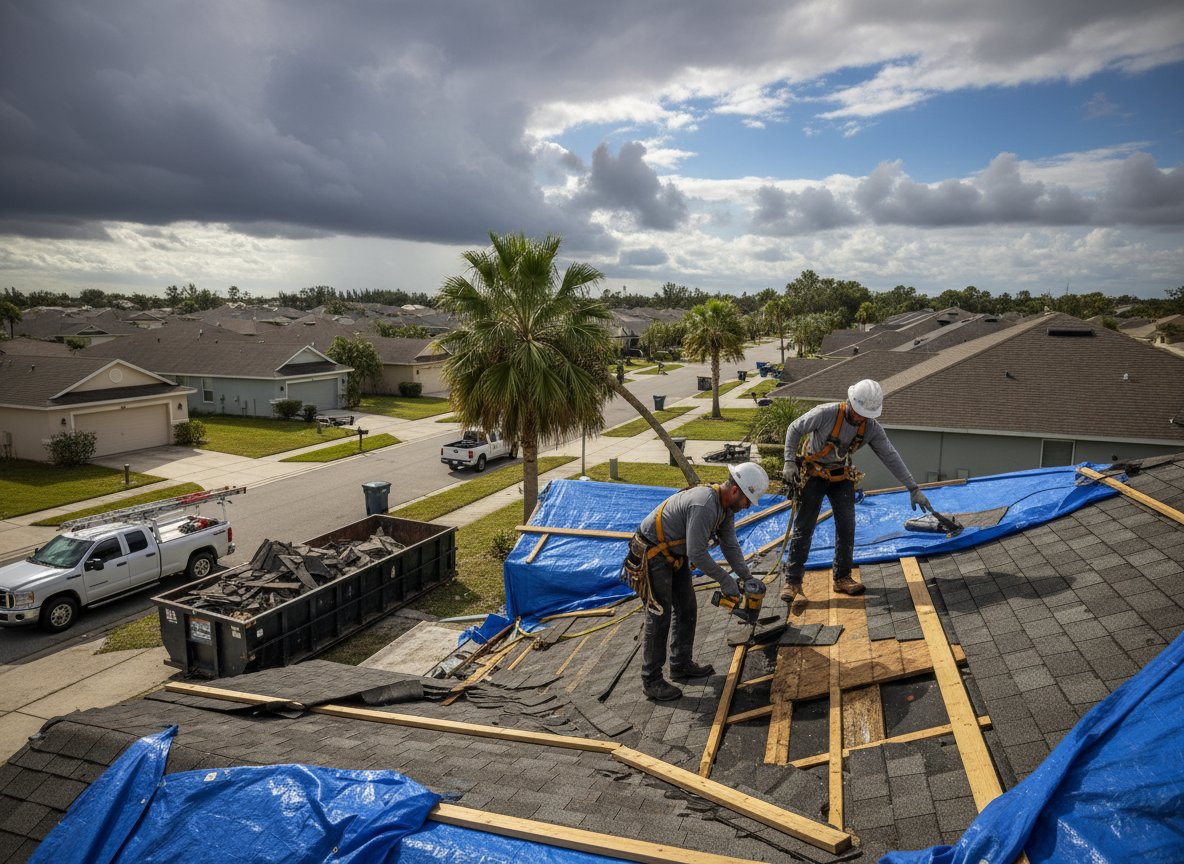
The full range applies. Leaks are roof leak repair, traced to the entry point. Where a storm has opened a roof, emergency roof tarping holds the weather out until a permanent repair is arranged, and emergency roof repair closes the damage that can be finished in one visit. After a storm the assessment covers the whole roof, and on the older stock it also covers the fixings: tile that has lost its mortar or wire is damaged even when the tile itself is intact. Roof repair is often the right answer on the older stock, where a sound main roof sits above a failed addition, and on tile roofs where the membrane has failed in one area. Roof replacement is the answer when the covering has reached the end of its life across the roof or the deck is soft in several places. Roof installation covers new builds and the rebuilds after a loss. The city's roofs are mostly shingle on the ranch housing and the subdivisions, clay or concrete tile on the 1920s houses and the larger later plans, metal where longevity is the priority, and membrane on the low-slope sections and commercial buildings, with coating for sound surfaces. Roof inspection is where every one of those decisions begins. Permits for addresses within Lakeland are issued by the city's building department; Polk County handles the unincorporated areas around it. The Florida Building Code governs the work, and the application includes the design wind speed, the covering's product approval and its fastening schedule. On the older tile roofs the permit conversation is about method as much as material: how the tile will be lifted, how it will be re-fixed, and what underlayment is being used beneath it. On a replacement, the deck and underlayment are inspected before the covering closes. The High-Velocity Hurricane Zone does not apply in Polk County, since it is limited to Broward and Miami-Dade counties, but the wind provisions still govern, and an inland site has a design wind speed of its own.
How a Job Runs
The survey reads the roof by generation: what was built when, what has been altered, and what is original. On a 1920s house that means looking at the framing and the deck as well as the covering; on a subdivision roof it means checking the junctions and the underlayment. The written scope sets out which areas are being opened, what is happening to the deck, and how the valleys, walls and penetrations will be finished. Then the permit, the work and the inspection. The job ends with a walk of the roof, photographs of what was underneath, and the inspection record handed over.
Ten Miles Around Lakeland
Within about ten miles: Lakeland Highlands and Medulla to the south, Combee Settlement and Crystal Lake to the east, Eaton Park to the southeast, and Highland City to the south at the edge of the radius. Each address is checked against its jurisdiction before an application is prepared.
Calling About a Lakeland Roof
The decade the house was built is the single most useful fact here, because it decides which of the city's roof types is on it. A photograph of the covering from the ground, and a note of where water is showing inside, are enough to start. Florida Roof Repair Pros, 4720 Millenia Blvd, Suite 175, Orlando, FL 32839, (407) 557-4529.
Clay Tile: Lifting, Relaying and Matching
A clay tile roof from the 1920s is worked on in a different way from anything modern, and the method matters as much as the material. The tile is lifted from the bottom course upward, one piece at a time, with the fixings cut rather than pulled where they have set. Each tile is numbered and stacked in the order it came off, because the roof has weathered unevenly and the pieces will not sit the same way if they are shuffled. Breakages are counted as the roof is opened, not discovered at the end. The underlayment underneath is replaced with a modern membrane, laid to the current standard and dressed into the valley and up the wall junctions. That is the layer that keeps the water out; the tile is the surface above it. Relaying is the slow part. The original fixings were often mortar at the head of the tile or wire tied to the batten, and where the tile is sound it can be re-fixed with modern fasteners that are concealed. Where a tile has broken, a replacement has to be found: some of the profiles used in the 1920s are still made, many are not, and the ones that are not are salvaged from elsewhere on the same roof or from a matching building. The result of doing it properly is a roof that keeps its appearance and gains another generation of service. The result of doing it cheaply is a roof where the new membrane is punctured by careless handling and the old tile is replaced by a mismatched patch that is visible from the street for the next fifty years.
Around Lakeland
We regularly work near:
- 📍Lake Mirror
- 📍Lake Hollingsworth
- 📍Bonnet Springs Park
- 📍Historic downtown Lakeland
- 📍Circle B Bar Reserve
Roofing Company in Lakeland — Local Notes
- •A 1920s boom town with clay tile still in service
- •Inland heat ages underlayment faster than the coast
- •Polk County and the city permit separately