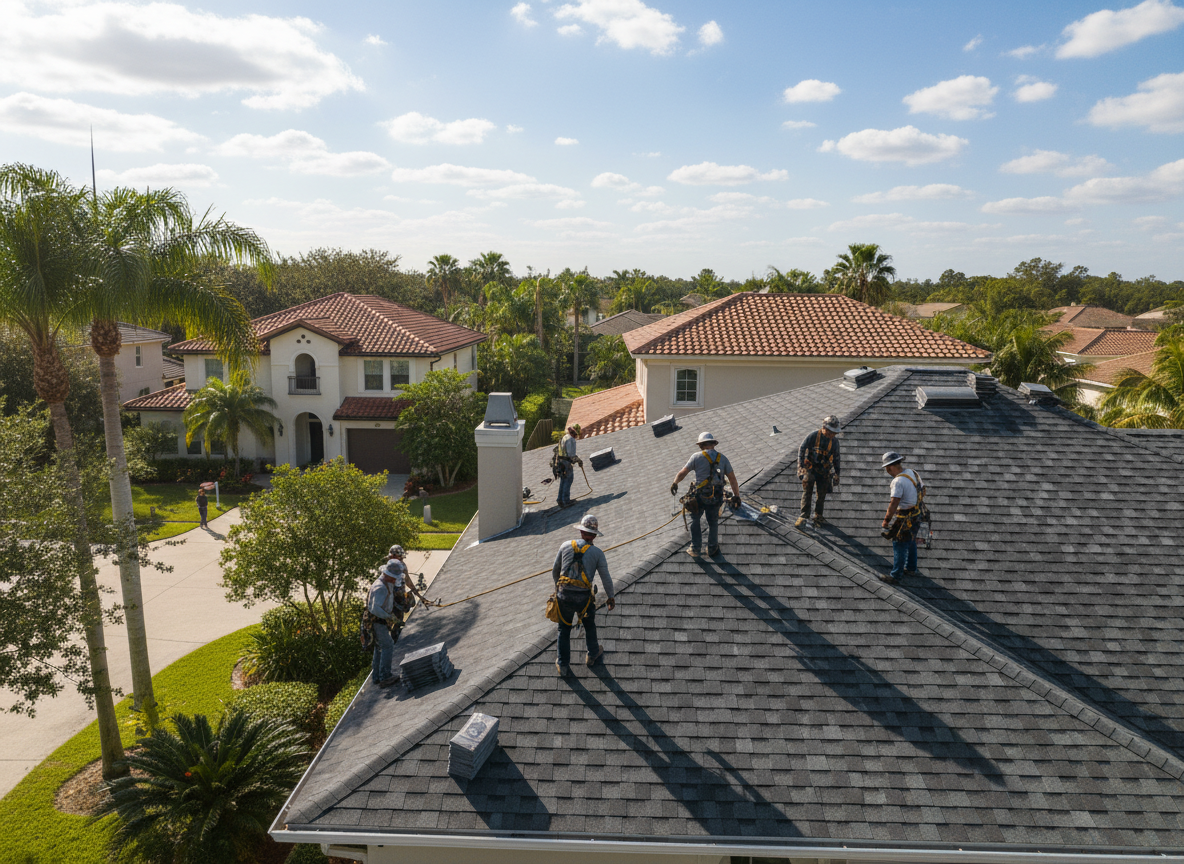
Orlando is the city this company works out of. The office is at 4720 Millenia Blvd, Suite 175, on the southwest side near the Millenia interchange, and the roofs inside the city limits are the ones we are asked about most. Roof repair in Orlando turns out to be less about the weather than people expect and more about jurisdiction and age. A bungalow off Curry Ford Road, a townhouse in Baldwin Park and a low warehouse near the airport can be three separate permit files with three different inspection sequences, and the covering rules are only one part of what separates them. The other part is age: Orlando has 1920s houses inside the ring roads, 1970s ranch houses around them, and subdivisions finished after 2010 at the edges, and those three groups fail in different ways.
The Address Comes Before the Roof
The first question on an Orlando roof is not what is wrong with it but which building department answers for it. The City of Orlando issues permits for property inside the city limits, and the city is larger than most people assume: it reaches from the Millenia area and Kirkman Road in the southwest out past Lake Nona in the southeast, and a small piece of the city crosses into Osceola County. Addresses outside the city limits but inside Orange County go to the county instead, and city and county run separate portals, separate review and separate inspection queues. Two houses three streets apart can sit in different systems.
That matters practically. The scope of work, the inspections and the paperwork all follow the permit, and a repair that one jurisdiction treats as minor may need a filed application in another. So before any conversation about shingles or tile, we ask for the address and look it up.
What Sits on Orlando Roofs
Orlando's housing is a set of rings, and each ring has its own roof. In the older neighbourhoods close to downtown — Thornton Park, Colonialtown, Delaney Park, the streets around Lake Eola — the stock is mostly 1920s to 1950s, with modest pitches, small footprints and roof structures framed for a lighter covering than what may be on them now.
A mile or two out, the pattern becomes 1950s to 1970s ranch houses: wide, low, often hipped, frequently with a garage added later and a flat or near-flat section over a porch, a lanai or a rear extension. Further out again, the 1980s and 1990s subdivisions around Metrowest, Hunter's Creek and the east side are almost entirely asphalt shingle on truss framing, built quickly and now on their second or third covering.
The newest ring, including Lake Nona and the southeast growth corridor, mixes shingle with concrete tile on Mediterranean elevations and standing-seam metal on a minority of houses. Commercial and multifamily property across the city is a different problem again: low-slope membrane, modified bitumen, and a good deal of coated metal that has been recoated rather than replaced. There is no single Orlando roof, and no single answer that fits all of them.
Where Orlando Roofs Fail
Set storm events aside and most Orlando leaks begin in five places. The first is the valley, where two planes meet and the water volume doubles; a valley laid with a single layer of underlayment and a rolled edge is the first thing to go. The second is where the roof meets a stucco wall. Orlando has a great deal of stucco, stucco cracks, and once water is behind the cladding it travels sideways and shows up on a ceiling well away from the roof.
The third is the pipe boot, the rubber collar around a plumbing vent. It perishes in Florida sun long before the shingles around it wear out, so a split boot is a small repair that turns into a deck repair if it is ignored for two seasons. The fourth is the underlayment itself: a shingle surface can look intact at twenty years while the felt beneath it has baked brittle, which is why a roof that looks presentable can leak at the first driving rain. The fifth is ponding on the flat sections — porch roofs, additions, low commercial roofs — where a drain set slightly high leaves water standing and the membrane seam takes the strain.
Algae streaking is the sixth thing homeowners notice, but it is cosmetic. The dark staining on north-facing and shaded slopes is surface growth, not a leak, though it is often the reason a roof gets replaced earlier than it needed to be.
How Weather Reaches Orlando
Orlando is inland, roughly an hour from either coast, so salt and surge are not the local problems. Two others are. The first is the summer pattern: from June into September the city runs on afternoon storms that build fast, drop heavy rain in a short window and are often severe, with frequent lightning and brief bursts of strong straight-line wind. Roofs here are tested by intensity rather than duration, and the parts that fail are the parts where water has to move quickly.
The second is the hurricane, rare but decisive. Hurricane Charley crossed Central Florida in August 2004 on a track from the southwest coast through Polk County and on across Orange and Seminole counties toward Daytona Beach; it is the storm that started the replacement cycle for a large share of the roofs now reaching the end of their second life. Hurricane Irma crossed the whole peninsula inland in September 2017 and reached Orlando as a long period of wind and rain rather than a short burst. Both matter for the same reason: wind lifts an edge, water gets under the lift, and the damage is done before the storm has passed.
The Roofing Work Orlando Properties Need
Every service on this site is offered in Orlando, and which of them a property needs is decided by a survey rather than by preference. The call that arrives most often is a leak that appeared after a storm: water at a ceiling, a stain that has spread since morning, a bucket in a hallway. That is roof leak repair, and it begins with finding the entry point rather than the stain.
When the roof is open to the weather — a lifted ridge, a missing field of shingles, a limb through the deck — the first visit is emergency roof tarping, a temporary measure that keeps water out of the structure until a proper repair can be scheduled, alongside emergency roof repair where the damage is contained enough to close in one visit. Storm and hurricane damage repair is the wider job: documenting what the wind did across the whole roof, separating damage that predates the storm from damage the storm caused, and rebuilding the parts that need it.
Where the covering has years left, roof repair is the right answer and replacement is not. Where the underlayment has gone and the deck is soft in more than one place, roof replacement is the honest answer, and a new roof installation is the same work on a building that has never had one. The covering is chosen from shingle roofing, tile roofing, metal roofing and flat roof repair for low-slope sections, with roof coating used where a sound low-slope or metal surface needs renewing rather than rebuilding. Roof inspection decides all of it, and on a property being bought, insured or sold it is often the only service required.
Heat, Ventilation and the Orlando Attic
There is a piece of Orlando roof performance that has nothing to do with rain. A shingle roof in this climate spends its life on a deck that is being cooked from above by the sun and from below by attic air. When the intake at the soffits is blocked — by insulation pushed into the eaves, by paint, by a screen that has never been cleaned — the ridge vent has nothing to pull, the attic temperature climbs, and the shingle mat on the upper slopes ages faster than the rest of the roof. Homeowners often see this as a roof that failed unevenly, with the south and west planes going first.
The same blocked intake shows up as condensation rather than a leak: damp sheathing, rusted fasteners, staining at the ridge that appears in winter and dries out in summer. It is worth checking during any survey, because it changes what the replacement has to include. A new covering laid over an attic that cannot breathe will age the same way the old one did, which is why the survey looks at soffit area, ridge vent length and whether household exhaust fans are venting into the attic instead of through the roof.
How an Orlando Job Runs
An Orlando job has a fixed shape from the first call. The survey comes first: a walk of the roof where it is safe to walk, a look at the attic where there is access, photographs of every plane, junction and penetration, and a check of the deck from underneath where the sheathing can be seen.
The written scope comes second, and it is written rather than verbal — what is being replaced, what is being repaired, what is being left alone, which materials are specified, and what the work assumes about the deck. If a permit is required, the scope is the document the application is built from, so it has to be specific. The permit is filed before work starts, with the product approval and the fastening pattern for the covering specified.
The work follows the inspection sequence the jurisdiction sets. On a replacement, deck repair and underlayment are normally inspected before the covering closes, and the final inspection happens after it is complete. Sign-off is a document rather than a conversation: the completed inspection, photographs of what sits under the finished surface, and a walk of the property with the owner to confirm flashings, drains and cleanup.
Permits and Code for Orlando Addresses
Roofing in Orlando is permitted under the Florida Building Code, and the code questions that come up on a house are consistent: the design wind speed for the site, the product approval for the covering, the fastening schedule that goes with it, and the underlayment specification.
Central Florida is not inside the High-Velocity Hurricane Zone, which covers Broward and Miami-Dade counties, so the stricter HVHZ product rules do not govern here. The wind provisions of the code still do, and a coastal address is designed for a higher wind speed than an inland one. The City of Orlando handles permits for addresses inside the city, Orange County's building safety division handles unincorporated Orange County, and the small part of the city that lies in Osceola County follows that county's process. On contract work a notice of commencement is normally recorded before the job starts, and it is one of the papers a homeowner should expect to see.
Areas We Cover From Orlando
The city is the centre of the work, and the ring around it sits within about ten miles of downtown: Winter Park to the north, Maitland to the northwest, Edgewood and Belle Isle to the south, Pine Hills and Holden Heights to the west, College Park and Conway inside the city, and Altamonte Springs at the northern edge of that radius. Each has its own permit office and its own housing pattern, and a job there is planned exactly the way a job in the city is.
Calling About an Orlando Roof
Have the address ready, because it decides the permit office, and the age of the roof if it is known. A photograph of the covering taken from the ground helps before the first visit, as does a note of where water is showing inside and when it started. Florida Roof Repair Pros works from 4720 Millenia Blvd, Suite 175, Orlando, FL 32839, and the number is (407) 557-4529.
Around Orlando
We regularly work near:
- 📍Lake Eola Park, downtown Orlando
- 📍Orlando International Airport
- 📍Lake Apopka, west Orange County
- 📍Econlockhatchee River, east Orlando
- 📍Turkey Lake Park, southwest Orlando
Roofing Company in Orlando — Local Notes
- •Office at 4720 Millenia Blvd, Suite 175, inside the city
- •City of Orlando and Orange County permit separately
- •Shingle dominates; 1920s-1970s roofs fail at junctions