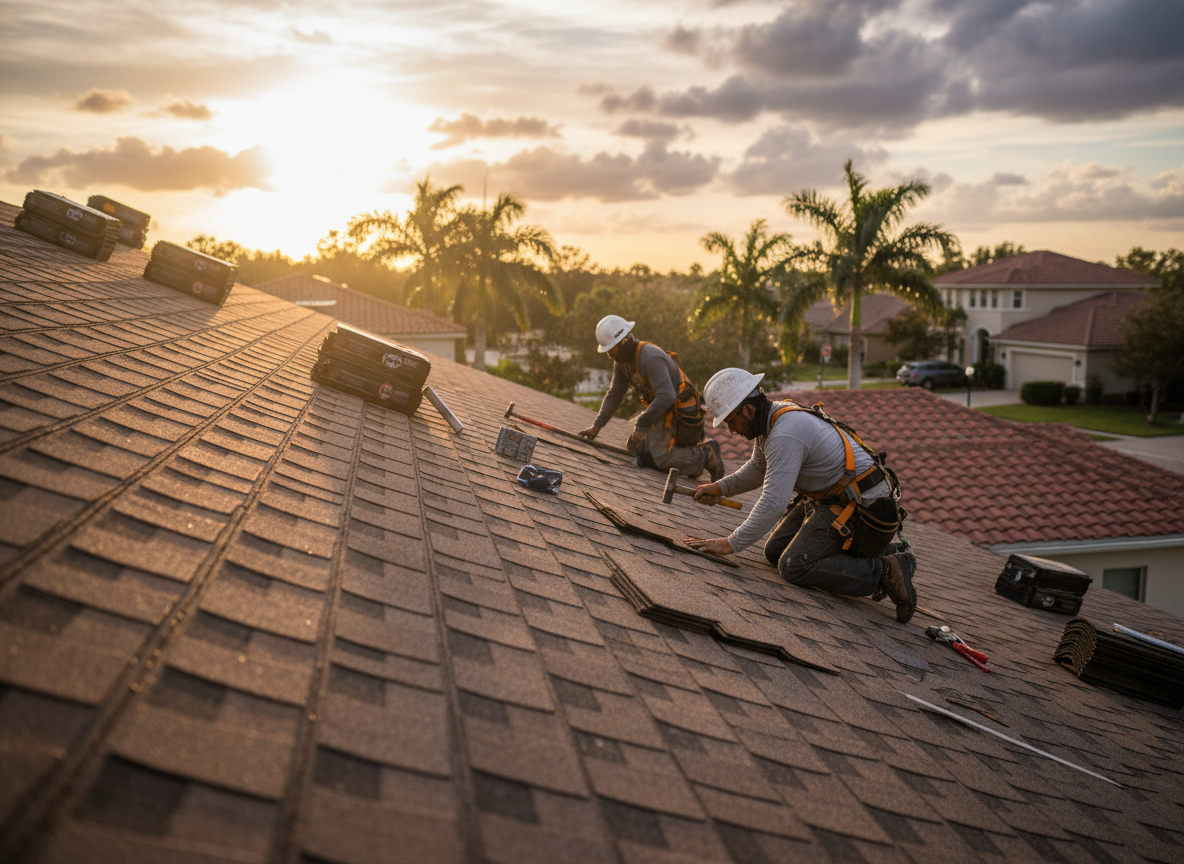
Titusville is the northern end of the Space Coast, sitting on the Indian River Lagoon where the river widens toward the Cape, and its housing tells the story of the same boom that built Melbourne forty minutes south. The town was a small citrus and fishing community until the late 1950s, then grew quickly as workers arrived for the missile and space programmes. The houses that went up between about 1958 and 1975 are still the backbone of the city, and their roofs are now on their second or third covering. Roof repair in Titusville is mostly the care and feeding of mid-century ranch roofs in a salty, humid, riverfront environment.
A Modest Housing Stock, Built Quickly
The Titusville house of that era is smaller and plainer than its counterpart in Melbourne. Single-storey, concrete block, a low-pitch gable or hip roof, a carport that was often enclosed later, and a lot that runs back toward a canal or a patch of scrub. The plans were economical, and the roofs reflect that: simple geometry, short spans, and shingle coverings that were expected to be replaced within a couple of decades. Simple geometry is an advantage for repairs, because there are fewer valleys and junctions to fail. The disadvantages come from the materials. A low pitch means the underlayment is doing most of the waterproofing, the overhangs are deep enough to collect debris, and the metal components — flashings, vents, edge trim — have spent fifty years in salt air. The city also has a stock of older riverfront houses, some from the 1920s, where the roofs have been altered repeatedly and the junctions are the whole story.
Salt, River and Lagoon
Titusville's exposure comes from the lagoon rather than the open ocean, but the effect is similar. Salt is in the air, humidity is high year round, and the prevailing wind comes across water. Metal corrodes, fasteners fail, fascia and soffit stay damp, and algae grows on any slope that does not get direct sun. The river also moderates temperature, which sounds pleasant and has a roofing consequence: surfaces that cool slowly at night stay wet longer into the morning, and the deck beneath a covering has less chance to dry out. On a roof that already has a marginal flashing, that is the difference between a slow stain and a leak. Houses that back onto a canal get both the humidity and the debris, because the vegetation along the water drops onto the roof and the low pitch keeps it there.
The Carport Problem
The most common alteration to a Titusville house is the enclosed carport. What was an open structure under a low roof became a room, and the roof over it was tied into the house wall with whatever seemed adequate at the time. Sometimes that was a proper flashing; often it was a strip of metal and a bead of sealant. Fifty years later, the sealant has failed and the junction is where water enters. It runs down the wall, into the block, and appears inside the house at a point that has no obvious relationship to the roof. Repairing that junction properly means opening the wall at the top, installing a stepped flashing, and rebuilding the transition — not resealing it. The same applies to the screened porches and Florida rooms that were added at the back, and to the carports that were converted into garages with a new door and a raised floor.
Flat Roofs and the Small Commercial Stock
Titusville's commercial buildings are modest: single-storey shops, offices, small industrial units, and the flat-roofed additions behind them. Those roofs are low-slope membrane or built-up, with equipment on top, and they are old enough that many have been patched and coated repeatedly. The failure pattern is predictable. Water stands where a drain has settled, a seam opens at a parapet, a curb around a unit cracks, and the membrane at the edge lifts in wind. Where the insulation below has stayed dry, these are repairs; where it has not, the assembly has to be opened. Coating is worth considering on a sound but weathered membrane. It is not a repair for a failed one, and it does not fix drainage, but it can add years to an assembly that is still doing its job.
Storms on This Part of the Coast
The northern Space Coast has its own storm history. Hurricane Frances came ashore at Sewall's Point in September 2004 and crossed the state, Hurricane Jeanne followed three weeks later near Fort Pierce, and both affected this coast. Hurricane Matthew stayed offshore in October 2016 but brought hurricane conditions and erosion along the barrier islands. Hurricane Irma crossed the peninsula in September 2017, and Hurricane Ian in September 2022 and Hurricane Milton in October 2024 both crossed the state and exited near Cape Canaveral. For roofs the pattern is consistent: the windward edges, the ridges and the perimeter take the damage, the rain gets in behind lifted edges, and the interior staining appears afterwards. On the older houses, the carport junctions and the porch tie-ins are where the wind-driven rain enters first.
What Fails on a Titusville Roof
The pipe boots, first and always, because they perish in the sun within a decade. Then the carport and porch junctions, which were never built to last fifty years. Then the valleys, where debris collects on a low pitch, and the fascia, which is where water runs off a wide overhang onto a gutter that has shifted. On the riverfront houses, the metal components fail before the covering: flashings, vents and edge trim corrode from the salt, and a roof that looks sound can leak at a piece of metal that has thinned to nothing. Underneath all of it is the underlayment. On a low pitch it is the layer doing the work, and it does not last as long as the shingle above it looks like it should.
The Work We Do in Titusville
The full range applies. Leaks are roof leak repair, traced to the entry point rather than treated at the stain. Where a storm has opened a roof, emergency roof tarping holds the weather out until a permanent repair can be arranged, and emergency roof repair closes the damage that can be finished in one visit. Storm work is assessed across the whole roof, with particular attention to the junctions at carports and porches, because that is where driven rain enters first. A failed junction above a covering with serviceable life is a repair; a covering that has gone across the planes is a replacement. Roof replacement is the answer when the covering has reached the end of its life across the roof or the deck is soft in more than one place. Roof installation covers new builds and the additions that replace an old carport roof properly. Shingle is on most of the housing, metal on the buildings where service life matters and on the sheds, tile on the larger later houses, and membrane on the low-slope sections and small commercial stock, with coating for surfaces that are weathered rather than failed. Roof inspection is where every one of those decisions starts. City of Titusville building department permits property inside the city limits; Brevard County permits unincorporated addresses to the north and west. The Florida Building Code applies, with the design wind speed for the site, the product approval for the covering and the fastening schedule attached to the application. The High-Velocity Hurricane Zone does not apply here — it is limited to Broward and Miami-Dade counties — but a coastal site has a higher design wind speed than an inland one, and the fasteners and edge metal are worth specifying for the salt as well as the wind. The inspection sequence is standard: deck and underlayment inspected before the covering closes on a replacement, final inspection at completion.
How a Job Runs
The survey covers the covering, the perimeter, the penetrations and every junction where an addition meets the original roof. The attic is inspected where there is access, and the metalwork is checked for corrosion rather than assumed to be serviceable. The written scope names the areas being opened, what happens to the deck, and how each carport and porch junction will be rebuilt with a proper flashing. Then the permit, the work and the inspection. At the end there is a walk of the property, the photographs of the work before it was closed in, and the inspection record.
Ten Miles Around Titusville
Within about ten miles: Mims to the north, Port St. John and Sharpes to the south, Christmas to the southwest, and Cocoa at the southern edge of the radius. Each address is checked against its jurisdiction before an application is prepared.
Calling About a Titusville Roof
The age of the house and the additions made to it are the two facts that shape the first visit, along with whether the property backs onto water. A photograph of the carport or porch roof helps more than a photograph of the front elevation. Florida Roof Repair Pros, 4720 Millenia Blvd, Suite 175, Orlando, FL 32839, (407) 557-4529.
The Carport Junction, Opened Up
The junction between a carport roof and the house wall is the single most common leak on a Titusville house, and it is worth describing what a proper repair involves, because the cheap version does not last. The carport roof is low-slope and it meets a wall that continues above it. Water running down that wall has to be directed out onto the carport roof and away, and the only way to do that is a flashing that is stepped into the wall or counter-flashed behind the cladding, lapped over the roof covering below. The common failure is that the junction was sealed instead. A bead of mastic along the wall looks like a flashing from the ground and works for a year or two. Then the sun and the movement of the two structures break the bond, and water goes behind it into the block, where it tracks sideways and appears inside. Opening it up means cutting back the wall finish at the junction, installing a proper flashing with the correct lap, sealing the top edge of the flashing rather than the bottom, and rebuilding the finish. On a block wall that also means dealing with the paint or the stucco so the flashing sits behind the finish rather than on top of it. It is a small area of work with a disproportionate effect. On a house that has leaked at the carport for years, the ceiling stain is often the only visible evidence, and the fix is at the wall rather than at the roof above it.
Around Titusville
We regularly work near:
- 📍Indian River Lagoon
- 📍Space View Park
- 📍Merritt Island National Wildlife Refuge
- 📍Canaveral National Seashore
- 📍Historic downtown Titusville
Roofing Company in Titusville — Local Notes
- •Housing mostly built between the late 1950s and 1970s
- •Enclosed carports are the most common leak point
- •Lagoon humidity and salt age the metalwork first