Apopka is a working town that became a suburb without stopping being a working town. It sits in the northwest corner of Orange County on ground that is slightly higher than Orlando's, with Lake Apopka along its southern edge and a long history of vegetable farming, fern growing and nursery production behind it. That mix shows up on the roofs. Along the older streets there are modest houses built between the 1940s and the 1970s for people who worked the land or the nurseries. Around them, from the 1990s onward, came subdivisions that filled the gaps between the old roads, and on the edges there are the agricultural buildings — sheds, packing houses, shade structures — that belong to a different kind of roofing entirely. Roof repair in Apopka covers all three, and each one fails for its own reason.
Wind With Nothing to Stop It
The most consistent local factor is exposure. Much of the land around the city is open — fields, nursery ranges, cleared lots waiting for houses — and open ground means wind arrives without being broken up by the tree canopy and rooflines that shelter older suburbs. A roof on the edge of a field takes more wind at its edges and ridges than the same roof three miles inside a built-up area.
That shows up as edge damage first: rakes, eaves, ridge caps and the corners where wind pressure concentrates. On a shingle roof it means tabs that lift and crease along the perimeter. On the agricultural buildings, where the covering is often exposed fastener metal, it means screws that work loose and panels that flutter and eventually fail at the fixing line.
The practical consequence is that detailing at the edges matters more here than it does in a sheltered neighbourhood. A roof that is fine in the middle of a subdivision can lose its edge on a lot that faces an open field, and the repair after a storm is usually at the perimeter rather than in the field of the roof.
The Older Housing Stock
The pre-1980 houses in Apopka were built for people who did not spend money on frills. They tend to be single-storey, rectangular, with a simple gable or hip roof, a carport that was enclosed at some point, and a rear addition that was added when the family grew. The covering has usually been replaced at least once, often with whatever was available, and the deck underneath is a mixture of original boards and later patched sheathing.
The rear additions are where the problems concentrate. A porch or a room added in the 1970s was often tied into the existing roof with a change of pitch and a short flashing, and forty years later that junction is the first place water gets in. Carport enclosures put a low-slope roof against a wall with no proper step flashing, and the wall is usually block, which means the water tracks inside the block and appears well away from the roof.
On these houses the honest first step is understanding the sequence of what was built, because a repair that ignores the addition will not hold.
Newer Subdivisions and Their Second Covering
The subdivisions built from the 1990s through the 2000s are the other half of the stock. They are asphalt shingle on engineered trusses, with more complex geometry than the older houses — multiple hips, valleys where wings meet, and a front elevation designed to look bigger than the plan. The original shingles are now at or past the age at which they were expected to be replaced, and a good number of these roofs are on their second covering already.
Complex geometry is the issue on these roofs. Every valley is a place where two planes deliver water to one line, every hip creates a ridge that has to be capped, and every wall that projects through the roof creates a junction. The original installation was usually competent but not generous, and the details have been weathering for twenty years. When a leak appears, it is rarely in the middle of a plane; it is at a valley, a wall or a penetration.
The second issue is ventilation. Many of these roofs were built with ridge vents and soffit intakes that have since been blocked by insulation, and the resulting heat shortens the life of the covering on the sun-facing slopes.
What Actually Fails Here
The pattern is consistent. Algae and organic growth on shaded slopes, because the humidity is high and the rain is frequent. Granule loss on the sun-facing slopes, which is normal ageing accelerated by attic heat. Lifted tabs at the windward edges on exposed lots. Failed pipe boots, which perish in the sun regardless of the roof around them. And on the older houses, the junction details around additions and enclosed carports.
Irrigation is a local factor worth mentioning. Nursery and agricultural properties run irrigation constantly, and on a house next to a nursery the eaves and fascia stay wet far longer than they would otherwise, which is where rot starts. The same is true of the shade houses and packing sheds, where the roof is doing a job rather than presenting an elevation.
The Work We Do in Apopka
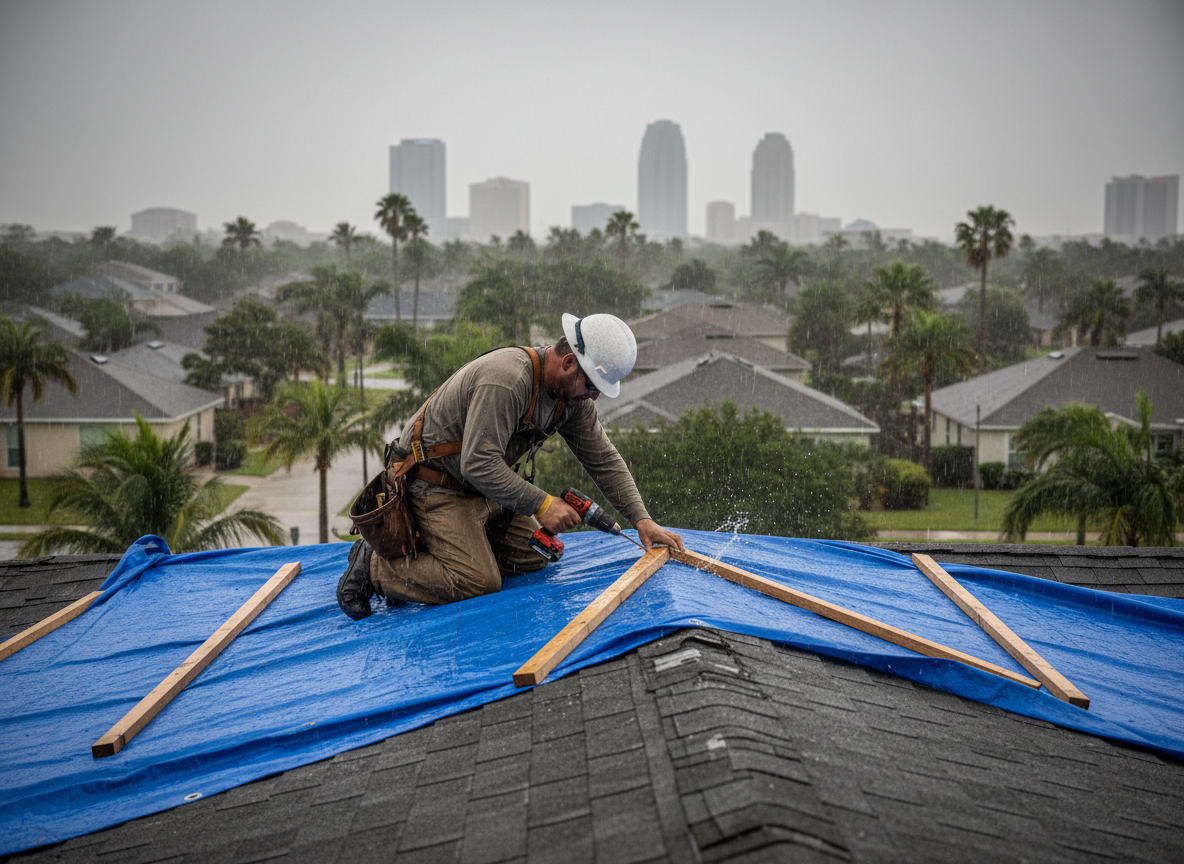
All of the services on this site are available here. Leaks are roof leak repair, traced to the entry point rather than treated at the stain. Where a storm has opened a roof, emergency roof tarping holds the weather out until a permanent repair is arranged, and emergency roof repair closes the cases that can be finished in a single visit.
Storm and hurricane damage repair is the wider assessment, and on this housing stock it means separating wind damage at the edges from wear in the field. Roof repair is often the right answer, particularly on the older houses where a sound main roof sits above a failed addition. Roof replacement is the answer when the covering is at the end of its life across whole planes or the deck is soft in several places. Roof installation covers new buildings and the agricultural structures.
The coverings are shingle roofing for the houses, metal roofing for outbuildings and for owners who want a longer service life, tile roofing where it appears on newer infill, and flat roof repair for the low-slope sections over porches, carports and additions. Roof coating is used on sound metal and membrane surfaces that need their surface renewed. Roof inspection is where every one of these decisions starts.
Permits for Apopka Addresses
The City of Apopka issues roofing permits for property inside the city limits; Orange County's building safety division handles unincorporated Orange County addresses around it, and the boundary does not follow the postal address. The code is the Florida Building Code either way, with the wind provisions that apply to the site and the product approval and fastening schedule that go with the specified covering.
Agricultural and accessory buildings are permitted on a different basis from a house, and the scope has to describe them accurately — an open-sided shed and a closed packing house are not the same structure, and the covering requirements follow the structure rather than the label somebody gives it.
On residential work, the inspection sequence is the usual one: the deck and underlayment are inspected before the covering closes on a replacement, and the final inspection happens at completion. The record from that inspection is worth keeping.
How a Job Runs
The survey comes first — the roof walked where it is safe, the attic inspected where there is access, the junctions around additions and carports photographed, and the deck checked where it can be reached. On an exposed lot, part of the survey is looking at how the edges are finished, because that is where the wind will work.
The written scope names the materials, states what is being done with the deck, and describes each junction that will be rebuilt. The permit application is built from it. Work follows the inspection sequence, and sign-off is a walk of the property with the owner, with photographs and the inspection record handed over.
Ten Miles Around Apopka
Within roughly ten miles: Altamonte Springs and Forest City to the east, Plymouth and Clarcona to the west and southwest, Wekiwa Springs to the northeast, Zellwood to the north, and Ocoee at the western edge of the radius. Each address is checked against its jurisdiction before a permit is prepared.
Calling About an Apopka Roof
The age of the house, the covering, and whether anything has been added to the original footprint are the three facts that shape the first visit. A photograph from the ground helps with the covering, but not with the junction details that usually cause the leak. Florida Roof Repair Pros, 4720 Millenia Blvd, Suite 175, Orlando, FL 32839, (407) 557-4529.
Agricultural Roofs: Fasteners, Panels and Wind
The buildings around Apopka that are not houses need their own method. A nursery range, a packing shed or a hay barn is usually covered in profiled metal on a steel frame, often with open sides, and its roof is maintained rather than replaced for as long as the panels hold.
The failure starts at the fasteners. Each screw passes through a washer that seals the hole, and the washer is the part that fails first. Sun hardens it, the panel moves slightly with every storm, and the seal opens. Water then tracks along the fixing line, which is why a shed roof that leaks usually leaks in lines rather than in patches.
The second failure is at the cut edges and the laps. Metal that has been cut with a blade has a raw edge, and on a coastal or humid site that edge corrodes first. On a building in Apopka the corrosion is slower than at the coast but it still happens, and it is the reason a panel that looks sound in the middle can be rotten at the end.
The third is wind. An open-sided building has nothing to resist uplift except its fixings, and a shed on open ground takes more wind than a house in a subdivision. Where fixings have loosened the panel flutters, and a fluttering panel works its neighbours loose.
Repair, in practice, means re-fixing with new washers, replacing the panels that have lost section, and renewing the flashings at the edges. A coating can extend the life of a sound but weathered roof, provided the fasteners have been dealt with first, because coating over a loose fixing will crack at the fixing line within a season.
None of this is domestic roofing, and it is worth saying that a barn is not a house. The scope describes the structure, the panel, the fixings and the flashings, and the work is scoped and scheduled on that basis.
Around Apopka
We regularly work near:
- 📍Lake Apopka north shore
- 📍Wekiwa Springs State Park
- 📍Rock Springs Run
- 📍Apopka City Hall
- 📍Lake Apopka Wildlife Drive
Roofing Company in Apopka — Local Notes
- •Northwest Orange County, higher ground than Orlando
- •Open farmland means less shelter from wind
- •Mixed stock: older homes and 2000s subdivisions