Sanford grew up facing the water. The old town sits on the south shore of Lake Monroe where the St. Johns River widens, the commercial streets run back from the waterfront, and the residential blocks behind them were built mostly between the 1880s and the 1920s. That history is what makes roof work here different from roof work in the subdivisions twenty minutes south. A house on those streets was framed before the Florida Building Code existed, roofed with materials that are no longer made, and altered at least once by an owner who had a different idea about what the back of the house should be. Roof repair in Sanford is often less about replacing a covering than about understanding a structure that has been edited.
Roofs That Predate the Code
The housing in Sanford's older neighbourhoods was built with dimension lumber rather than engineered trusses, and the roof deck is frequently board sheathing — individual planks run across the rafters with gaps between them — rather than plywood or oriented strand board. Board decking is not a defect. It is simply a different substrate, and it behaves differently: the planks shrink and cup over a century, fasteners hold in some places and not others, and a covering that was nailed to it decades ago may be relying on nails that have lost their grip. That matters when a roof is re-covered. On modern sheathing a new layer goes down over a flat, consistent surface. On board decking the surface has to be assessed plank by plank, because a covering laid over cupped boards will telegraph the shape and will not fasten evenly. Where the boards are sound, an overlay panel can be installed; where they are not, the section is replaced. Neither decision can be made from the ground or from a photograph. The same era produced roofs that were ventilated by accident rather than by calculation — gable vents, open eaves, no ridge vent — which is worth knowing before anyone closes those openings up during a re-roof.
What a Historic Street Adds to a Roof Job
Parts of Sanford are inside designated historic districts, and in those areas an exterior change can go through a preservation review as well as a building permit. Roof covering is one of the things that review tends to care about, because on these houses the roof reads as part of the elevation: the porch roof, the dormer and the main slope are all visible from the street, and a change of material or profile changes the look of the block. The practical advice is to check before ordering materials rather than after. Where the existing covering is metal on a porch and shingle on the main roof, matching the porch profile is usually what the review expects, and where the original covering is no longer made, the conversation is about what reads as equivalent rather than what is cheapest. None of this replaces the building permit; it sits alongside it, and both can run at the same time if the scope describes the material clearly enough.
The River, the Lake and the Wind
Sanford's position on the water shapes its weather. The St. Johns River and Lake Monroe open the town to wind from the north and east with little to slow it, and the afternoon storms that cross Central Florida in summer arrive here with a clear run across the water. Roof edges, ridge caps and the porch roofs that face the lake take the first of it. Humidity is the other constant. The river keeps the air moist through the night, so surfaces that get wet in the afternoon are still damp at dawn. On older houses that shows up as rot in the fascia and soffit, corrosion on the fasteners of the metal porch roofs, and a particular kind of failure at the bottom edge of a roof where water has been running onto a gutter that has been out of alignment for years. It also keeps algae growing on the shaded slopes, which is cosmetic but often the reason a covering gets replaced before its time. Flooding is a separate subject with a direct roof connection: after a high-water event, the first calls are usually about ceilings, and the entry point is often a flashing that had been marginal for a decade.
Where Sanford Roofs Actually Leak
The list is short and repetitive. Porch roof tie-ins come first: the small roof over a front porch meets the main roof at a shallow angle, and on a hundred-year-old house that junction has often been sealed with tar or mastic rather than properly stepped and flashed. When it fails, water runs back under the porch ceiling and shows up as a stain on the porch soffit. Chimneys come second. Sanford's older houses have them, and the flashing at the chimney is where the roof meets masonry that moves at a different rate. A cracked mortar crown or a failed counter-flashing lets water in at the top and delivers it inside the roof structure, where it can travel a long way before it appears. Valleys, dormers and vent penetrations follow. On the metal porch roofs the failure is usually at a fastener: the washer hardens, the screw backs out a fraction, and the hole it made becomes a drip point that stains the ceiling below. On the shingle slopes the nails themselves are a factor, because on board decking they can work loose over decades and leave a field of small openings that only leak in wind-driven rain.
Choosing a Covering for an Older House
Covering choice on these houses is a balance between what the structure can carry, what the street looks like and what the code will accept. Asphalt shingle is the common answer because it is light and works on almost any pitch, and on a historic block a shingle profile that sits flat and reads simply from the street is often the least contentious option. Metal is the other traditional answer here, and a standing-seam or ribbed profile on a porch roof matches what many of these houses already have. Tile is heavier, and adding weight to a roof framed for something lighter is a structural question rather than a taste question. The one thing worth saying plainly is that the covering is the visible layer, not the waterproof one. On a low-slope porch or a shallow main roof the underlayment does most of the work, and the choice of shingle or metal above it matters less than how the underlayment is lapped and how the edges are finished. The Florida Building Code governs, and on board decking the scope states the substrate treatment that the application and the inspection will be judged against. The City of Sanford handles property inside the city limits; Seminole County handles unincorporated addresses around it. Both apply the same statewide code, with the wind provisions that go with the site, and neither is inside the High-Velocity Hurricane Zone, which is limited to Broward and Miami-Dade counties. What differs on the older housing stock is the inspection conversation. A replacement on board decking raises questions about the substrate that a replacement on plywood does not, and the answer is a scope that states what is being done with the deck rather than leaving it to be discovered. Where the covering is being changed rather than repaired, the product approval and the fastening pattern go with the application, and the inspection happens before the covering closes. We also tell owners to keep the final inspection record. On houses of this age it is the document that answers questions later, whether from a buyer, an insurer or the next contractor who works on the roof.
The Work We Do in Sanford
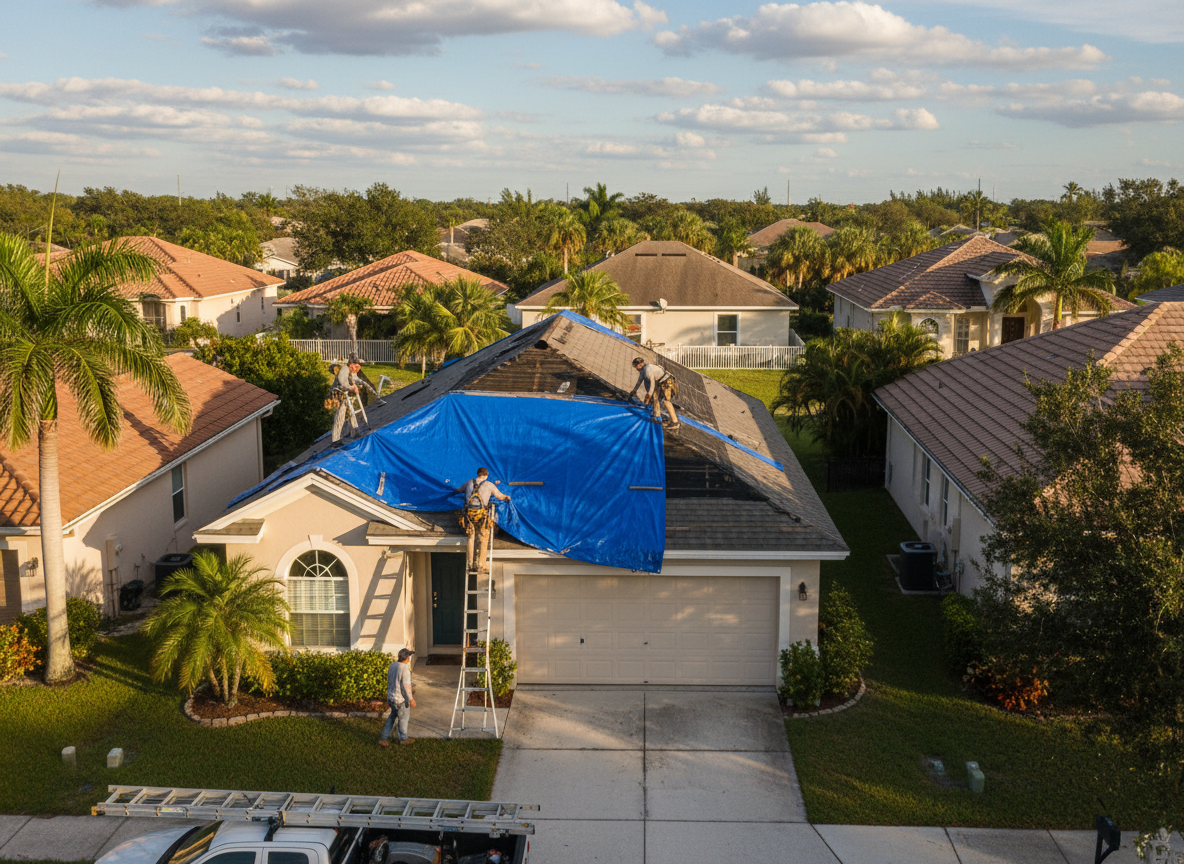
The full service range applies, and the survey decides which part of it a house needs. Leaks that appear after a storm are roof leak repair, traced to the entry point rather than treated at the stain. Where a limb has opened the roof or wind has lifted a section, emergency roof tarping closes it until a proper repair can be scheduled, and emergency roof repair finishes the cases that can be closed in one visit. After a storm the assessment covers the whole roof and the junctions that were already marginal, because on houses of this age wind finds the details long before it finds the field. Roof repair versus roof replacement is the decision that follows, and on a historic house it is worth taking slowly: a main field with life left in it and one failed porch roof is a repair job, not a replacement. Roof installation covers new builds and additions. Shingle is the usual choice on these houses, light and workable on the pitches they were built with; metal matches what many porches already carry; tile appears where weight was designed for; and the low-slope porch roofs are membrane work, with coating for sound metal surfaces. Roof inspection is the starting point for all of it, and on a house with no service history it is the only sensible first step.
How a Job Runs Here
The survey is the part that takes longest on a Sanford house, because the roof has to be read rather than measured. The roof is walked where it is safe, the attic is inspected from inside, the deck is checked where it can be reached, and the junctions are photographed before anything is proposed. On board decking, part of the survey is identifying which sections will take a new covering and which will not. The written scope says what happens to the board deck, how much of it is overlaid and how much replaced, and how the porch tie-in, chimney and valleys are rebuilt. The permit application is built from it, and where a preservation review applies it is submitted in parallel. Work follows the inspection sequence, with the deck and underlayment inspected before the covering closes and a final inspection at completion. The job closes with a walk of the property, the photographs of the deck and flashings, and the final inspection for the house file.
Ten Miles Around Sanford
Within about ten miles of downtown: Lake Mary and Heathrow to the south, Longwood and Winter Springs to the southwest, Midway immediately west, DeBary across the river to the north, and Deltona at the outer edge of that radius. Each sits in its own jurisdiction, and we confirm which one before a permit application is prepared.
Calling About a Sanford Roof
It helps to know the age of the house and whether the roof has been re-covered before, because on this housing stock those two answers shape the survey. A photograph of the porch roof and the main slope from the street is a useful start. Florida Roof Repair Pros, 4720 Millenia Blvd, Suite 175, Orlando, FL 32839, (407) 557-4529.
Around Sanford
We regularly work near:
- 📍Lake Monroe waterfront
- 📍Sanford RiverWalk
- 📍Historic downtown Sanford
- 📍St. Johns River
- 📍Museum of Seminole County History
Roofing Company in Sanford — Local Notes
- •Historic districts have their own review process
- •Many roofs sit on original board decking
- •River wind and humidity drive the failure pattern