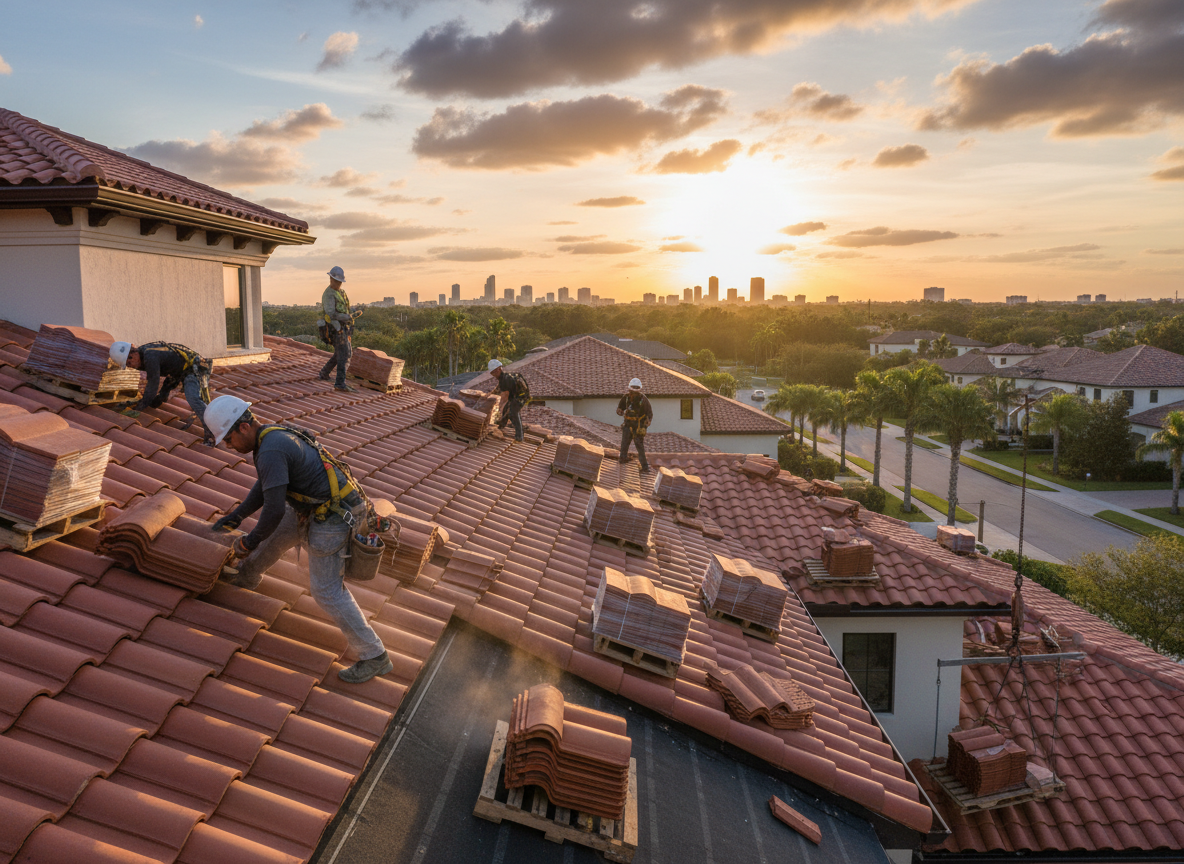
Winter Haven is built around water. The city sits in a chain of lakes in eastern Polk County, and the lakes are not a backdrop to the town so much as the reason for it: citrus money built houses on the shores, the gardens and the water skiing that made the town known drew visitors for decades, and the modern city has grown around the same water with subdivisions, retirement communities and a good deal of rental housing. Roof repair in Winter Haven is shaped by that setting. Humidity off the lakes, afternoon storms, and a housing stock that runs from 1920s lake cottages to houses built in the last ten years.
Lake Cottages and the 1920s Stock
The oldest houses in Winter Haven were built for people who wanted to be near the water. They are modest in size, often with a wide porch facing the lake, a low-pitch roof and deep eaves, and they were built with the materials of the time: board decking, dimension lumber, and whatever covering the owner could afford. A century later those roofs have been through several coverings and several repairs. The main roof may be sound while the porch roof, which takes the weather from the lake, has been rebuilt twice. The junctions between the porch and the main roof, and between the house and a later addition, are where the water gets in, and a repair that ignores them will not hold. The lakefront position also means more wind, more humidity and more debris than a house three streets back.
The 1950s to 1970s Ranch Houses
Most of Winter Haven's housing was built after the war, in the decades when the citrus economy was strong and the town grew steadily. Those houses are single-storey, concrete block, with low-pitch hip and gable roofs, a carport or garage, and a screened porch at the back. The roofs are simple and the spans are short, which makes them straightforward to work on. The coverings are on their second or third life. What fails on them is predictable: pipe boots, valleys, and the junctions where a carport was enclosed or a porch was turned into a room. On a low pitch the underlayment is doing most of the waterproofing, and it fails before the shingle above it looks worn. Attic ventilation on these houses is often minimal by modern standards, which makes the attics hot and the coverings age faster on the sun-facing slopes.
Newer Subdivisions and Retirement Communities
The growth of the last thirty years added subdivisions on the edges of the city and a number of communities built for retirees, with clubhouses, pools and a good deal of concrete tile. Those roofs are younger and heavier, and they fail on a different schedule: the tile will outlast the underlayment beneath it, and the first sign of failure is usually a stain inside rather than anything visible on the roof. On these roofs the survey means lifting tile, checking the valleys where it is cut, and inspecting the junctions at walls and at the roof-to-lanai transitions that are standard on Florida plans. Repairs lift the tile in one area and relay it, which keeps the roof consistent with the rest of the street. Where a community has architectural standards, the covering has to be approved before it is ordered, and that process runs alongside the building permit.
Lakes, Humidity and Algae
The chain of lakes keeps the air moist, and moisture is what ages a roof in Florida. Surfaces stay damp through the night, algae and mildew grow on the shaded slopes, and the wood in the fascia and soffit stays wet long enough for rot to establish itself. The visible symptom is the black streaking that appears on north-facing and shaded planes. It is cosmetic, but it is a signal: the roof is staying wet, and the same conditions that support the growth shorten the life of the covering and the woodwork around it. The lakes also bring debris. Oak, cypress and palm all drop material, and on a low-pitch roof it stays where it lands, blocking valleys and filling gutters.
Afternoon Storms and Hurricane Seasons
Winter Haven's storms are the inland Central Florida pattern: intense afternoon thunderstorms from June into September, with frequent lightning, short bursts of wind and heavy rain. Polk County is inland, but inland is not sheltered. Hurricane Charley crossed the county in August 2004 on its way toward Orlando, Hurricane Irma crossed the peninsula in September 2017, and Hurricane Milton crossed in October 2024. The damage pattern follows the roof type. Shingle roofs lose tabs at ridges and rakes; tile roofs lose individual pieces and, on older roofs, the fixings that hold them; flat roofs lose their edge terminations. The interior damage appears afterwards, often days later, because water that entered behind a lifted edge takes time to show. A survey after a storm is worth more than a glance from the street, particularly on a low-pitch roof where the damage is at the edge.
What Fails Here
On the lake cottages: the porch tie-in, the valley, and the fascia where water from a wide eave runs onto a gutter that has shifted. On the ranch houses: pipe boots, valleys, and the junctions at enclosed carports and porches. On the newer tile roofs: the underlayment, which fails invisibly. Across all of them, the same three things are worth checking every few years: the pipe boots, the flashings at walls, and the state of the metal at the edges. Those are the components that fail first and cost least to fix early.
The Work We Do in Winter Haven
The full range applies. Leaks are roof leak repair, traced to the entry point. Where a storm has opened a roof, emergency roof tarping holds the weather out until a permanent repair can be arranged, and emergency roof repair closes the damage that can be finished in one visit. When a storm has done real damage, the assessment widens to the whole roof: what the wind opened, what was already worn, and which of the two an insurer will treat differently. Where one detail has failed and the surrounding covering still has serviceable years in it, the sensible job is a repair rather than a strip. Roof replacement is the answer when the covering has reached the end of its life across the roof or the deck is soft in several places. Roof installation covers new builds and additions. Shingle covers most of the ranch housing and the subdivisions; tile appears on the newer and larger plans; metal turns up where an owner wants longevity; and the low-slope sections over porches and lanais are handled as membrane work, with coating reserved for surfaces that are still sound underneath. Roof inspection is where the decision starts. Roofing permits for addresses within Winter Haven come from the city's building department; unincorporated Polk County property is handled by the county instead. The governing code is the Florida Building Code, and the application carries the design wind speed for the site along with the product approval and fastening pattern for the covering. The High-Velocity Hurricane Zone does not apply in Polk County, since it is limited to Broward and Miami-Dade counties, but the wind provisions still govern, and the design wind speed for the site is a published value. The inspection sequence is standard: deck and underlayment inspected before the covering closes on a replacement, final inspection at completion.
How a Job Runs on a Lakefront Lot
Water changes the logistics before it changes the work. On a lot that runs down to the lakes, the roof is often the only part of the property with clear access, the seawall and the dock limit where material can be set down, and a lift has to be positioned on a street that may be narrow or lined with mature oaks. That is settled at the survey rather than on the morning the work starts. The technical sequence is the one used everywhere: the covering, the perimeter, the penetrations and every junction where a porch, a lanai or a later addition meets the original roof are recorded, the attic is inspected where there is access, and the scope is written down area by area, naming what happens to the deck and how each junction is rebuilt. The permit follows from that scope, the work follows the inspection sequence, and the finish is a walk of the roof with the owner and the inspection record for the file.
Citrus Buildings and the Metal Roofs Behind the Houses
The citrus economy left more roofs in Winter Haven than the houses on the lakes. Packing houses, equipment sheds, garages and small workshops stand behind the older streets and along the rail line, and many are still in use as storage, workshops or units let to a small business. Those roofs are usually metal: corrugated or ribbed panels on purlins, fixed with exposed fasteners and washered screws, sometimes over an older built-up roof that was never removed. The failure pattern is different from a house. The panels themselves last, but the fasteners back out with thermal movement, the washers harden, and water enters at the screw line rather than through the sheet. Rust starts at cut edges and at the bottom of a valley where debris holds moisture. Repair on this stock is usually about the fixings, the flashings at the ridge and the transition where a lean-to meets the main building, not about replacing whole sheets. On an open-sided building the wind load matters more than on a house, because there is nothing to break it before it reaches the edge. Those buildings usually sit outside the community standards that govern the subdivisions, so the covering can be chosen for performance rather than appearance: a heavier sheet, a coating that suits constant humidity, or a closure at the eave that keeps driven rain out of the purlins.
The Towns Around Winter Haven
The work reaches out from the chain of lakes: Cypress Gardens and Jan Phyl Village immediately north of the city, Lake Alfred and Wahneta to the northwest, Eagle Lake to the east, and Auburndale at the northern edge of a ten-mile radius. Each of those has its own permitting arrangement, which is confirmed from the property record rather than from the postmark on the address.
Asking About a Winter Haven Roof
Lakefront or inland is the first question worth answering, because it changes what the survey looks at. The second is the house: a 1925 cottage, a 1960s ranch and a 2005 tile roof are three different jobs. Florida Roof Repair Pros, 4720 Millenia Blvd, Suite 175, Orlando, FL 32839, (407) 557-4529.
Around Winter Haven
We regularly work near:
- 📍Lake Howard
- 📍Chain of Lakes
- 📍Downtown Winter Haven
- 📍Lake Eloise
- 📍Winter Haven Chain of Lakes Trail
Roofing Company in Winter Haven — Local Notes
- •Chain-of-lakes city in eastern Polk County
- •Lake cottages, ranch houses and newer tile roofs
- •Humidity keeps shaded slopes damp year round