Ocala is horse country, and the roofs reflect it: farm buildings, barns, sheds and arenas on the outskirts, and a city of modest houses in the middle. Marion County sits inland, north-west of Orlando, far enough from either coast that salt is not a factor and close enough to the centre of the peninsula that the summer storms are. The city itself was laid out in the 1880s and grew on citrus, phosphate and the springs that made it a destination, so the housing runs from Victorian-era downtown houses to 1960s ranch houses to subdivisions built in the last twenty years. Roof repair in Ocala covers all of it, plus the agricultural buildings that most roofing companies never see.
Live Oaks and What They Drop
The live oak is the defining tree of Marion County, and a mature oak over a roof is a long-term relationship. It drops leaves, twigs and acorns more or less continuously, and it holds its leaves through much of the winter, so the roof does not get a clear season. Debris collects in valleys, behind chimneys and along the eaves, and on a low-pitch roof it stays there. Shade is the other side of the relationship. A roof under an oak dries slowly, algae grows on the shaded planes, and the wood in the fascia stays damp. The Oaks also drop limbs in storms, and a limb that lands on a shingle roof can break the seal across several courses without leaving a visible hole. Homeowners here know the cycle. What is worth saying is that clearing the valleys and the gutters is maintenance, not a repair, and it postpones the failures that would otherwise follow.
The Older City Stock
Ocala's oldest houses are in and around the downtown grid: Victorian-era houses with steep roofs and dormers, 1910s and 1920s bungalows, and commercial buildings with parapets and flat roofs. Many of those roofs have been altered, extended and re-covered several times, and the detailing is a mixture of original work and later improvisation. The steep roofs on the Victorian houses are a different proposition from the low-pitch stock that dominates the rest of the county. They shed water well but they have more valleys, dormers and wall junctions, and each of those is a place where water can enter. Access is also harder, which affects how the work is done. Bungalows from the 1920s are more straightforward: a low-pitch main roof, a deep porch, and additions at the back that were usually built with the same casual approach to flashing that the rest of Florida had at the time.
Ranch Houses and Subdivisions
Most of Ocala's housing was built after the war. The 1950s to 1980s ranch houses are single-storey, block-built, with low-pitch hip and gable roofs and a carport or garage. Those roofs are on their second or third covering and they fail in the ordinary way: pipe boots, valleys, and the junctions at enclosed carports and porches. From the 1990s onward the subdivisions arrived, with steeper pitches, more complex geometry and a good deal of tile on the larger plans. Those roofs are now reaching the age at which the underlayment under tile starts to fail, and the earliest shingle roofs in those subdivisions are at the end of their expected life. There is also a stock of manufactured homes in the county, which are surveyed on their own terms rather than treated as site-built houses with a low pitch.
Barns, Sheds and Farm Buildings
Marion County's agricultural buildings are a category of their own. Barns, run-in sheds, hay storage, equipment sheds and covered arenas are usually metal, often with exposed fasteners, and their roofs are maintained rather than replaced until the panels fail. The problems are different from a house. Fasteners work loose with the movement of the structure and the wind, washers perish, and the panels themselves corrode at cut edges and at the fixing line. A barn roof that leaks onto hay or into a stall is a problem worth fixing quickly, and it is usually a matter of re-fixing and replacing components rather than a full re-roof. These buildings are also where a metal roof earns its keep, because the span is long, the pitch is often low, and the covering has to shed water without much help.
Inland Heat and Afternoon Storms
Ocala's summers follow the Central Florida pattern: mornings that build, afternoons that break, and storms that drop a lot of rain in a short time with frequent lightning and brief strong wind. The county is far enough inland that the sea breeze does not moderate the heat, so attic temperatures are high and shingle surfaces on the west and south planes take the worst of it. Hurricane Irma crossed the peninsula in September 2017 and its wind field reached Marion County, and the 2004 season brought Charley, Frances and Jeanne across the state in six weeks. The damage here tends to be at edges and ridges rather than across whole roofs, but on a county with a lot of trees, the wind damage is often accompanied by limb damage. After a storm, the useful thing is a survey that separates the two: what the wind did, and what the tree did.
What Fails on Ocala Roofs
On the older houses: valleys choked with oak debris, the porch tie-in, and the flashing at chimneys and dormers. On the ranch houses: pipe boots, valleys and the junctions at carports and porches. On the newer tile roofs: the underlayment, which fails out of sight. On the farm buildings: fasteners, washers and cut edges. Across all of them, heat and debris do the slow work. A roof that is shaded and never cleared will fail earlier than one that is swept and inspected, and that is true regardless of the covering.
The Work We Do in Ocala
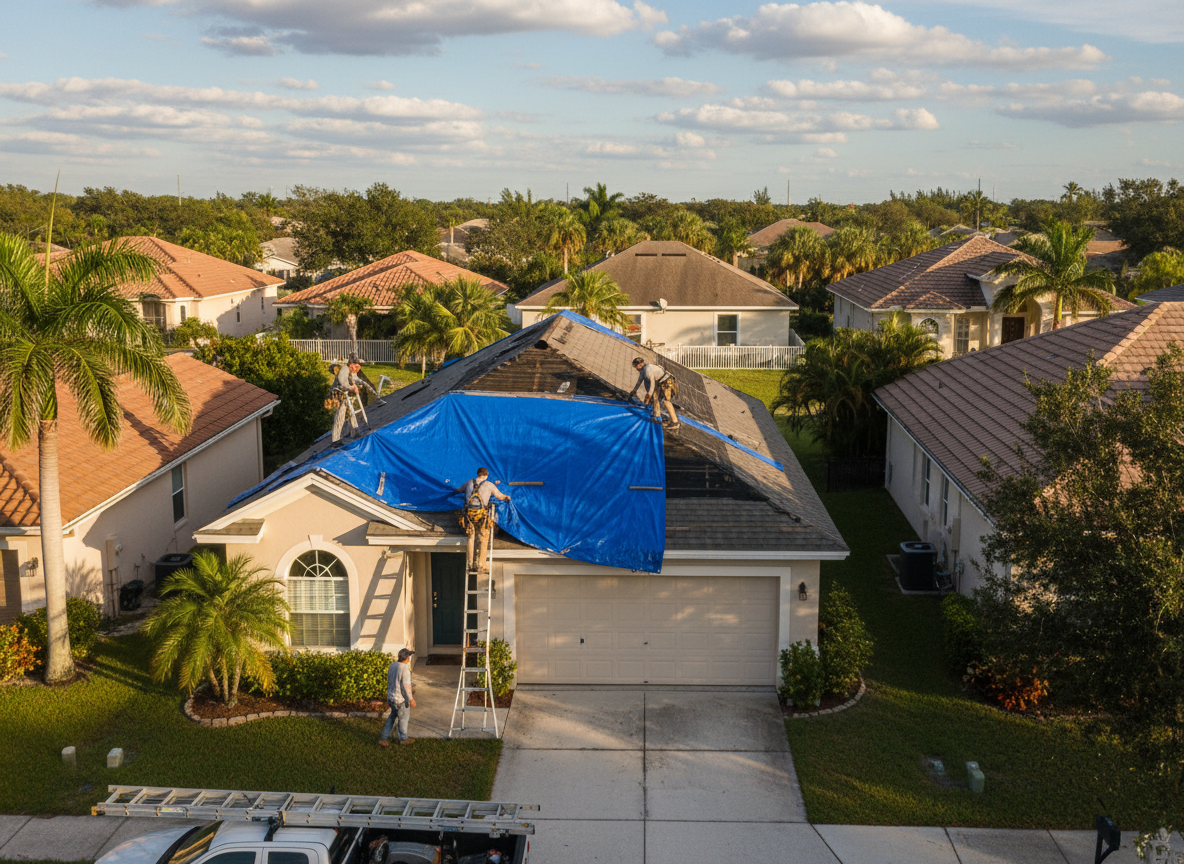
The full range applies. Leaks are roof leak repair, traced to the entry point. Where a storm has opened a roof, emergency roof tarping holds the weather out until a permanent repair can be arranged, and emergency roof repair closes the damage that can be finished in one visit. Where a storm is the cause, the survey widens to the whole roof and separates two things that are easy to confuse: wind damage, and the damage a falling limb did on its way down. On a roof with life left in the field, a failed detail is a repair; on one that has aged out across whole planes, it is not. Roof replacement is the answer when the covering has reached the end of its life across the roof or the deck is soft in several places. Roof installation covers new builds and the agricultural buildings that need a new covering. Shingle is the default across the housing; metal is used on barns, sheds and houses where longevity matters; tile appears on the later plans; and the low-slope sections and commercial roofs are membrane work, with coating for surfaces that are weathered rather than failed. Roof inspection is where each decision begins. The City of Ocala building department permits work inside the city; Marion County permits the unincorporated land that makes up most of the county. Applications sit under the Florida Building Code and carry the design wind speed for the site, the product approval for the covering and the fastening schedule that goes with it. Agricultural buildings are permitted on a different basis from a house, and the scope has to describe the structure accurately — an open-sided shed and an enclosed barn are not the same building, and the requirements follow the structure. The High-Velocity Hurricane Zone does not apply here, since it is limited to Broward and Miami-Dade counties. The inspection sequence is standard: deck and underlayment before the covering closes, final inspection at completion.
How a Job Runs
The survey reads the roof and the site: the covering, the perimeter, the penetrations, the junctions with additions, and the trees over the roof. On the older houses the attic and the deck are inspected as well, because a century of alterations leaves a lot to read. The written scope is specific about three things: the areas being opened, the treatment of the deck, and the way each junction will be rebuilt rather than resealed. Then the permit, the work and the inspection. Handover is a walk of the property, a set of photographs of the work before it was covered, and the inspection record.
Ten Miles Around Ocala
Within about ten miles: Anthony to the northeast, Sparr to the north, Silver Springs Shores to the southeast, and Belleview at the southern edge of the radius. Each address is checked against its jurisdiction before an application is prepared.
Calling About an Ocala Roof
The age of the house, the covering, and whether there are oaks over the roof are the three facts that shape the first visit. A photograph from the ground helps with the covering; it will not show what the trees have done to the valleys. Florida Roof Repair Pros, 4720 Millenia Blvd, Suite 175, Orlando, FL 32839, (407) 557-4529.
Debris, Valleys and the Oak Canopy
An oak over a roof changes the maintenance schedule more than it changes the roof. The covering is the same product, but what lands on it and how long it stays are different. The debris that matters is not the leaves a homeowner notices. It is the small material — twigs, acorn caps, the fine litter that breaks down — which collects in a valley and in the pan behind a chimney, compacts with rain and forms a mat. A mat holds water against the covering, blocks the valley, and in a short time turns a detail that was working into one that is not. The second thing oaks do is keep the roof in shade, so the surface stays damp and the underlayment ages in a different way from a roof in full sun. Algae grows, the deck stays moist at the eaves, and the fascia rots from the outside in. The third is limbs. A limb does not have to come through the roof to cause damage. A branch that scrapes across a slope in the wind will wear the granules off a shingle and can crack a tile without moving it, and the leak that follows appears with no visible hole. The practical response is routine rather than dramatic: clear the valleys and the gutters, check the roof after a windy event, and have it inspected every few years. On a property with several large oaks, that is the difference between a roof that lasts and one that is replaced early.
Metal Roofs on Houses Here
Metal is not the traditional covering in Ocala, but it is a common replacement choice, for reasons that make sense on this housing stock. The first is service life. A metal covering outlasts asphalt shingle by a wide margin, and on a house that has already been re-covered twice the calculation changes. The second is weight: metal is lighter than shingle for the same area, which matters on older frames and on houses where the deck has been patched. The third is the pitch: metal works on lower slopes than shingle, which suits the ranch houses and the additions that were built with a shallow roof. The considerations are equally practical. Metal is a different surface to walk and to work on, the fixings are exposed on a ribbed profile and concealed on a standing seam, and the detailing at valleys, walls and penetrations is different from shingle work. A metal roof installed with shingle habits will leak at the details. On a 1920s house, metal is also a question of appearance. A ribbed profile on a bungalow porch is sympathetic; a bright standing seam on a house that has always carried shingle is a change to the street. The material is worth considering on its merits, provided the supplier, the profile and the details are chosen for the building rather than for a catalogue.
Around Ocala
We regularly work near:
- 📍Silver Springs State Park
- 📍Downtown Ocala square
- 📍Fort King National Historic Landmark
- 📍Ocala National Forest
- 📍Tuscawilla Park
Roofing Company in Ocala — Local Notes
- •Inland Marion County, no coastal salt exposure
- •Live oaks drop debris onto roofs year round
- •Farm buildings are a separate category of work