Kissimmee is two towns sharing one boundary. There is the old county-seat town around the courthouse square and the lakefront, where the houses are small, the lots are deep and many roofs date from the 1920s to the 1940s. Then there is the corridor along US-192 and the subdivisions behind it, built from the 1980s onward, where the roofs are bigger, the pitches are steeper, and a large share of the properties are rented to visitors rather than lived in year round. Roof repair in Kissimmee is decided by which of those two you are standing in. A 1930s hip roof two blocks from Lake Tohopekaliga and a 2005 tile roof in a gated community fail for completely different reasons, and the paperwork that surrounds the work is different too.
Which Office Handles a Kissimmee Address
Kissimmee is the seat of Osceola County, and the city and the county run separate building departments. Property inside the city limits goes to the City of Kissimmee; property in unincorporated Osceola County — which includes large communities east and south of the city, and the planned community of Celebration — goes to the county. Poinciana is a special case because it straddles a county line, so the address decides rather than the subdivision name. This is not a technicality. A roof replacement is a permitted job in either jurisdiction, and the inspection sequence, the documents required at application and the record that survives the job all come from the office that issued it. When a house is sold or an insurer asks for proof of the roof, the closing document people want is the final inspection from the correct jurisdiction, not a receipt from a contractor. We confirm the address in the first conversation for that reason.
Two Roof Stocks, Two Sets of Problems
The older town is the more interesting roof stock. Houses built between about 1910 and 1945 in the blocks around downtown tend to be single-storey with a hip or gable roof at a modest pitch, a porch under its own small roof, and a metal roof over part of the rear that was added at some point in the last seventy years. Those roofs have usually been re-covered at least twice, and the deck under them has been patched by several different hands. Working on them is a matter of reading what previous jobs did, because the weak point is almost always a junction somebody improvised. The newer stock is more uniform and more deceptive. Subdivisions built from the late 1980s through the 2000s are asphalt shingle on engineered trusses, often with a steep front elevation and a lot of hip and valley geometry. The resort communities add concrete tile, and the tile roofs are the ones that surprise owners: the tile itself is durable and looks unchanged at twenty-five years, while the underlayment beneath it has been baking in the sun the whole time. When that underlayment finally fails, the leak arrives with no visible warning on the surface.
Flat Ground, High Water and Lake Tohopekaliga
Kissimmee sits low and close to water. Lake Tohopekaliga forms the northern edge of the city, Shingle Creek runs through the area, and the ground between the lakes is flat enough that heavy rain has nowhere to go quickly. During the wet season that shows up as standing water against foundations and in swales, and it shows up on roofs as sustained humidity rather than a single soaking. The practical effects are worth knowing. Wood fascia and soffit around the eaves stay damp for long stretches, which is where rot starts on older houses; the same damp air keeps algae growing on shaded shingle slopes; and any roof detail that relies on water draining off quickly is tested constantly. A roof in Kissimmee does not often fail because of one dramatic event. It fails because a small opening stays wet for months.
What Fails First on a Kissimmee Roof
On tile roofs, the underlayment goes first and the tile hides it. On shingle roofs, the failures cluster at the same details: the valley where two planes meet, the wall junction where a stucco or block wall rises above the roof, and the pipe boots around plumbing vents, which perish in the sun years before the shingles around them. Older downtown houses have their own list. Porch roofs meet the main roof at a low angle and are frequently flashed with nothing more than a bead of sealant; rear additions and converted garages have roof tie-ins that were never properly stepped into the main covering; and the metal sections that were added decades ago have fasteners that have backed out or washers that have hardened. Air-conditioning platforms cut into a roof are another common entry point, because the curb around them is small and the vibration works the sealant loose over time. Fascia rot belongs on the same list. It is not a roof leak in the usual sense, but on a house with deep eaves and constant humidity, soft fascia is often the first sign that water has been sitting where it should not.
The Rental Calendar Changes the Sequence
A large share of Kissimmee roofs sit on properties that are rented by the week. That changes the practical order of work even when the technical answer is the same. A leak in a rented house is usually found by a guest, reported to a manager, and only then reaches a roofer, which means the water has often been running for longer than the owner thinks. It also means the work has to fit between bookings, and that the record of what was done matters as much as the work itself. Photographs of the affected area before and after, a written scope that names the materials, and the inspection record from the jurisdiction are what a manager needs when an owner, an insurer or a booking platform asks what happened. None of that is unusual; it just has to be planned rather than assembled afterwards. For these properties the inspection is often the most useful service, because it can be done between guests and it produces a list that can be scheduled in order of urgency rather than all at once.
The Work We Do in Kissimmee
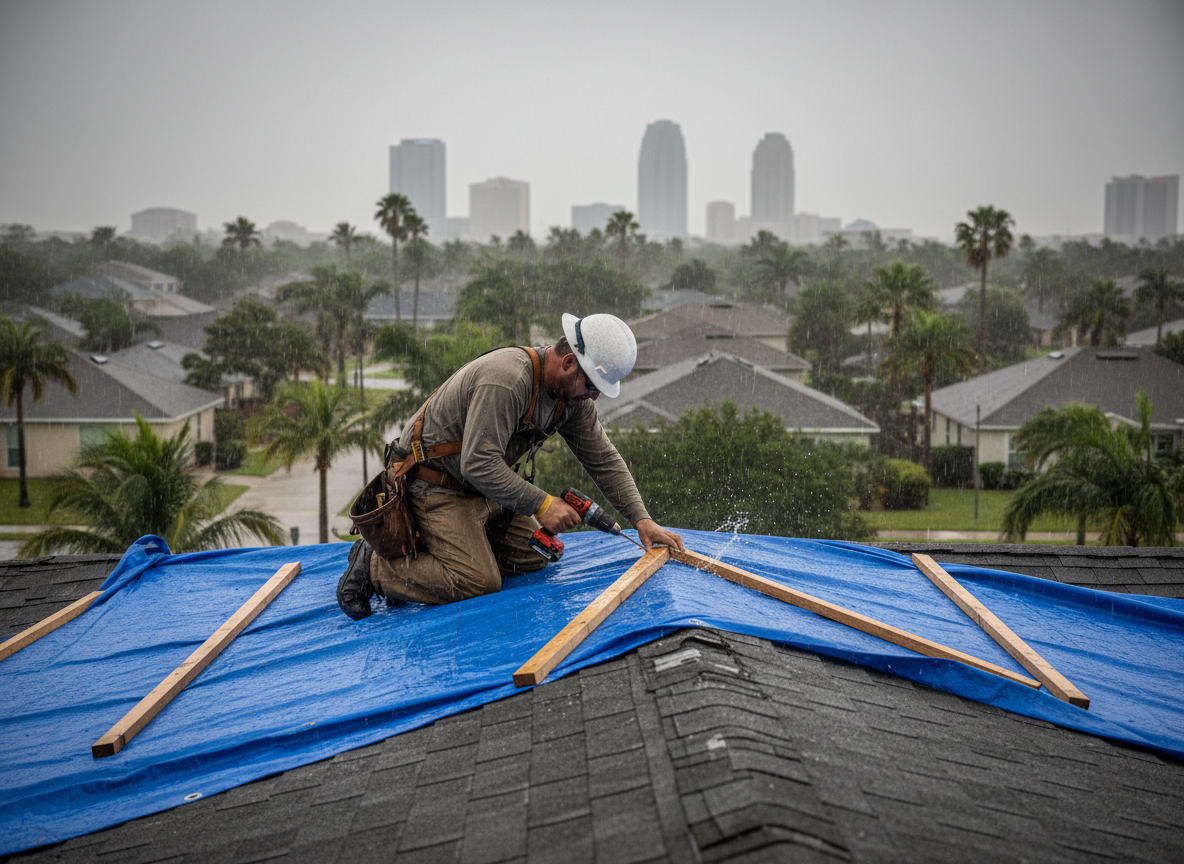
The full service list applies here, and the survey decides which part of it a property needs. Storm-driven rain is the usual trigger: a ceiling stain after an afternoon storm, water at a light fitting, a bulge in the paint above a window. That is roof leak repair, and it starts with tracing the entry point rather than treating the stain. Where the roof is open — lifted shingles after wind, a limb through the deck, tiles displaced on a steep elevation — emergency roof tarping closes it against the weather until a proper repair can be scheduled, and emergency roof repair handles the cases where the damage is contained enough to finish in one visit. Storm and hurricane damage repair covers the wider assessment: what the wind did across the whole roof, what predates the storm, and what has to be rebuilt. For coverings with life left in them, roof repair is the answer. Where the underlayment has failed under tile, or the deck is soft in several places under shingle, roof replacement is the honest one, and roof installation applies to new builds and to roofs that were never properly completed. The covering options are shingle roofing, tile roofing, metal roofing and flat roof repair for the low-slope sections, with roof coating for sound low-slope and metal surfaces that need renewing. Roof inspection ties it together, particularly on rental property where problems are found late.
How a Kissimmee Roof Job Runs
It starts with the survey: the roof walked where it is safe, the attic inspected where there is access, and photographs taken of every plane, junction and penetration. On tile, part of the survey is lifting a small number of tiles to see the underlayment directly, because the surface tells you almost nothing about what is underneath it. The written scope follows, listing what is being replaced, what is being repaired and what is being left alone, with the materials named. The permit application is built from that scope. Many Kissimmee communities also have an architectural review process, and where a covering has to match the rest of the street, that approval is worth starting early because it can take longer than the permit. Work then follows the jurisdiction's inspection sequence, with the deck and underlayment inspected before the covering closes on a replacement. Sign-off is the completed inspection plus a walk of the property: flashings checked, drains checked, and the site cleared of nails and offcuts.
Ten Miles Around Kissimmee
Within roughly ten miles of downtown: St. Cloud to the east, Celebration and the communities off Poinciana Boulevard to the south, Buenaventura Lakes and Campbell to the southeast, Intercession City to the south, and the Hunters Creek and Lake Buena Vista edges of Orange County to the west. Each has its own permit authority, and we check which one applies before scheduling.
Calling About a Kissimmee Roof
The address matters first, because it decides whether the city or the county issues the permit, and the covering matters second, because tile and shingle need different surveys. A photograph from the ground and a note of where water is appearing inside are enough to start. Florida Roof Repair Pros, 4720 Millenia Blvd, Suite 175, Orlando, FL 32839, (407) 557-4529.
Insurance, Roof Age and the Question That Gets Asked
Roof work in Kissimmee is often driven by a letter rather than a leak. Insurers writing policies on Florida houses increasingly want to know the age and condition of the roof, and on a house that has been covered twice the answer is not always obvious from a drive past. An inspection that records the covering type, the number of layers where it can be determined, the condition of the flashings and the state of the deck gives an owner something concrete to send back, and gives an insurer a defensible record. The useful part is the honesty of it. A roof with several years left should be described as exactly that, with the specific defects named, because a report that overstates the condition causes a different set of problems later. Where the covering is genuinely at the end of its life, the report says so and says why: underlayment that has failed under tile, shingles that have lost their granules across whole planes, fasteners that no longer hold, or a deck that flexes underfoot. Older downtown Kissimmee houses are the ones where this gets complicated. A 1930s roof may have a serviceable main field and one badly built addition, and the right answer is to repair the addition and leave the rest alone. A report that treats the whole roof as one unit forces a replacement that the house does not need. Splitting the roof into areas and reporting on each is more work at the survey stage and considerably less work at the decision stage. The same record is what a property manager keeps for a rental, and what a buyer asks for during a sale. It is not a marketing document; it is a description of what is on the roof and what state it is in.
Around Kissimmee
We regularly work near:
- 📍Lake Tohopekaliga lakefront
- 📍Kissimmee Lakefront Park
- 📍Shingle Creek
- 📍East Lake Tohopekaliga
- 📍Historic downtown Kissimmee
Roofing Company in Kissimmee — Local Notes
- •Osceola County seat, south of Orlando
- •City and county permit offices are separate
- •Tile roofs hide aged underlayment until it leaks