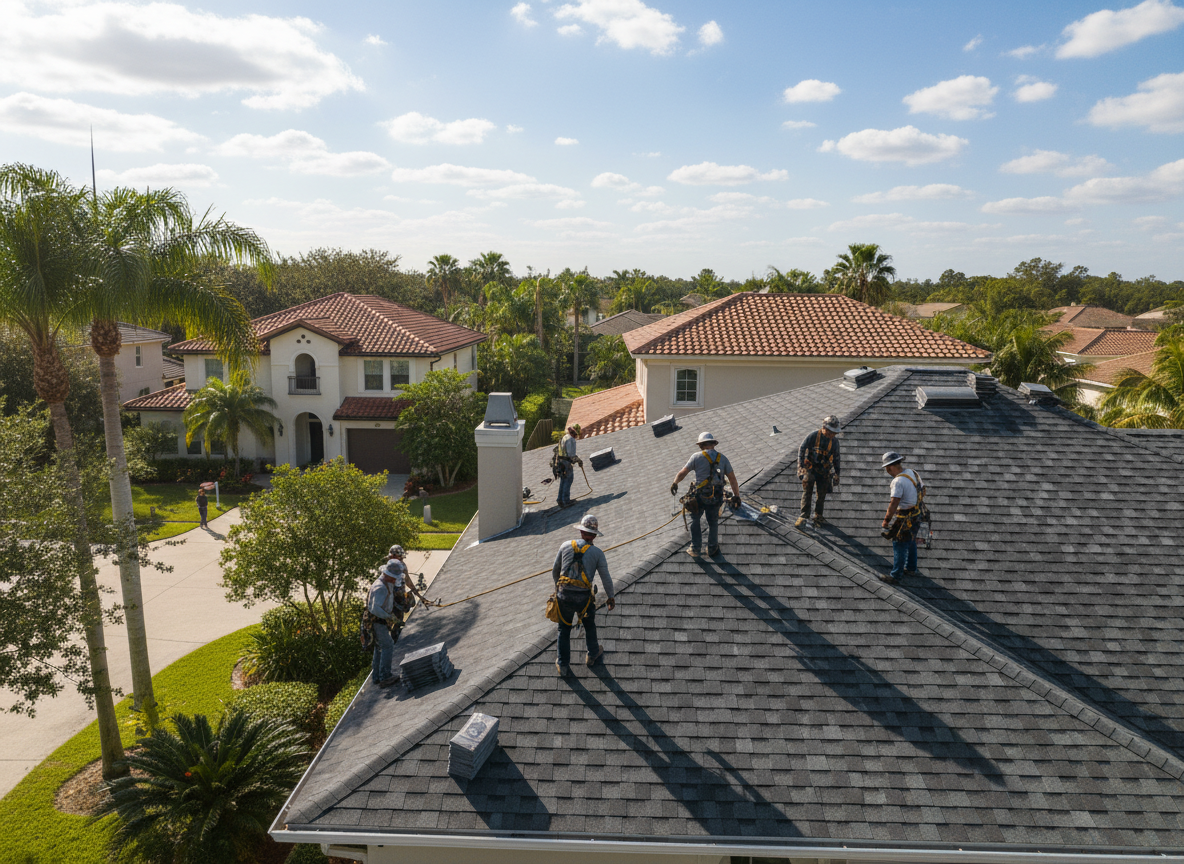
Melbourne grew in step with the space programme. Before the 1950s it was a small citrus and fishing town on the Indian River Lagoon, with a separate neighbour at Eau Gallie; from the late 1950s the missile and space work at the Cape brought engineers, contractors and families, and the housing went up quickly to meet them. The result is a city whose roof stock is dominated by houses built between about 1958 and 1975, laid out on a grid of straight streets west of the river, with a smaller and older core near downtown and a barrier island of beach houses to the east. Roof repair in Melbourne is mostly about those mid-century ranches, and about the salt that reaches every one of them.
The Housing the Boom Left Behind
The typical Melbourne house of that era is a single-storey ranch on a concrete slab, with a low-pitch hip or gable roof, a carport or a garage, and a screened porch at the back. Roof structures are simple and the spans are short, which is good news for repairs. The original coverings were asphalt shingle, and most have been replaced at least twice since. Because the houses went up quickly and to a limited number of plans, whole streets share the same roof geometry and the same failure points. That makes the work predictable, and it also means a street tends to replace its roofs in waves, so the neighbours are often the best source of information about what the roofs are doing. The older core near the river includes houses from the 1910s and 1920s, some with board decking and metal porch roofs, and a handful of buildings with tile. Those are worked on individually rather than by pattern.
Salt Spray and the Lagoon
Melbourne sits on the Indian River Lagoon, with the barrier island a short bridge away, and the salt is present in the air on both sides. The effect on roofs is measurable: fasteners corrode, flashings thin, metal valley sections lose their coating, and the steel in ridge vents and edge trim goes before the covering does. The lagoon also keeps the humidity high, which matters more than the salt on a shingle roof. Surfaces stay damp through the night, algae grows on the shaded slopes, and the wood in the fascia and soffit stays wet long enough for rot to start. On a house a few streets from the water, the combination of salt and constant humidity means the metal components are inspected as carefully as the covering. Houses on the island take more of it, and the wind that comes with it.
Barrier Island and Mainland
The two sides of Melbourne are different roofing environments. On the mainland, west of the lagoon, the housing is the boom-era ranch stock and the later subdivisions, with shingle roofs and a few tile, sheltered by other houses and by trees. On the island — Melbourne Beach and Indialantic — the houses are closer together and closer to the ocean, the wind has a clear run at them, and the salt is stronger. Roofs there are replaced more often, the metalwork is specified for corrosion resistance rather than cost, and the perimeter detailing matters more because there is nothing to break the wind before it reaches the roof edge. A roof that would last a long time in a sheltered street on the mainland will not last as long three streets back from the beach, and that difference is worth acknowledging when a covering is chosen.
Flat Roofs on Commercial Property
Brevard's commercial strip carries a lot of low-slope roofing: shopping centres, offices, small industrial units and the flat-roofed additions behind them. Those roofs are membrane or built-up, with equipment on top, and they age in a different way from a shingle roof. The failures are at the edges and the penetrations. A membrane that has shrunk slightly pulls away from a parapet, a curb around an air-conditioning unit cracks, a drain blocks with debris and water stands. Where the assembly below is dry, these are repairs; where water has been in the insulation for a season, the assembly has to be opened and rebuilt. Coating is a realistic option for a sound membrane whose surface has weathered, and it is often the sensible middle step between patching and replacement.
Hurricanes and the East Coast
The east coast takes a different storm history from the Gulf side. Hurricane Frances came ashore at Sewall's Point in September 2004 and crossed the state; Hurricane Jeanne followed three weeks later, making landfall near Fort Pierce. Hurricane Matthew stayed offshore in October 2016 but brought hurricane conditions and heavy erosion along this coast. Hurricane Irma crossed the peninsula in September 2017, Hurricane Ian crossed in September 2022 and exited near Cape Canaveral, and Hurricane Milton crossed in October 2024 on a similar line. For roofs, the pattern is consistent: the windward edges and ridges take the damage, the rain gets in behind lifted edges, and the interior damage appears afterwards. On the barrier island the wind is stronger and the rain is more driven, which is why the perimeter is where the inspection starts.
Where These Roofs Fail
Pipe boots first, because they perish in the sun within a decade and they are the most common small leak on a mid-century ranch. Then the valleys, where two planes deliver water to one line, and the wall junctions where a carport or a Florida room was added. On the older houses near the river, the porch roof tie-in and the metal fasteners are the weak points. On the island, the edge metal and the ridge are where corrosion and wind combine. And on every roof of this age, the underlayment is the layer that decides: on a low pitch it is doing most of the waterproofing, and it fails before the shingle above it looks worn.
The Work We Do in Melbourne
The full range applies. Leaks are roof leak repair, traced to the entry point. Where a storm has opened a roof, emergency roof tarping holds the weather out until a permanent repair can be arranged, and emergency roof repair closes the damage that can be finished in one visit. Storm assessment here is as much about the metal as the covering: the perimeter, the flashings and the fixings are checked because salt has usually reached them first. Where the covering has years left and one detail has failed, repair is the honest answer; where the perimeter has corroded through, it is not. Roof replacement is the answer when the covering has reached the end of its life across the roof or the deck is soft in several places. Roof installation covers new builds and additions on the island and the mainland. Shingle covers the boom-era ranches and most of the later housing, tile appears on the larger plans, metal is chosen where the salt makes longevity worth paying for, and the commercial and low-slope roofs are membrane work, with coating for surfaces that are sound but weathered. Roof inspection is where the decision starts, and on an island roof it is the only way to judge how much life the metalwork has left. Within the city, roofing permits come from the City of Melbourne building department; Brevard County issues them for unincorporated property, including much of the island. Work is filed under the Florida Building Code with the design wind speed for the address, the product approval for the covering, and fasteners specified for a coastal site. The High-Velocity Hurricane Zone does not apply here, since it is limited to Broward and Miami-Dade counties, but a coastal site is designed for a higher wind speed than an inland one, and the fasteners and edge metal on a beachfront roof should be specified for the salt as well as the wind. The inspection sequence is standard: deck and underlayment before the covering closes, final inspection at completion. On commercial work, the membrane and insulation are inspected before the assembly closes.
How a Job Runs, and Where We Cover
The survey covers the covering, the perimeter, the penetrations and the junctions, and on a coastal house it pays specific attention to the metalwork. The attic is inspected where there is access, and photographs are taken of every detail before anything is proposed. What is written down covers the areas being opened, the deck, the fastener specification for a coastal address, and the way each junction will be rebuilt. Then the permit, the work and the inspection. The close-out is a walk of the roof with the owner, the photographs taken before the covering went back on, and the inspection record. Within about ten miles: West Melbourne and Melbourne Village inland, Palm Bay to the south, Melbourne Beach and Indialantic on the island, and Satellite Beach and Indian Harbour Beach to the north at the edge of the radius.
Calling About a Melbourne Roof
The age of the house and which side of the lagoon it is on are the two things that shape the first visit. A photograph of the roof edge is more useful here than a photograph of the middle of the roof, because the edge is where the salt and the wind do their work. Florida Roof Repair Pros, 4720 Millenia Blvd, Suite 175, Orlando, FL 32839, (407) 557-4529.
Why the Metal Ages Before the Shingle
On a Melbourne roof, the metalwork often reaches the end of its life before the covering it belongs to. The shingle may have years left while the drip edge, the valley metal and the vent flashings have already corroded. The reason is thickness. A shingle is a compounded product with a mat and granules, and it is designed to sit in the sun for decades. A piece of galvanised steel at an edge is thin, and once its coating is breached the base metal goes quickly in salt air. The components are also the parts that get cut on site, and a cut edge has no coating at all. The practical consequences are worth knowing. A roofing job that replaces the covering but reuses the original edge metal is a job that will need attention at the perimeter earlier than it should. A leak that appears at the eave, at a valley or at a vent is often a metal failure rather than a covering failure, and replacing the shingle around it does not solve it. On the barrier island the effect is stronger, and it is the main reason island roofs are assessed differently from mainland roofs even when they carry the same covering. The specification for the fasteners and the edge trim is where a coastal roof earns its life. The inspection looks at the metal deliberately: the drip edge along the rakes and eaves, the valley lining where it is visible, the flashings at walls and vents, and the fixings. It is a short list, and it is where a coastal roof usually fails.
Around Melbourne
We regularly work near:
- 📍Indian River Lagoon
- 📍Melbourne Causeway
- 📍Front Street Park
- 📍Eau Gallie Arts District
- 📍Wickham Park
Roofing Company in Melbourne — Local Notes
- •Housing dates mostly from the late 1950s to the 1970s
- •Salt spray attacks fasteners and edge metal
- •Island roofs face stronger wind than mainland roofs