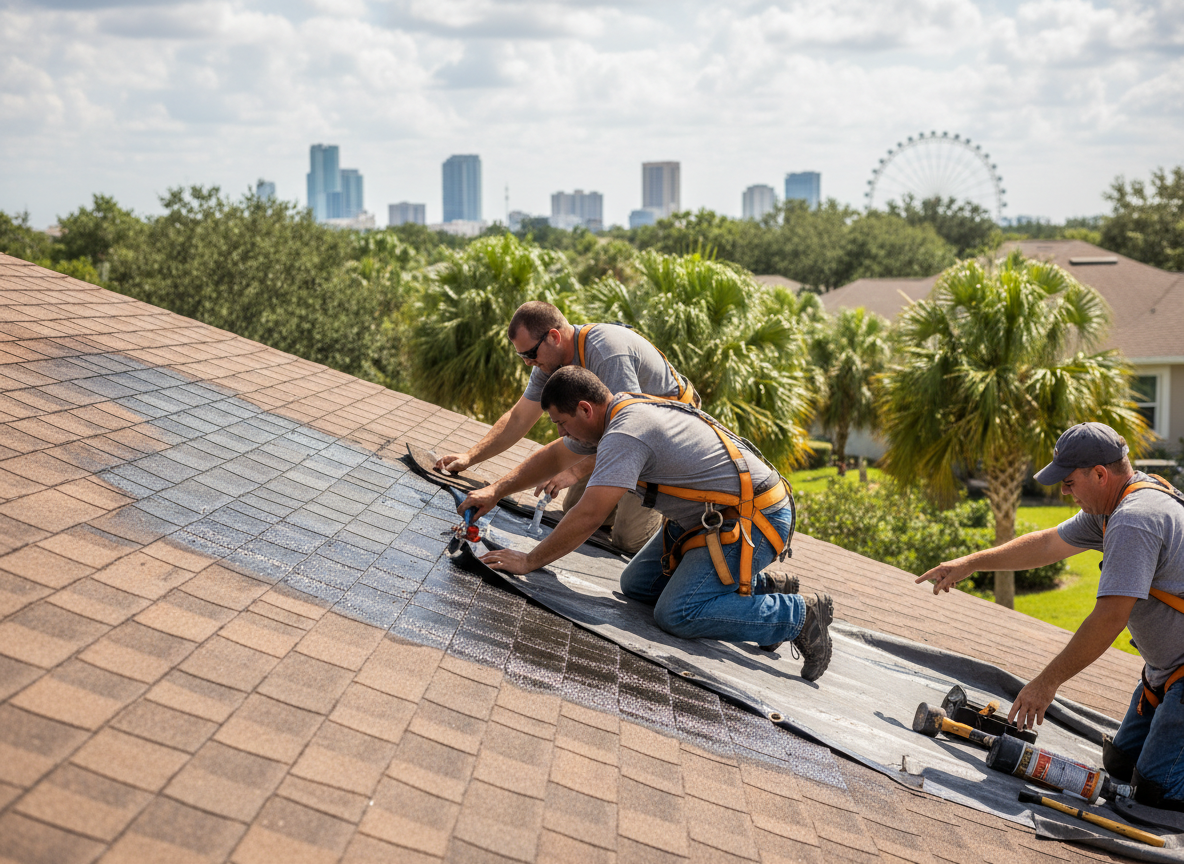
Leesburg sits in the middle of the Harris Chain of Lakes, in Lake County, and water has shaped the town since it was laid out in the 1850s. The downtown grid runs back from the lakefront, the old houses are on the streets behind it, and the modern city spreads east and south into subdivisions and retirement communities. Roof repair in Leesburg is a mix of those worlds: 1920s houses with steep roofs and porches, 1960s and 1970s ranch houses, and newer tile roofs in planned communities where the covering has to be approved before it is ordered.
The Downtown Grid and the 1920s Houses
The oldest part of Leesburg has a housing stock that dates from the 1900s to the 1930s: two-storey houses with steep roofs and dormers, bungalows with deep porches, and a handful of buildings with tile or metal. Those roofs are steep enough to shed water well, which is an advantage in a wet climate, but they have more geometry than a modern roof — valleys, dormers, chimneys and porch tie-ins. They are also old enough that the deck, the flashing and the framing have all been altered. Working on one of these houses is a matter of reading what previous jobs did, because the weak point is usually a junction somebody improvised rather than a failure in the field of the roof. Access is another factor. The downtown streets are narrow, the lots are deep, and the trees are mature, so staging has to be planned before the first morning.
Ranch Houses and the Post-War Decades
Between the 1950s and the 1980s Leesburg grew steadily, and most of that housing is the Florida ranch: single-storey, block-built, low-pitch hip or gable, with a carport or garage and a screened porch at the back. Those roofs are simple and they are now on their second or third covering. The failures are predictable. Pipe boots perish in the sun. Valleys collect debris from the oaks and pines. Carports that were enclosed later have junctions that were sealed rather than flashed. And on a low pitch the underlayment is doing the waterproofing, so it fails before the shingle above it looks worn. The good news is that these roofs are straightforward to repair and to replace, and the geometry is simple enough that the scope can be precise.
Retirement Communities and Newer Subdivisions
The growth of the last thirty years has added subdivisions and a number of communities built for retirees, with clubhouses, pools and concrete tile. The largest of them sit to the south and east of the city, and their roof stock is younger, heavier and more uniform than anything in the old grid. On those roofs the tile outlives the underlayment, and the failure is invisible until water appears inside. The survey means lifting tile, checking the valleys where it is cut, and inspecting the junctions at walls and at the roof-to-lanai transitions that are standard on Florida plans. Where a community has architectural standards, the covering has to be approved before it is ordered. That process runs alongside the building permit, and it can take longer.
The Lakes and the Air
The Harris Chain keeps the air moist, and the moisture is what ages a roof here. Surfaces stay damp through the night, algae grows on the shaded slopes, and the wood in the fascia and soffit stays wet long enough for rot to start. Lakefront houses also take more wind and more debris. A roof that faces open water has nothing to break the wind before it reaches the edge, and the trees along the shoreline drop material onto a low-pitch roof where it stays. The gutters fill faster than on an inland street, and when they overflow the water goes down the fascia. The visible sign is the black streaking on north-facing planes. It is cosmetic, but it is evidence that the roof is staying wet, which is the condition that shortens the life of the covering and the woodwork.
Storms, Lightning and Inland Heat
Leesburg's summer is the Central Florida pattern: heat that builds through the morning, storms that break in the afternoon, heavy rain in a short window, frequent lightning and brief strong wind. Lake County is far enough inland that the sea breeze does not moderate the temperature, so attics run hot and the sun-facing slopes age fastest. Hurricane Charley crossed Central Florida in August 2004 on its way from the southwest coast to the Atlantic, and the 2004 season brought three more storms across the peninsula within six weeks. Hurricane Irma crossed inland in September 2017 and its wind field covered the county, and Hurricane Milton crossed in October 2024. The damage here is usually at edges and ridges, and on a county with a lot of water and trees it is often accompanied by limb damage. Separating the two is part of the survey.
What Fails on Leesburg Roofs
On the older downtown houses: valleys, dormer cheeks, chimneys and porch tie-ins. On the ranch houses: pipe boots, valleys and the junctions at enclosed carports and porches. On the newer tile roofs: the underlayment, which fails out of sight. On lakefront houses: the edges, where the wind arrives first. Across all of them, the same maintenance matters: clear the valleys and the gutters, check the boots, and look at the metal at the edges. Those three things prevent more leaks than any other work on a Florida roof.
The Work We Do in Leesburg
The full range applies. Leaks are roof leak repair, traced to the entry point. Where a storm has opened a roof, emergency roof tarping holds the weather out until a permanent repair can be arranged, and emergency roof repair closes the damage that can be finished in one visit. Storm work widens the question from the damaged area to the whole roof, because wind rarely damages only what is visible and the interior staining usually appears days later. A localised failure above a covering with life left in it is repair work; a covering that has failed across several planes is not. Roof replacement is the answer when the covering has reached the end of its life across the roof or the deck is soft in several places. Roof installation covers new builds and additions. The mix here is shingle on the post-war ranches and most subdivisions, concrete tile in the retirement communities, metal on the older downtown houses that already carry it, and membrane repair for the low-slope sections, with coating where the surface has aged but the assembly has not. Roof inspection is where each decision begins. Inside the city, roofing permits are issued by the City of Leesburg building department; outside it, Lake County takes the application. Everything is filed under the Florida Building Code, with the site's design wind speed, the covering's product approval and its fastening schedule attached. The High-Velocity Hurricane Zone does not apply in Lake County, since it is limited to Broward and Miami-Dade counties. The inspection sequence is standard: deck and underlayment before the covering closes on a replacement, final inspection at completion. On the older downtown houses, the permit conversation often turns on what is being done with the deck and how the junctions will be rebuilt, because those are the parts of the job that decide whether it lasts.
How a Job Runs From the Downtown Grid Outward
Access decides the order of the day on the old streets. A narrow lot with a mature oak over the ridge, a driveway that holds one truck and a neighbour's wall close to the eave all shape how material is delivered and where it is set down, so that is planned at the survey instead of being discovered later. The survey itself reads the roof in sections: the covering, the perimeter, the penetrations, and every junction with a dormer, a chimney, a porch or a later addition. The attic is inspected where there is access, and on a property that fronts the chain the exposure at the edge is assessed in the same visit. The scope is written rather than spoken, section by section, naming what happens to the sheathing and how each junction is rebuilt. Then the permit, the work and the inspection, followed by a walk of the roof with the owner and the record of what was found underneath before it closed.
Boathouses, Docks and the Roofs at the Waterline
The Harris Chain gives Leesburg a class of roof that inland towns do not have. Boathouses, covered docks and the small buildings at the end of a seawall are roofed in metal, shingle or a flat membrane, they sit low over the water, and they take weather from an angle a house never sees. A boathouse roof is wet from below as well as above: spray, splash and constant humidity keep the underside damp, fasteners corrode from the tip inward, and the deck under a low-slope covering stays soft. Wind arriving across open water reaches these structures without obstruction, so the edge fixings and the connection to the frame matter more than the appearance of the covering. Repair work here is often about the frame and the fastenings rather than the sheet or the shingle, and it is worth inspecting a boathouse roof at the same time as the house, because the two fail on different schedules and a leak in one is easily blamed on the other. Boathouses on the open water of Lake Griffin meet a longer wind run than the sheltered coves off Lake Harris, and the difference shows in which edges work loose first. A roof over a dock is also worked from below or from a barge rather than from ladders, which changes how much of it can be examined on a first visit and what a repair has to be planned around.
Out Past the City Limits
A ten-mile radius from downtown takes in Fruitland Park to the north, Okahumpka and Yalaha to the south, Eustis to the east and Tavares to the southeast, with Lady Lake at the northern edge. Some of those addresses sit inside a city and some do not, and the difference decides where the paperwork goes.
Before You Ring About a Leesburg Roof
Two answers save time at the start: whether the property fronts the water, and what decade the house was built. Everything else — the covering, the junctions, the deck — follows from those. Florida Roof Repair Pros, 4720 Millenia Blvd, Suite 175, Orlando, FL 32839, (407) 557-4529.
Around Leesburg
We regularly work near:
- 📍Lake Harris
- 📍Venetian Gardens
- 📍Downtown Leesburg
- 📍Lake Griffin
- 📍Leesburg Library
Roofing Company in Leesburg — Local Notes
- •Harris Chain of Lakes, Lake County
- •1920s downtown grid plus post-war ranch housing
- •Lakefront roofs take wind and debris first