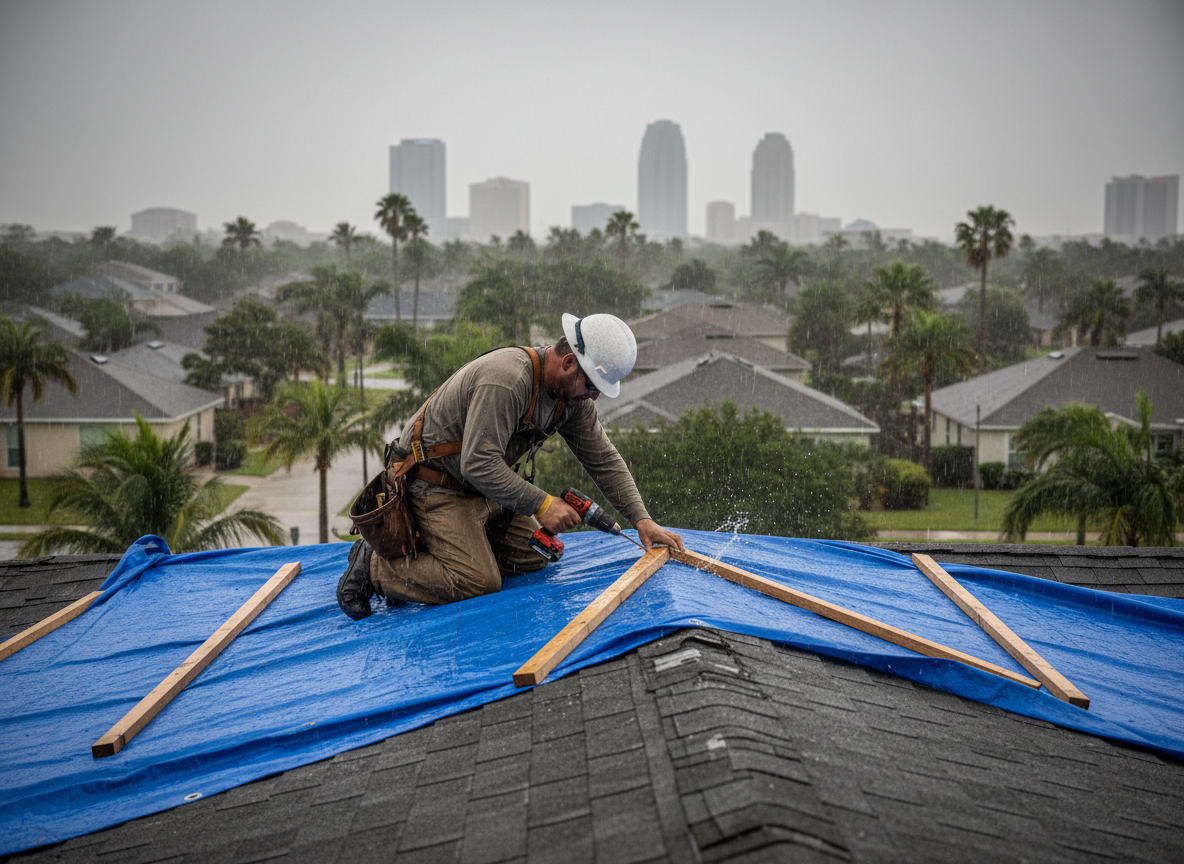
Oviedo was a celery and citrus town until the 1990s, when the subdivisions arrived and it became something else. The old settlement is still visible around the historic centre and along the rural roads to the north and east, but most of the housing that exists now was built in the two decades around the turn of the century. That timing matters for roofs, because it means the city's roof stock is unusually uniform in age: a very large number of houses are on their second covering, or are living on borrowed time with their first. Roof repair in Oviedo is therefore mostly a conversation about a twenty-year-old shingle roof on a steep, complicated frame, and about what happens next.
The 2004 Season and the Cycle It Started
The four hurricanes of 2004 did not all cross Oviedo, but the season left a mark that is still visible on the roofs. Hurricane Charley came ashore on the southwest coast in August and crossed Central Florida on a track that took it through Polk, Osceola, Orange and Seminole counties toward Daytona Beach, and Seminole County recorded widespread damage. In Oviedo, as across east Seminole, that meant a wave of insurance claims and replacements in the years that followed.
That wave is why so many local roofs share an age. Coverings installed in 2005 and 2006 are now at the point where the shingle has weathered, the granule loss is visible on the sun-facing planes, and the underlayment is approaching the end of its service. It is a useful thing to know when a roof starts leaking: the roof may be failing because of its age and the storm that preceded it, not because of anything that happened last month.
Hurricane Irma in 2017 added a second, smaller wave of damage across the same housing stock, mostly at edges and ridges rather than across whole roofs.
The Shape of a 1990s Subdivision Roof
The typical house here is a two-storey or a large single-storey with a steep roof: a front gable that faces the street, a hip over the garage, at least one valley where the wings meet, and dormers or a bay that push out through the slope. The look was popular and it produces a roof with a lot of linear feet of edge and ridge for its floor area.
Every one of those edges is a place where wind and water work. The valleys collect whatever falls on the roof, the ridges are where the capping takes the wind, and the wall junctions where a two-storey section rises above a single-storey roof are the classic leak point. On these plans, the wall junction is often a short vertical surface above a lower roof, which means water runs down the wall and sits against the flashing until it finds a way in.
Steep pitch is also an access issue. A 9:12 or 10:12 roof is not walkable in the way a 4:12 roof is, and working on it safely requires staging rather than a ladder and confidence. That affects how long a job takes and how the survey is done, and it is worth knowing before comparing one scope with another.
The Rural Edges
North and east of the subdivisions, Oviedo runs into Black Hammock, Lake Jesup and the Econlockhatchee, and the roofs out there are a different proposition. Houses on large lots, mobile and manufactured homes, barns and workshops, and a scattering of older rural houses that have been added to over decades.
Those roofs need a survey rather than an assumption. A manufactured home has a different roof structure and different covering options from a site-built house; a workshop or barn may have exposed fastener metal that needs re-fixing rather than replacement; and an older rural house often has additions on three sides, each with its own roof and its own junction. Lake Jesup brings its own humidity, and the tree cover around the river bottom keeps roofs damp.
What Fails on These Roofs
The failures track the age of the stock. Granule loss and shingle brittleness on the south and west planes, where the sun does the most work. Lifted or missing tabs at the ridges and rakes after a storm. Failed pipe boots, which are the single most common small leak on a roof of this age. Valley debris dams where oak or pine drops onto a roof that sits under trees. And the wall junctions described above, which leak slowly and show up as a damp patch on a ceiling far from the roof.
Attic ventilation is worth checking at the same time. Roofs built in the 1990s were vented to the standard of the day, and where the soffit intake has been blocked by later insulation the ridge vent does very little. That is one reason a roof can fail early on one plane and not another.
The Work We Do in Oviedo
The full service list applies. A leak after a storm is roof leak repair, traced from the entry point. Where wind has opened a roof, emergency roof tarping keeps the water out until a permanent repair can be scheduled, and emergency roof repair finishes the damage that can be closed in one visit. Storm and hurricane damage repair is the wider assessment across the roof, separating new damage from the wear that was already there.
Roof repair is the right answer where the failure is local and the covering has life left. Roof replacement is the answer on a roof of this age once the underlayment has gone or the shingles have lost their seal across whole planes, and it is a decision worth making on evidence rather than on the first leak. Roof installation covers new builds and additions. The coverings are shingle roofing for the majority of houses, tile roofing on the later and larger homes, metal roofing where owners are replacing for a longer service life, and flat roof repair for the low-slope sections over lanais and porches. Roof coating renews sound metal and membrane surfaces. Roof inspection is where it starts, and on a 2005 roof it is the only way to answer the question honestly.
Permits and Inspections
The City of Oviedo issues roofing permits for property inside the city; Seminole County handles unincorporated addresses, which includes much of the rural area to the north and east. The work is permitted under the Florida Building Code, with the wind provisions for the site and the product approval and fastening schedule for the covering specified.
Two things come up repeatedly on this housing stock. The first is that a replacement on a steep, complex roof generates a scope with a lot of line items, and the application is built from that scope, so it is worth being precise. The second is that many of these houses have been re-covered once already, which raises the question of what is underneath; the code and the deck condition decide whether the existing layers can stay.
The inspection sequence is standard: deck and underlayment inspected before the covering closes, final inspection at completion. The record from that inspection is the document that matters later.
How a Job Runs
The survey begins with access. On a steep roof that means staging, and on a house with a valley and two wall junctions it means photographing each of them before anything is proposed. The attic is inspected where there is access, because the underside tells you things the surface does not.
The written scope names materials, states what happens to the deck, and describes how each junction is rebuilt. Then the permit, then the work, then the inspection. Sign-off is a walk of the property with the owner, with the photographs and the inspection record handed over at the end.
Ten Miles Around Oviedo
Within about ten miles: Winter Springs to the west, Casselberry to the southwest, Chuluota and the rural roads to the east, Geneva to the northeast, Sanford to the north, and the Alafaya corridor of Orange County to the south. Each address is checked against its jurisdiction before a permit is prepared.
Calling About an Oviedo Roof
The age of the roof is the most useful thing to know, because most of the housing here was built in a narrow window. A photograph from the ground shows the covering; it does not show the wall junctions or the valleys, which is where these roofs usually fail. Florida Roof Repair Pros, 4720 Millenia Blvd, Suite 175, Orlando, FL 32839, (407) 557-4529.
Valleys, Wall Junctions and Steep Roofs
The two details that cause most leaks on Oviedo's steep roofs are the valley and the wall junction, and they fail for opposite reasons.
A valley is where two planes deliver their water to one line. The flow is double what any other part of the roof carries, so the lining has to be wide enough, lapped in the right direction and continuous. On a roof built quickly in the 1990s or 2000s the valley lining is often a single length of underlayment, which is fine until it is not: once it has aged, the water finds the lap and runs under the shingles on both sides. From the ground the valley looks normal, because the failure is below the surface.
A wall junction is where a vertical surface meets the slope — a dormer cheek, a two-storey wall above a lower roof, a chimney. Water runs down the wall, and the flashing has to direct it out onto the roof and over the shingle below. Where the flashing is short, or where the step is too large, water gets behind it and into the wall. The stain inside then appears on a ceiling well away from the junction, which is why these leaks take longer to find than valley leaks.
Both details behave differently on a steep roof. Water moves faster, which helps, but wind-driven rain hits the junction at a sharper angle and pushes water uphill against the flashing. That is why a junction that is fine in a straight fall of rain can leak in a storm from a particular direction.
The repair for both is the same in principle: open the detail, rebuild it with the correct material and the correct lap, and close the covering over it. Sealing over the top is a temporary measure that will fail again, usually at the next storm with the right wind direction.
Around Oviedo
We regularly work near:
- 📍Lake Jesup
- 📍Little Big Econ State Forest
- 📍Econlockhatchee River
- 📍Oviedo on the Park
- 📍Black Hammock
Roofing Company in Oviedo — Local Notes
- •East Seminole County, formerly a celery-farming town
- •Much of the housing dates from the 1990s and 2000s
- •The 2004 season drove a replacement cycle across the city