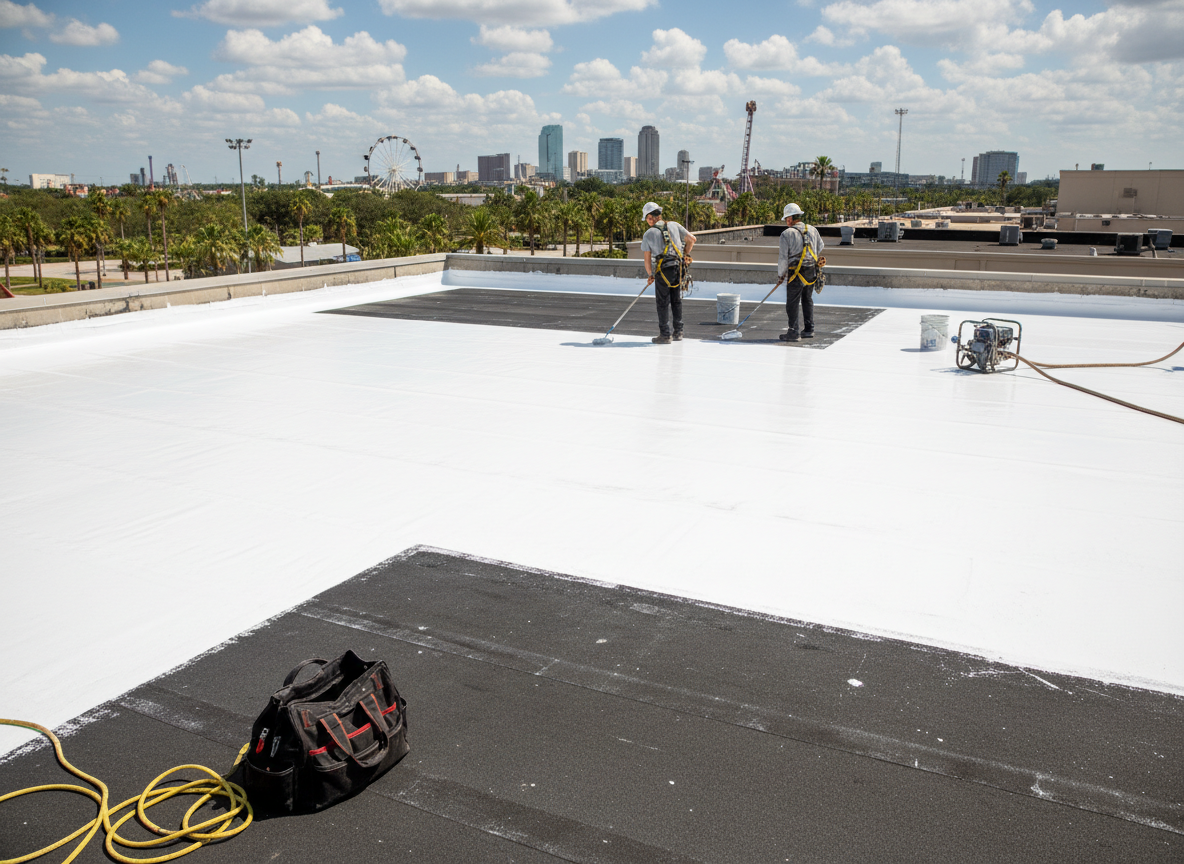
West Palm Beach has been rebuilt more than once, and its roofs are the record of it. The city grew up beside the railroad in the 1890s, burned, rebuilt, and was struck again in 1928 by the hurricane that came ashore near here and killed thousands around Lake Okeechobee. Each rebuild left a layer. The 1920s boom produced Mediterranean Revival houses under barrel tile in El Cid, Flamingo Park, Grandview Heights and the Northwest Historic District, and masonry commercial buildings under flat roofs along the old downtown. Later decades added mid-century flat-roofed apartments, waterfront towers and infill. Roof repair in West Palm Beach, FL means working out which layer of that history you are standing on.
It is a Palm Beach County city, which means the High-Velocity Hurricane Zone that covers Broward and Miami-Dade stops short of it. The code's wind provisions still govern, and the lagoon, the ocean across the bridge and the summer storms do the rest. Florida Roof Repair Pros works this city out of Orlando, and the line is (407) 557-4529.
What Survived the Rebuilds
The oldest surviving houses are masonry with clay tile and shallow pitches, built to a standard that predates modern wind engineering and has nevertheless proved durable in its own way. Their roofs have been replaced at least once, often twice, and the tile still on some of them is original. On a house of that age the constraint is rarely the tile field. It is the deck beneath it and whether the last replacement was detailed the way the original was, with the flashings set into the masonry rather than laid against it.
The commercial core is a different archive. Along Clematis and the streets around it, 1920s masonry buildings carry flat roofs behind parapets, some of them still on a built-up surface that has been coated and patched for decades. The 1960s and 1970s blocks nearby carry membrane or coated built-up roofs. The waterfront towers carry tapered insulation, single-ply membrane and a great deal of equipment on the deck. All four sit within a few blocks of each other, and each fails in a way the others do not.
The Historic Core and Its Tile
The historic districts are where barrel tile dominates, and it is the covering most often misread. Tile is a rain screen and a sun shield, not the waterproof layer itself; the barrier sits in the membrane beneath it. On a roof that has already been re-covered more than once, that membrane is the part with a limited life, while the tile above may still have decades of service in it.
The result is that tile work on these streets is usually a section rather than a whole roof. Tile is lifted over the affected run, the underlayment is read, the failed portion is replaced, and the original tile goes back down. That keeps material which cannot be sourced again and preserves the look of a street that depends on it. The judgement rests on the membrane, not on how the surface reads from the road.
Downtown Flat Roofs
A flat roof on a 1920s commercial building is a stack of decisions made by previous owners. The original built-up surface, a coating applied in the 1980s, a patch over a seam in the 1990s, another coating after that. By the time a leak appears in a ground-floor ceiling the assembly may be four layers deep and the original deck may not have been seen in decades. Opening it is the only way to know what is actually there.
The failure order on these roofs is consistent: parapet flashing, then scupper or drain, then a seam at the low point, then a penetration. On a building where the roof is also the ceiling of the top floor, water travels before it shows, and by the time a tenant complains it has usually been moving for a while. Coating has a place on a sound surface that has aged, and it is the wrong answer when the membrane has split or the deck has softened underneath.
Salt From the Lagoon
Salt comes off the lagoon on the afternoon breeze and settles east of the bridge. It is not the tile or the shingle that suffers; it is every piece of metal holding the roof together and closing it at the edges. Fastenings, valley and hip flashings, drip edge, vent collars, scupper liners, the coping on a parapet: those are what a lagoon-side roof loses first, and they are what a specification has to account for.
Inland, toward the western edges of the city, the same roof ages on a different curve. Less salt, more heat, and shingle that lives or dies on ventilation. A blocked soffit intake is common on houses that have been re-landscaped or re-insulated, and the result is an attic that bakes through the afternoon and a shingle mat that fails on the west and south planes years before the rest of the field.
Reading the Wet Spots
Water reaches a tile roof through the membrane in a valley, at a hip, or where the covering meets a wall. It reaches a flat roof at the parapet, the scupper or a seam. It reaches a shingle roof at a boot, a ridge cap, or the point where a pitched plane runs into a flat porch roof. The routes are few; finding which one is active is the work.
Two rules hold everywhere. Water travels before it appears, so the stain inside is rarely below the entry point. And on a roof that has been rebuilt or re-covered, the first question is what is underneath, because a repair applied to the top layer of a four-layer assembly is a repair to the wrong thing.
The Storms This City Remembers
Four dates explain most of the roof stock. 1926 ended the boom and left the masonry buildings that survived it. 1928 came ashore near here and reset the region. 2004 brought Frances and Jeanne to Hutchinson Island, close enough to lash this coast. 2005 brought Wilma across from the Gulf, and a roof installed in its aftermath is now around twenty years old.
Because the county sits outside the hurricane zone, the specification here follows the Florida Building Code's wind provisions without the zone's extra chapter. That changes which products are available and how the underlayment is described, but not whether wind matters. On a historic house or a downtown parapet, the edge is where the specification earns its keep.
Three Files, One Roof
Every job here leaves three records behind, and the useful ones are the permit file, the historic file where a district applies, and the maintenance file that nobody keeps. The permit file says what is legally on the roof and when it went on. The historic file says what was approved to be visible from the street. The maintenance file — the stack of patches, coatings and invoices — is the one that explains why the roof behaves as it does, and it is almost always missing. Reconstructing it is part of the survey.
The work itself is ordinary once that is done. Water at a ceiling gets traced to its entry. A membrane that has split gets repaired; one that has aged out across the field gets replaced. A tile field whose membrane has expired gets lifted and relayed. A pan whose fastenings are gone gets re-fixed or replaced, depending on how much of the metal is still sound.
What changes with the building is the emphasis. On a 1926 masonry block the parapet and the wall flashing carry the risk. On a 1970s membrane roof it is the drainage and the seams. On a historic house it is the membrane under the tile and the appearance the district expects. On the western shingle streets it is the attic and the number of layers.
Reading a Roof That Has Been Rebuilt
A survey on a building of this age starts with the layers. On a flat commercial roof a section is opened at the parapet and at a drain so the stack can be counted and the deck felt underneath. On a tile house the field is lifted far enough to read the underlayment and the battens. On a shingle street the attic is entered, because the deck and the ventilation tell you more than the surface does.
Photographs accompany every one of those openings, and the tile profile, the covering colour and the existing finish are recorded where a historic district applies. That record does two jobs: it supports the scope, and it answers the appearance question a district will ask before it approves anything.
The scope is then written in plain terms: what comes off, what goes back, which underlayment and fastening are specified, what is assumed about the deck, and what is excluded. Where the deck turns out worse than the survey suggested, the scope says how that is handled rather than leaving it to the day.
Permits, and the Second Signature
The City of West Palm Beach issues the building permit for addresses inside the city; Palm Beach County handles unincorporated land, and the other municipalities issue their own. Where a property sits in a historic district, a second approval covers appearance rather than structure, and it can reach the tile profile and the colour. Neither approval substitutes for the other, and both are settled before material is ordered.
The technical questions under the permit are the code's wind provisions, since this county sits north of the hurricane zone: the design wind speed at the site, the approval for the covering, the fastening schedule, and the underlayment specification. On a flat roof the perimeter fixing is the detail examined hardest, and on a parapet it is the coping and the flashing behind it.
What Surrounds the City
Palm Beach is across the bridge. Riviera Beach and Mangonia Park are north, Haverhill, Cloud Lake and Glen Ridge west, Lake Clarke Shores and Lake Worth Beach south, with Royal Palm Beach, Wellington and Greenacres inside the same short drive. Each has its own permit desk and its own roof stock, and none of them is a copy of this one.
The 1928 hurricane shaped this city's building stock as much as any boom did. It came ashore south of here and drove water across the lake country to the west, and the rebuilding that followed, then the wartime expansion and the postwar subdivisions, produced a city with three distinct roof ages standing within a few miles of each other. On the historic streets the tile and the parapets are original fabric; along the Flagler corridor the mid-century commercial roofs are flat and patched; west of the turnpike the shingle subdivisions date from the 1980s onward. A single survey template cannot read all three, and it is not asked to.
Before the First Visit
Bring the address, since it decides the permit desk, and say which side of the bridge the property is on, because that usually predicts the roof. On a commercial building, the number of roofs applied over the original matters more than the building's age. On a historic house, a photograph of the street elevation is useful. The last permit date is worth finding in a closing folder. Florida Roof Repair Pros can be reached at 4720 Millenia Blvd, Suite 175, Orlando, FL 32839, or on (407) 557-4529 for West Palm Beach.
Around West Palm Beach
We regularly work near:
- 📍Clematis Street
- 📍The Norton Museum of Art
- 📍Palm Beach Atlantic University
- 📍Lake Worth Lagoon
- 📍Kravis Center
Roofing Company in West Palm Beach — Local Notes
- •City of West Palm Beach permits its own addresses
- •Palm Beach County is outside the High-Velocity Hurricane Zone
- •Salt load from the Lake Worth Lagoon east of the bridge