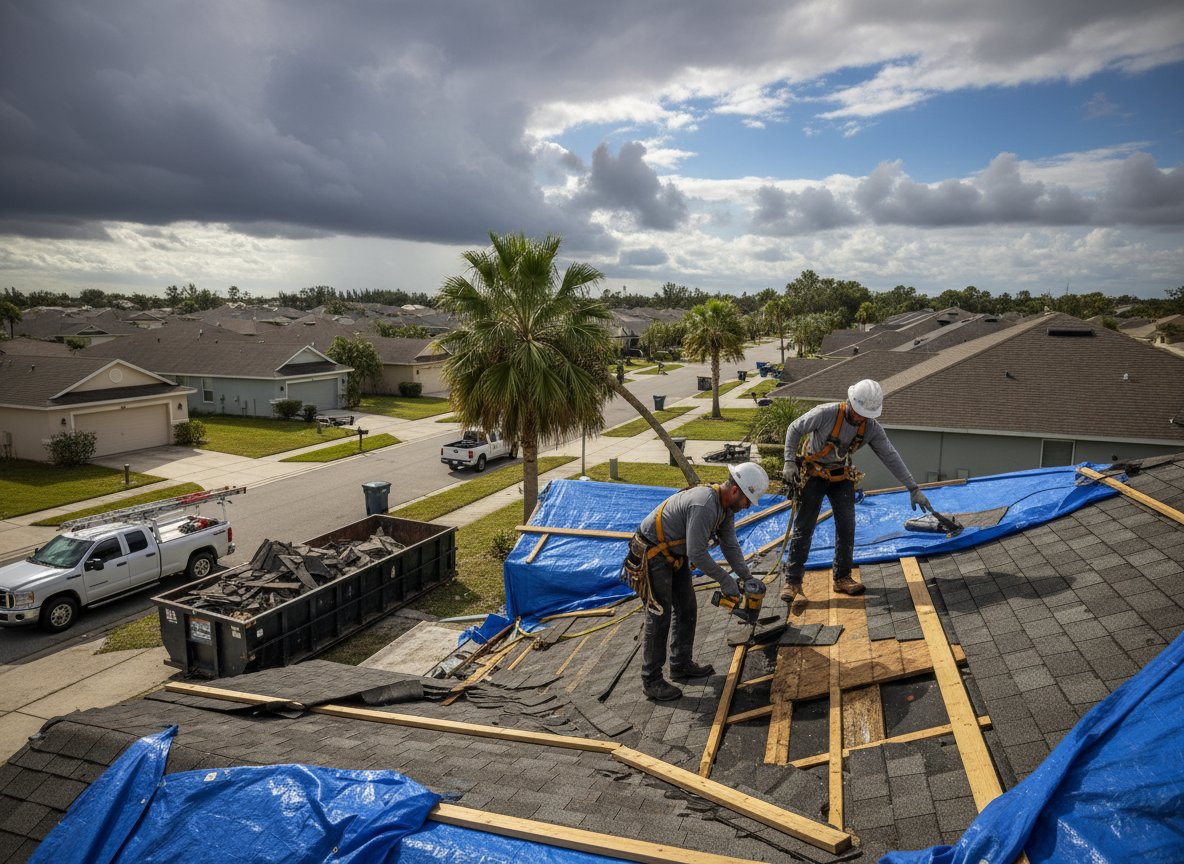
Wesley Chapel was not a town that grew into its roof stock. It is a place that was designed, platted and built in planned pieces from the 1990s onward, and the roofs there reflect that origin: subdivision after subdivision with the same truss spacing, the same sheathing, the same underlayment and the same ventilation, laid out over twenty-five years with the same handful of details repeated tens of thousands of times.
That uniformity is useful. It means the failure pattern in one house is very likely the failure pattern in the next twenty on the same street, and it means the age of the roof can usually be judged from the age of the community. It also means that when a detail is wrong, it is wrong across a whole phase of a subdivision rather than in a single house, which is why a survey here is often as much about the phase as about the building. Roof repair in Wesley Chapel, FL starts with the year the house was built.
Master-Planned Roofs, 1990 to 2015
The earliest communities date from the 1990s, when the area was still mostly pasture and the roads were two lanes. Those houses are four-bedroom two-storey plans with hip and gable roofs, architectural shingle, and a lanai or covered patio added as an option. The middle period, through the 2000s, brought larger houses, more complex rooflines and a much higher proportion of concrete tile, particularly on the premium lots and around the golf course frontage.
The most recent phases, from around 2010 onward, mix tile and shingle again, with metal appearing on a minority of custom and semi-custom builds. What they share is a modern roofline: multiple hip and valley intersections, a covered entry, a two-storey mass at the front, and a lanai under the same roof structure rather than a separate one.
That lanai is important. On most of these houses the lanai roof is not an addition bolted on later; it is part of the main roof, framed and sheathed with the rest, which means a leak there is a leak in the primary roof rather than in a separate assembly. On older Tampa Bay housing the opposite is usually true.
Tile, Shingle and the Lanai Under One Roof
Where the covering is concrete tile, the roof is a two-part assembly: the tile, which sheds the bulk of the rain and takes the sun, and the underlayment beneath it, which is the actual waterproof layer. On a Wesley Chapel tile roof built in the 2000s, the tile is sound and the membrane is approaching or past its rated life. That is the single most common finding on these roofs.
Where the covering is shingle, the failure order is well established: the pipe boots first, then ridge caps, then valley metal, then the sealant at wall junctions and at the lanai tie-in. A shingle roof installed in 2003 is at the age where all four are due, and the covering itself may still have years left.
In both cases the lanai is where the water shows. It is the lowest part of the roof in many plans, it is the plane most exposed to wind-driven rain from the west, and it is the part of the roof that gets the least attention because nobody looks at it from the street.
Inland Storms: Heat, Lightning and Wind
Wesley Chapel is far enough inland that surge is not a factor and close enough to the Gulf that hurricane wind still is. The summer pattern is the inland Florida one: heat building through the morning, storms firing in the afternoon, short and violent rain with wind, and lightning that arrives before the rain.
Lightning is the hazard that gets least attention. A strike on a ridge vent, a metal flue or a vent stack can crack tile and split shingle without leaving a visible mark from the ground, and the damage is often found later as a leak in a specific spot with no wind history to explain it. On a two-storey house the strike path frequently runs down a wall rather than through the roof surface.
Wind is the second agent, and the exposure here is the straight-line storm rather than the hurricane. A gust front crossing an open subdivision at fifty or sixty miles an hour lifts edges, peels ridge caps and drives rain sideways under the field. The 2004 hurricane season, when Charley crossed the peninsula through Polk County and Frances and Jeanne followed, is still the reference point for how much wind a roof here can be asked to take in a single season. Hurricane Irma in 2017 and Hurricane Milton in 2024 both reached Pasco, and Milton in particular left lifted coverings and opened roofs across the county.
The Details That Fail on a Twenty-Year-Old Roof
Four things account for most of the leaks on this housing stock. The pipe boots: plastic collars that crack in the sun and let water run straight down a vent into the ceiling. The ridge and hip caps: the most exposed part of any roof and the first to lose their seal, particularly where a hip runs into a wall.
The valley: on a complex roofline the valleys carry the most water in a storm, and an open metal valley collects debris from the trees that have grown up around these houses since they were built. And the wall junction: where a second-storey wall rises out of a lower roof, or where the lanai meets the house, there is a flashing that was installed when the house was framed and has not been looked at since.
On tile roofs, add the hip and ridge mortar. It is exposed to the most sun and the most wind on the whole roof, and on a twenty-year-old tile roof it is usually the first thing to crack and the first place water gets under the tile field.
Associations, Districts and Approval Before the Work
Most of Wesley Chapel is deed-restricted, and a roof covering that differs in colour or material from what is there usually needs approval from the community's architectural review process before it is installed. That review is separate from the building permit and does not replace it, and on a street where every house carries the same tile, a different tile is a visible change.
The other local wrinkle is that many communities sit within a community development district, which handles infrastructure and sometimes maintenance obligations. That does not change who permits a roof, but it does mean that the association and the district are two different conversations, and neither of them is the building department.
Getting the approvals in the right order is the practical point. Architectural approval first, then the permit application, then the material order, because a delivered pallet of the wrong tile is an expensive mistake on a street with a recorded colour scheme.
Repair or Replace, and the Deck Underneath
The decision on a Wesley Chapel roof turns on the deck and the underlayment rather than on the age of the covering. A tile roof with a failed membrane needs the tile lifted and the underlayment replaced; whether that is the whole field or part of it depends on how the membrane reads at the valleys, the wall junctions and the lower edges.
A shingle roof with a sound deck and failed details is a repair. A shingle roof with a brittle field, granule loss across every plane and soft sheathing at two valleys is a replacement, and the difference shows up in the attic as much as on the roof. On a two-storey house the attic access may be limited, which is one reason the survey takes longer here than owners expect.
Where the roof is replaced, the ventilation is worth reviewing at the same time. A modern roof over a poorly ventilated attic will not reach its rated life, and on these houses the soffit intake is often blocked by insulation that has settled or been pushed aside.
The Work, and the Permits
Leak repair is the bulk of the work, traced from the stain back to the junction. Where a storm has opened a roof, emergency roof tarping holds the weather out until a repair can be scheduled, and emergency roof repair closes the openings that can be finished in one visit. Storm and hurricane damage repair is the wider assessment, with photographs that separate fresh damage from wear.
Roof repair or roof replacement is the next decision, and roof installation covers the new builds and the additions. The coverings are shingle roofing, tile roofing, metal roofing and flat roof repair, with roof coating used on sound metal and low-slope surfaces. Roof inspection is the service that answers what most owners here want to know, which is how much life is left in a roof of a known age.
Wesley Chapel is unincorporated Pasco County, so roofing permits go to Pasco County's building construction services department through the county's online permitting portal. There is no municipal building department. The application carries the product approval, the fastening schedule and the design wind speed, and on a tile roof the deck and underlayment are inspected before the tile is relayed.
Ten Miles Around Wesley Chapel
Within about ten miles: Lutz, Land O' Lakes, Pebble Creek, New Tampa, Tampa Palms, San Antonio, Zephyrhills, Odessa, Trinity and the northern edge of Tampa. Every address is checked against its own jurisdiction, because the county line and the city limits both run close to here.
Calling About a Wesley Chapel Roof
What helps is the year the house was built, the covering, and where the water is showing. If the community has an architectural review, mention it, so the approvals are sequenced properly. If the house has a lanai under the main roof, say so, because that is usually the first place these roofs leak. Florida Roof Repair Pros, 4720 Millenia Blvd, Suite 175, Orlando, FL 32839, (407) 557-4529.
What a Survey Covers on a Two-Storey House
A two-storey Wesley Chapel house is harder to survey than its age suggests, and the reason is access. The lower roof planes can be walked, but the upper roof, the valleys where the second storey meets the first, and the wall junction above the lanai are not visible from the ground and not always reachable from a ladder. That is where the water usually is.
The attic is the other half of the survey, and on these houses it is often cramped or reached through a ceiling hatch in a garage. What it shows is the underside of the sheathing at the valleys and around penetrations, the condition of the underlayment at the eaves, and whether the ventilation is actually working. Staining on the underside of a sheet of sheathing tells you which plane has been wet and for how long.
The report then separates what is a repair from what is a replacement. On a house built in 2004, that is frequently a list of details rather than a verdict on the covering: boots, ridge caps, a valley, the flashing above the lanai. On a house from the 1990s, it is more often a conversation about the whole assembly, because everything on it is the same age.
Either way the written scope names the junctions rather than the general area. "Repair leak at rear" is not a scope; "replace underlayment at the lanai valley and rebuild the wall flashing where the lanai roof meets the two-storey wall" is.
Around Wesley Chapel
We regularly work near:
- 📍The Shops at Wiregrass
- 📍Seven Oaks
- 📍Meadow Pointe
- 📍Pasco-Hernando State College
- 📍Wiregrass Ranch
Roofing Company in Wesley Chapel — Local Notes
- •Unincorporated Pasco County permits, not a city department
- •Concrete tile roofs here are at the age where underlayment fails
- •The lanai is usually part of the main roof, not a separate addition