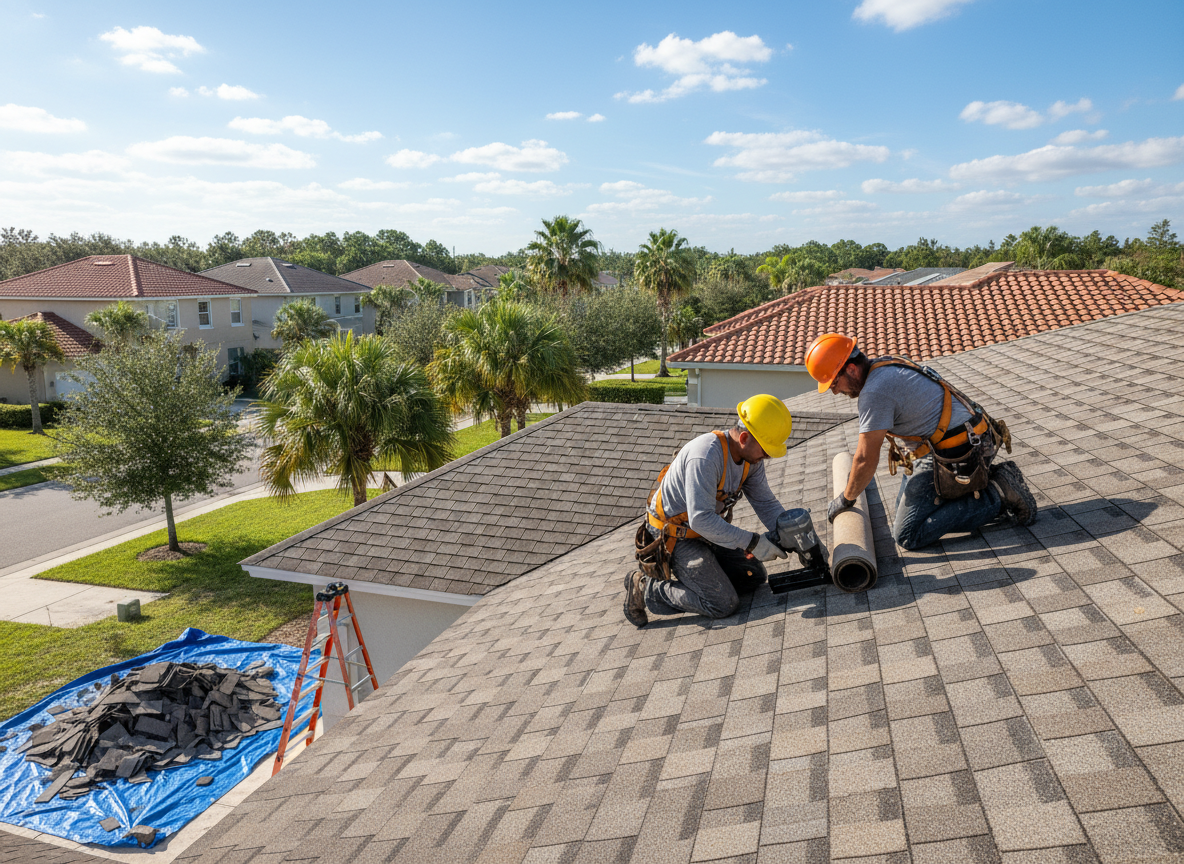
Venice was designed before it was inhabited, and the design is still legible in its roofs. The city was laid out in the 1920s by the Brotherhood of Locomotive Engineers as a planned retirement town, built in a Northern Italian idiom: low buildings, arcaded shopfronts, and a great deal of barrel tile. The historic district on the island still reads that way, and the tile roofs of the 1920s are the reason roof work here has a conservation problem before it has a construction problem.
The city occupies a barrier island and the mainland behind it, joined by two bridges over the Intracoastal. On the island the stock is old and close together; on the mainland it is postwar and spread out, with the unincorporated communities of South Venice and Nokomis filling the ground either side. Roof repair in Venice, FL, therefore means working on a 1926 tile roof one day and a 1979 shingle ranch the next, in a city small enough that both are ten minutes apart.
A Planned City and Its Roofs
The 1920s plan left Venice with a stock that is unusually coherent for Florida: houses and commercial buildings of similar scale, built within a short period, under a covering that was chosen as part of the look. That coherence is the city's character and also its maintenance problem, because a hundred roofs of the same era reach the end of their lives at the same time.
Barrel tile from that period is often original and frequently out of production. The clay is brittle after a century in the sun, the profiles vary between buildings, and a broken piece has to be salvaged from somewhere. That makes repair a matter of inventory as much as skill: what is on the roof, what can be lifted without breaking, and what can be matched if it cannot.
Tile, Mortar and the Island Streets
On the 1920s houses the failure is at the mortar and the membrane. Ridge and hip tiles bedded in mortar crack and let go, and the crack is where the rain enters. The battens below rot where a leak has been running, and the underlayment, whatever it was in 1926, has long since stopped shedding water.
The repair is a lift-and-relay: tile lifted by hand and sorted, membrane replaced, battens replaced where they are soft, and the field relayed with new mortar at the ridges and hips. Some tile will break. A scope that assumes otherwise is a scope written by someone who has not done it. Where enough tile survives, the roof keeps its original appearance; where it does not, the conversation turns to matching profiles, which is a slower and more expensive search.
The Mainland Grid
Across the bridges the city and the county are postwar. The houses are concrete-block ranches under asphalt shingle, built from the 1950s through the 1980s, with carports, lanais and the occasional addition. The failure pattern is the one that applies across this coast: sun on the south and west, heat from a low attic, granules in the gutter, and a mat that hardens until it checks.
Ventilation is the variable. A ridge vent with closed soffits draws nothing, and in this city a great many attics have been re-insulated to the eaves without anyone checking the intake. The deck then runs hot, and the shingle ages from underneath. When a 1970s roof fails early, that is usually why.
South Venice and Nokomis
The unincorporated communities on either side of the city are a different jurisdiction and a slightly different stock. South Venice was platted in the postwar years and built out over decades, with a mix of small ranches and newer houses on the same streets. Nokomis sits between Venice and Osprey, with a waterfront and a mix of older cottages and newer construction.
Because those addresses are in Sarasota County rather than the city, the permit route changes at the boundary even where the streets look identical. That is worth establishing early, because the review and inspection stages differ between the two desks.
Helene, Milton and the Inlet
Helene passed offshore in September 2024 and pushed surge through the inlet and onto the low streets, and Milton made landfall at Siesta Key in October 2024, close enough that the city took its wind. Irma crossed in 2017, and Charley in 2004 crossed Charlotte County just to the south. The record here is a sequence of close passes and near misses rather than a single defining event, which is why roofs in Venice tend to be replaced in smaller waves than in Punta Gorda or Cape Coral.
What that means in practice is a stock with a wide age spread. On one street there may be a roof from 2005, one from 2018 and one from last year, and each needs a different conversation. The date of the last permit is often more useful than the appearance of the covering.
Salt, the Inlet and the Beach Blocks
On the island and along the beach, salt is the ageing factor. It attacks the metal rather than the tile: drip edge, valley metal, hip and ridge flashings, vent collars, the fixings on any metal panel, the frames of enclosures. Those parts fail under a field that still looks sound, which is why a Venice Beach roof is judged at its edges and hips before its field.
The specification follows. Stainless or coated fastenings, compatible metals wherever water runs from one to another, flashings replaced rather than reused where they have already corroded. On a beach block the design wind speed and the edge detail are the parts of the job that decide how the roof behaves in the next storm.
Flat Roofs and Small Commercial
Downtown Venice and the commercial streets on the mainland carry flat and low-slope roofs, and those fail by drainage. Ponding is the diagnostic question, and a membrane with several patches is usually a membrane that has lost its fall. Coating extends a sound surface and does not rescue a ponding one.
On the island the flat roofs are often small — a shop, an office, a rear extension — and the details that matter are the parapet, the drain and the junction with the pitched roof next door. Those junctions are also where the leaks start.
Where a Venice Roof Leaks
On the 1920s houses, the ridge and hip mortar, the wall junction and the porch roof. On the postwar ranches, the valley, the vent boot and the carport transition. On the commercial stock, the parapet and the drain. On the beach blocks, the hips, the edges and any penetration near the Gulf side.
Water travels before it appears, and on the island's narrow lots the distance is short but the damage is often hidden in a wall rather than a ceiling. The survey photographs junctions and penetrations rather than the stain, and the repair is priced from what is found there.
The Services Available Here
The list is the site's own, applied to this stock. Roof leak repair is the diagnostic core, and on a heritage tile roof it is a careful one. Emergency roof repair and emergency roof tarping cover the night a storm opens a roof or a limb comes through a deck. Storm and hurricane damage repair handles the documented sequence afterwards: make safe, photograph, repair, and keep a file an insurer can follow.
Roof repair is the everyday work, and here it splits between tile conservation in the historic district and shingle and flashing work on the mainland. Roof replacement and roof installation handle the end of a layered shingle roof or a tile roof whose underlayment has gone. Shingle roofing covers the postwar grid, tile roofing the 1920s city and the villa communities, metal roofing the beach houses where exposure justifies it. Flat roof repair and roof coating cover the downtown commercial stock and the small rear extensions. Roof inspection is the visit that starts all of it, and on a heritage property it is the document that carries the decision.
How a Venice Job Runs
The first visit is a survey: ladder, roof where it can be walked, attic where there is one, camera at every junction. On a barrel tile roof the field is not walked, because walking it breaks tile; it is read from a ladder, from the ground with a camera, and from the attic.
Then the written scope, which separates what is replaced from what is kept, names the underlayment and fastening method, records what is assumed about the deck, and lists exclusions. On a heritage house the scope also records the tile inventory, because the repair depends on how much original material survives the lift.
The permit is filed before work starts, and inspections follow the jurisdiction's stages. The close-out is a walk with the owner covering ridges, hips, edges and cleanup, plus photographs of everything now covered up. On a 1926 roof those photographs are the only record of what the next generation inherits.
Permits: City and County
Addresses inside the City of Venice are permitted by the city's building department. The unincorporated communities around it — South Venice, Nokomis and the ground between — are permitted by Sarasota County. North Port to the south-east and Englewood to the south are separate jurisdictions again.
The Florida Building Code applies beneath the local permit. Sarasota County is outside the High-Velocity Hurricane Zone, which covers Broward and Miami-Dade, so the zone's extra underlayment chapter does not reach here. The wind provisions do, and the coastal strip including the island is in the wind-borne debris region, which brings product approval and opening protection into a replacement permit near the water.
Within Ten Miles
Nokomis to the north, South Venice and Venice East inland, Laurel and Manasota to the south, Osprey at the northern edge of the ten-mile ring, and the beach blocks along the island. Each has its own permit desk or none, and the exposure changes as you move from the island to the mainland.
Calling About a Venice Roof
The address settles the permit and, on the island, the exposure. The covering settles the survey method, because a barrel tile roof is read and a shingle roof is walked. The age of the roof and the date of the last permit decide whether this is a repair or a replacement conversation, and on a heritage house the tile inventory decides what is even possible. The office is at 4720 Millenia Blvd, Suite 175, Orlando, FL 32839, and Venice calls come to (407) 557-4529.
Around Venice
We regularly work near:
- 📍Venice Beach
- 📍Venice Historic District
- 📍Venice Train Depot
- 📍Caspersen Beach
- 📍Centennial Park
Roofing Company in Venice — Local Notes
- •City of Venice permits its own addresses; Sarasota County takes South Venice and Nokomis
- •The 1920s planned city left a coherent stock of barrel tile roofs
- •Milton passed close enough in 2024 that the city took its wind