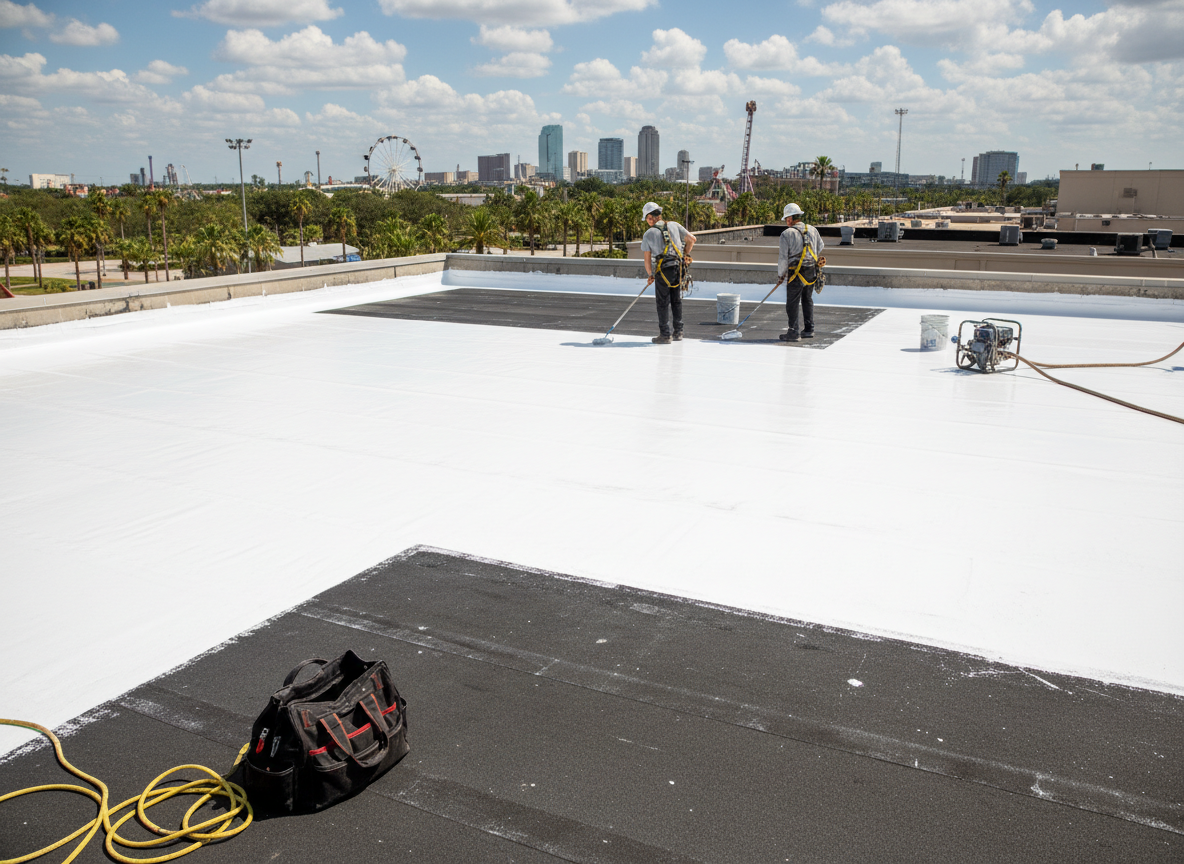
St. Petersburg was largely built before air conditioning and before the subdivision pattern that followed the war, and its roofs still carry that history. Walk a block in Kenwood or Crescent Lake and the houses are 1920s bungalows and Mediterranean Revival cottages with low pitches, deep porches and, frequently, a flat roof over a rear room. Walk a block in the north or the far west and the houses are 1950s and 1960s concrete block ranches with shallow hip roofs and carports. Those two roof types fail in completely different ways, and a contractor who treats them as one job will misdiagnose both.
The other half of the picture is water. St. Petersburg is a low, flat city on a peninsula with a storm drainage system that was designed for a smaller place, and the storms of the last decade have made that plain. Roof work here is inseparable from the question of how the building behaves when water arrives from below as well as above, which is why the survey looks at ceilings and wall cavities and not only at the covering.
A City Built Between 1910 and 1965
The historic core runs from the waterfront out through Old Northeast, Snell Isle, Crescent Lake, Uptown, Kenwood, Euclid-St. Paul and Historic Roser Park. These are the 1910s to 1930s houses, and their roofs are a mix of low-pitch shingle, barrel tile on the Mediterranean Revival houses, and flat built-up roofs over porches, sunrooms and rear extensions. The framing is often board sheathing on closely spaced rafters, and the eave detail is shallow, sometimes almost flush, which leaves little room for error when a new covering is detailed.
The 1940s to 1960s city is block construction with a hip or low gable roof, often with a carport that was later enclosed and given its own low-slope roof. Whole neighbourhoods west and north of downtown follow this pattern. A great many of these roofs have been re-covered two or three times, and a good number now carry a layer of shingle over an older layer, which changes what is possible when the time comes.
The city also holds a large number of manufactured home communities and 55-plus parks, where the roof is a different assembly again: a low-pitch metal or shingle panel over a light frame, often with a membrane over an addition or a Florida room. And along the downtown waterfront and the beaches there are condominium towers, where the roof is a membrane deck with parapets, mechanical equipment and an association that owns it.
Flat Roofs, Low Pitches and the Block House
A flat or near-flat roof is normal here rather than exceptional. It appears over rear additions on the bungalows, over carports and porches on the block houses, over commercial buildings along Central Avenue and the corridors, and over the whole of many 1950s houses that were built with a built-up roof from the start.
These roofs are judged differently. There is no covering to shed water by gravity, so the membrane and the drainage do all the work. A built-up or modified bitumen surface that has dried out, blistered or lost its gravel will let water through at a seam, and the ponding that follows a summer storm will find the low point whether or not that is where the drain is. When a flat roof leaks, the questions are the drain, the scupper, the parapet and the seam, in that order.
Pitch matters on the pitched roofs too. Several of the older bungalows run at a slope below what modern shingle products are rated for, which is why some carry metal or a low-slope membrane on part of the roof. When a covering is replaced, the product has to be rated for the pitch it is going onto, and the transition between a low-slope section and a steeper plane has to be built rather than improvised with sealant.
Salt, Surge and the Storms of 2024
Salt air reaches almost every roof in this city, because no address is far from water. It does not wear out shingle or tile. It attacks the metal: fasteners, drip edge, valley metal, vent flues, the screws in a metal panel, the clips on a tile roof. On the barrier islands and along the bay front, a roof can look sound and still be losing its grip at every fixing.
Hurricane Irma in September 2017 brought wind across the peninsula and stripped coverings, lifted edge metal and dropped limbs on the older housing. Then in 2024 two storms arrived within a fortnight of each other. Helene passed offshore in late September and pushed surge into the city's low-lying neighbourhoods, Shore Acres and Riviera Bay among them, leaving homes with water in the walls and insulation that had to come out. Milton followed in October, came ashore at Siesta Key and crossed the bay with wind that peeled roofs open, moved tile and took off porch coverings.
The sequence matters for roofing. A house that took water from below has a different problem from a house that lost shingles from above, and doing one without addressing the other leaves a ceiling that keeps staining. The 1921 hurricane remains the benchmark for a direct hit on this part of the coast, and the city's low elevation is why surge, rather than wind, is the event that does the most damage here.
What the Coverings Tell You
Shingle covers most of the post-war city and the re-roofed bungalows. Its failure pattern is predictable: the pipe boot perishes first, then the ridge, then the valley, then the sealant at a wall or chimney. On a low-pitch roof the shingle is also more exposed to wind uplift at the edges, which is why the perimeter detail matters more here than inland.
Barrel and S-profile tile appears on the Mediterranean Revival houses and on some 1980s infill. The tile is durable to the point of outliving the roof it sits on, and the membrane beneath it is the part that expires. On a 1920s tile roof the fixings may be mortar, wire or a combination, and that decides how the tile can be lifted and relaid.
Built-up, modified bitumen and single-ply membranes cover the flat roofs, the commercial stock and the towers. Metal is present but in the minority, usually on carports, porch roofs, newer houses and the manufactured home communities, where a low-pitch panel is the standard assembly.
The Leaks This City Produces
The first is the junction where a pitched roof meets a flat addition: a rear room, a Florida room, an enclosed carport. Water backs up at that transition and enters the wall or the ceiling below, and the stain is rarely directly under the join.
The second is the parapet and the flat roof edge. On the block houses and the commercial buildings, a parapet with a failed coping or a rusted through-wall scupper puts water into the wall, and the damage appears at the ceiling line inside. The third is the porch roof, which on a bungalow is often a separate low-slope assembly tied into the main roof with a short flashing.
The fourth is wind damage at the perimeter: lifted drip edge, a corner of shingle peeled back, a ridge vent that has lost its cap. After a storm these are the calls that come in first, and they are the ones where a tarp and a proper repair in the same week prevent a ceiling from coming down.
The Work, and When It Becomes Replacement
Leak repair is the core of it, and on this stock it means finding the entry rather than treating the stain. Emergency roof tarping is the first visit when a roof is open, with emergency roof repair for the cases that can be closed properly on the day. Storm and hurricane damage repair is the wider job: reading what the wind or the water did across every plane and separating that from wear that was already there.
Roof repair or roof replacement is the decision that follows, and it should follow the survey rather than the age of the house. A 1950s block house with a sound deck and a failed flat section needs that section rebuilt, not a whole new roof. A bungalow whose shingle is at the end of its life and whose decking is soft in two places is a replacement. Roof installation covers the new builds and the additions.
The coverings are shingle roofing, tile roofing, metal roofing and flat roof repair, with roof coating used where a sound metal or membrane surface needs renewing rather than rebuilding, which is common on the low-slope sections of this city. Roof inspection is the service that answers what most owners here actually want to know, which is whether the roof will carry them through another hurricane season.
Permits: the City, Not the County
St. Petersburg is an incorporated city with its own building department, and roofing permits for an address inside the city limits are filed there, through the city's permitting office at the Municipal Services Center. Unincorporated Pinellas County addresses, which begin immediately outside the city line in places like Lealman and West Lealman, go to the county's building and development review services instead. The two run separate portals and separate inspection schedules.
Both work under the Florida Building Code, and both require the covering to be an approved product installed to its approval, with the design wind speed for the site stated in the application. On a flat roof the specification matters as much as on a pitched one, because the membrane system and its attachment are named in the permit rather than chosen on site.
Within Ten Miles
Gulfport, South Pasadena, Kenneth City, Lealman, West Lealman, Pinellas Park, Seminole, Bay Pines, St. Pete Beach, Treasure Island and Madeira Beach all sit within about ten miles, and each has its own jurisdiction or sits in unincorporated county territory. The address is checked before a permit is prepared.
Calling About a St. Petersburg Roof
What helps is the age of the house, whether the roof is flat or pitched, and where the water is showing. On a block house, a photograph of the carport or porch roof from the ground is genuinely useful, because those are usually separate assemblies. Florida Roof Repair Pros, 4720 Millenia Blvd, Suite 175, Orlando, FL 32839, (407) 557-4529.
Around St. Petersburg
We regularly work near:
- 📍The Pier
- 📍Sunken Gardens
- 📍Kenwood Historic District
- 📍Vinoy Park
- 📍Fort De Soto Park
Roofing Company in St. Petersburg — Local Notes
- •City of St. Petersburg permits inside the city limits; Pinellas County outside
- •Flat and low-slope roofs are standard here, not unusual
- •Salt attacks fasteners and edge metal before the covering