St. Augustine is the oldest continuously occupied European-established settlement in the continental United States, and its roofs are the most varied in this part of Florida. That is not a marketing line; it is a practical problem. Within a few blocks of the Plaza there are buildings whose walls are coquina, shellstone quarried on Anastasia Island and set in lime mortar, houses framed in cypress and covered in metal, Flagler-era hotels under terracotta tile, and postwar bungalows under asphalt shingle. Roof repair in St. Augustine, FL, has to begin by identifying which of those it is dealing with, because the answer changes the survey, the material and the approvals.
The city sits on a narrow peninsula between the Matanzas River and the San Sebastian, with Anastasia Island across the water to the east and the inlet at Vilano Beach to the north-east. Most of the historic district is only a few feet above sea level. Streets that look dry in a normal week are the first to flood in a storm, and water in the street is a reliable indicator of how much humidity the roof above it is managing.
The Oldest Roof Stock in the Region
The colonial buildings are masonry, and their roofs are framed independently of the walls, sitting on plates that were set into the masonry when the building went up. That detail is where a great deal of modern repair work starts, because a timber plate embedded in a coquina or tabby wall has had three centuries of humidity to rot. The symptom appears inside as a stain at the wall head, and on the roof as a sag along the eave. Neither is a shingle problem, and neither is fixed by a new covering.
On the eighteenth and nineteenth century houses the roof plane is usually a simple gable or a low pitch hidden behind a parapet, and the covering has been replaced many times while the structure underneath has not. Repointing, the renewal of the lime mortar at the wall head, is often part of the work alongside the roof itself. That is masonry conservation rather than roofing, and it is the reason a historic-district job here takes longer to scope than a suburban one.
Metal and the Nineteenth-Century Streets
Walk the streets north and south of the Plaza and most of the roofs you see are metal: standing seam on the grander houses, five-vee crimp on the smaller ones, painted in colours that were chosen decades ago and repainted since. Metal became the default covering here for good reasons. It sheds the volume of rain a coastal thunderstorm delivers, it tolerates the pitch of these roofs, and it can be repaired in sections rather than replaced whole.
Its failure modes are specific. Fasteners lose their washers and back out, and each one becomes a pinhole. Seams open where the pans have moved against each other through thermal cycling. Paint chalks and then fails at the laps, and once the galvanised coating is gone the steel rusts from the lap outward, which is why a five-vee roof often looks sound across the pan and is rotten at every overlap. Valleys where a metal plane meets a shingle plane fail at the transition, because the two materials move differently and the flashing between them is the only thing holding the joint.
The Flagler Generation
The hotels that Henry Flagler built in the 1880s gave the city a second roof tradition. The Ponce de Leon, now Flagler College, and the Alcazar and Casa Monica were designed in Spanish Renaissance and Moorish Revival styles, with terracotta barrel tile, deep cornices and flat sections behind parapets. The tile on those buildings is a century and a half old, and the buildings are still in daily use, which says something about how well a clay roof performs when the membrane beneath it is maintained.
On a building of that generation the failure is almost never the tile. It is the underlayment, the built-in gutters behind the parapet, and the copper or lead at the cornice. Water enters at the parapet, runs behind the tile and appears well away from the entry point, usually on a ceiling two floors down. Reading that path is the whole diagnostic exercise, and it is slow work.
Lincolnville and the Working Streets
Lincolnville was settled after the Civil War by freedmen and their families, and it holds one of the largest collections of late nineteenth and early twentieth century vernacular housing in the state. The houses are small and frame-built, mostly with gable-front roofs, and they have been covered in metal and then in asphalt shingle as each generation did what it could afford. West Augustine developed along the same lines.
These roofs are steep and small, which sounds simple and is not. A steep pitch sheds water quickly but concentrates it at the eaves and in the valleys between wings and additions. Window units, rear extensions and porches have been added over the decades, and each addition created a new junction. Where shingle has been laid over the original skip sheathing, the deck is not flat and the shingle has been asked to bridge gaps it was never designed for. That is why a twenty-year-old shingle roof on a Lincolnville house can fail years early.
Anastasia Island, Davis Shores and Vilano
Davis Shores was developed in the 1920s on marsh that was filled for the purpose, which means the ground under those houses is made ground and the water table is close. Anastasia Island runs south from the Bridge of Lions with a mix of cottages, motels and newer houses, and Vilano Beach sits at the inlet with nothing between it and the ocean. The exposure changes block by block, and so does the specification.
On the island the roof is judged at its edges first. Drip edge, rake trim, hip and ridge, and the fasteners that hold them are what a coastal roof depends on, and they are exactly the parts that corrode fastest. The wind provisions of the Florida Building Code apply everywhere in the state, but the wind-borne debris region adds product approval and opening protection requirements near the coast, and a replacement on the island should be specified with that in mind rather than discovered at inspection.
Matthew, Irma and What the Water Did
Hurricane Matthew in October 2016 passed close enough offshore to push surge into the downtown streets and the low blocks around the bayfront, and the flooding did more damage than the wind. Irma in September 2017 crossed the state and sent water up the rivers again. Dora, in 1964, had already shown what a landfall on this coast does to a town built at water level.
The pattern those events establish is consistent. St. Augustine roofs are rarely torn off. They are soaked, their flashings are tested for hours by driven rain, and their wall heads take water that finds the old plates. After a storm the work is at parapets, valleys, chimneys and wall junctions rather than across the field. A roof that was already tired fails at those points, and a roof that was sound mostly survives.
Salt, Sun and Fasteners
Salt attacks metal, not shingle. It takes the galvanising off a drip edge, pits the washers on a fastener, corrodes the collar around a vent and eats the frames of pool enclosures and the fixings on a metal pan. On a house a few streets from the water, those parts can be finished while the field above them still looks new. That is why a coastal roof is judged at its terminations before its surface.
The specification follows from it: fasteners and flashings in stainless or a coated product, compatible metals wherever water runs from one material to another, and replacement rather than reuse of any flashing that has already started to corrode. The sun does the rest. Ultraviolet light ages the surface of a shingle or a membrane long before the structure beneath it is in trouble, and on a low-slope roof the combination of sun and standing water is what ends the covering's life.
The Services, Matched to the Stock
Roof leak repair is the core of the work here, and on a historic building it is investigative before it is physical. Emergency roof repair and emergency roof tarping matter after a storm has opened a plane or a limb has come down on a roof that cannot be left open overnight. Storm and hurricane damage repair covers the sequence from making the building watertight to producing a record an insurer or a preservation office can follow.
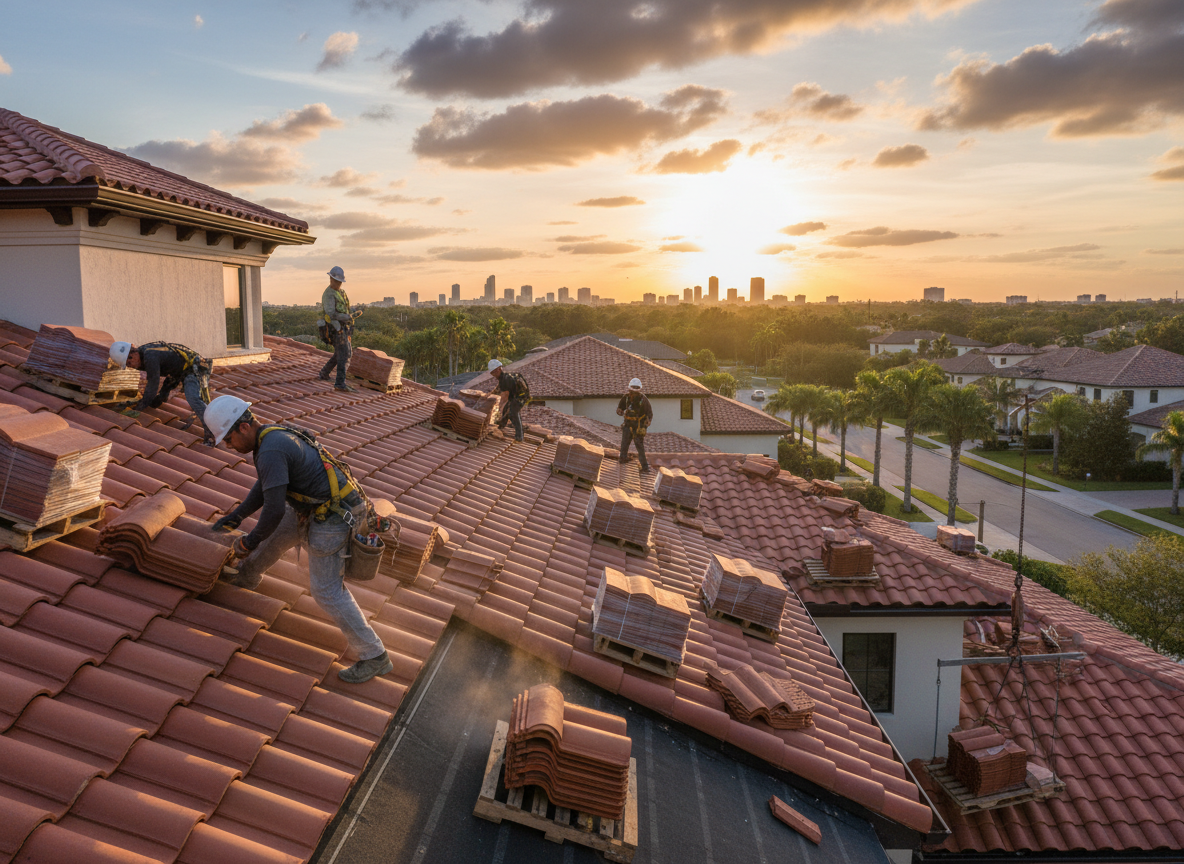
Roof repair handles the flashing and valley work that most of these roofs actually need. Roof replacement and roof installation are the answer where the covering has reached the end, and on a historic building they are also an approval question. Shingle roofing serves Lincolnville, West Augustine and the postwar streets; metal roofing is the natural fit for the nineteenth-century houses and for the island, where the original covering was metal in the first place. Tile roofing covers the Flagler-era buildings and the Mediterranean-style houses built later in their image. Flat roof repair and roof coating serve the parapet roofs and the commercial frontages downtown, and roof inspection is the visit that produces the record on which everything else is decided.
How a St. Augustine Job Runs
Work on a historic building starts with what the city will allow, not with what the roof needs. The historic preservation districts cover five zoning categories, and exterior changes visible from the street go through the Historic Architectural Review Board. A roof is visible from the street. Establishing the approved covering, profile and colour before material is ordered is the difference between a scheduled job and a stalled one.
The survey comes next: the roof plane, the attic, the wall heads and every penetration, photographed. On a metal roof the seams and fasteners are examined by hand. On a tile or parapet roof the membrane is exposed at the suspect detail. The written scope then records what is replaced, what is retained, what is assumed about the deck and the wall plates, and what is excluded, because on a building of this age the unknowns are structural rather than cosmetic.
The permit is filed with the city, inspections follow the stages the work requires, and the job closes with a walk over the finished roof and a photographic record of every detail that is now hidden. On a coquina building that file has value beyond the job, because it documents the condition of the wall head at a known date.
Permits: City, County and the Beach
Addresses inside the City of St. Augustine are permitted by the city's Planning and Building Department. Unincorporated St. Johns County, which includes much of the ground west and south of the city, is permitted by St. Johns County Building Services on Lewis Speedway. St. Augustine Beach is its own municipality with its own building department, so an address on the island needs the right jurisdiction named. The Florida Building Code applies beneath all three.
Within Ten Miles
Lincolnville and Davis Shores immediately south of the Plaza, the historic district itself, West Augustine across the San Sebastian, Anastasia Island and St. Augustine Beach across the Matanzas, Vilano Beach at the inlet, and the older streets along the San Sebastian to the north. Each has a different era of roof and, at the beach, a different permit desk.
Calling About a St. Augustine Roof
The address establishes the jurisdiction and, in the historic districts, whether review applies. The covering establishes the survey method, because a metal roof is examined seam by seam and a tile roof is opened at the parapet. The age of the building establishes what may be hidden at the wall head. The office is at 4720 Millenia Blvd, Suite 175, Orlando, FL 32839, and St. Augustine calls come to (407) 557-4529.
Around St. Augustine
We regularly work near:
- 📍Castillo de San Marcos
- 📍Flagler College
- 📍St. George Street
- 📍Anastasia Island
- 📍Bridge of Lions
Roofing Company in St. Augustine — Local Notes
- •City of St. Augustine, St. Johns County and St. Augustine Beach run separate permit desks
- •Exterior changes in the historic districts go through the Historic Architectural Review Board
- •Matthew in 2016 flooded downtown streets; the damage was mostly water, not wind