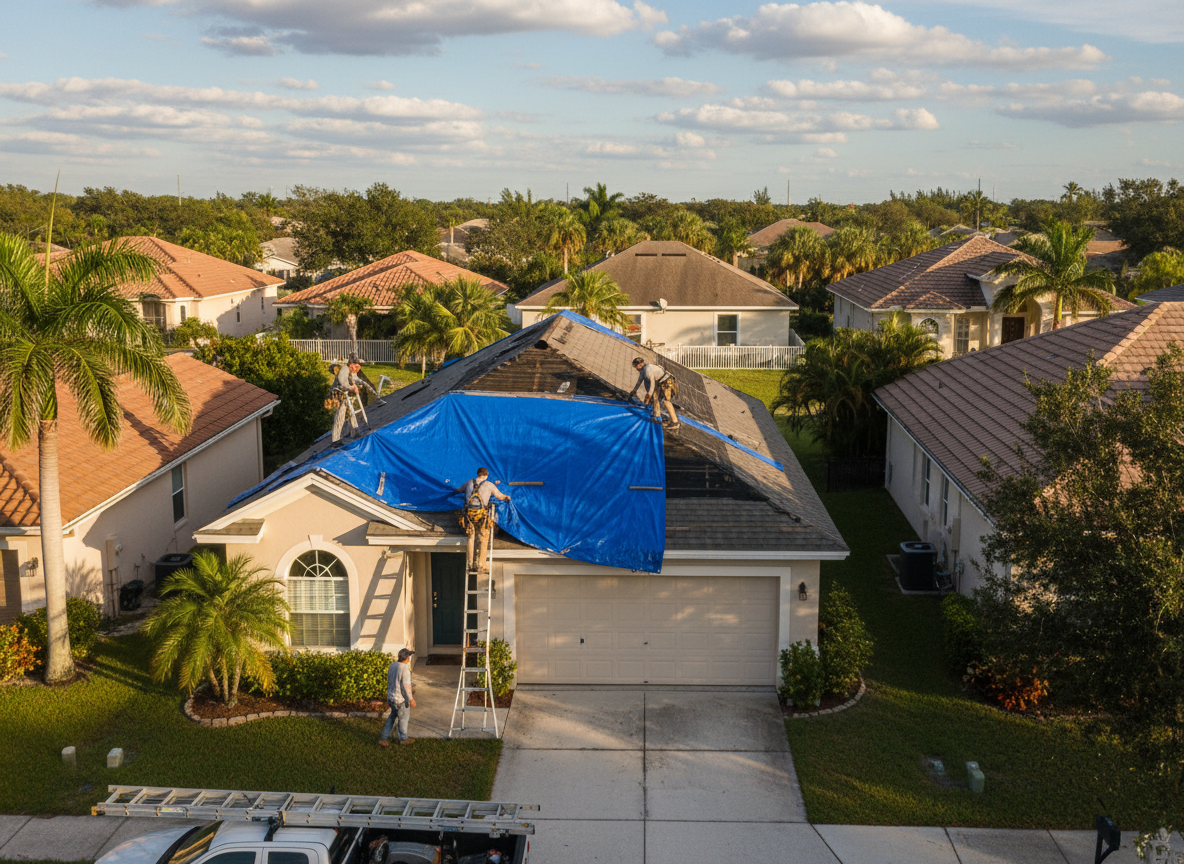
Most of Spring Hill was laid out by one developer on a grid, sold as lots and built out through the 1970s and 1980s, and the roofs there carry that single origin. The houses are single-storey, concrete block or frame, three bedrooms and two baths, with a hip or gable roof at a shallow pitch, an attached garage and, on many of them, a screened porch or a Florida room added later. The shingle on the original roof is long gone, and the second or third covering is now the one being judged.
That gives Spring Hill a particular roofing conversation. It is not about historic detail or complex modern rooflines; it is about an enormous stock of houses of roughly the same age, built to roughly the same specification, all reaching the end of a covering's life within a decade of each other. Roof repair in Spring Hill, FL is mostly the business of deciding, house by house, whether the deck under a thirty-year-old assembly is still good enough to carry another covering.
The Grid and Its Houses
The street pattern is a grid, which makes access straightforward and makes the roofscape visible: from any intersection you can see twenty roofs, and on a street where one has been replaced it is usually obvious. The lots are flat and mostly cleared, with sandy soil and a drainage swale rather than a kerb and gutter in many parts.
The houses themselves were built for a market that wanted space and a low entry point rather than detailing. The roof framing is simple, the eaves overhang modestly, the pitch is shallow enough that shingle is close to its limit, and the ventilation is often two gable-end vents or a small ridge vent rather than a balanced soffit-and-ridge system. That combination — shallow pitch, modest ventilation, hot climate — is why these roofs age faster than the label on the shingle suggests.
Additions are common and they vary. A Florida room at the rear, a carport converted, a screen enclosure over a pool, a shed attached to the side. Each one introduced a new roof junction to a house that was designed with very few, and those junctions are where the water gets in now.
Shingle Roofs at the End of Their Life
A shingle roof on a 1980s Spring Hill house has usually been replaced once, sometimes twice, and the current covering is often between fifteen and twenty-five years old. At that age the field may still look presentable from the ground while the parts that matter have already gone: boots cracked, ridge caps lifted, valley metal rusted through, sealant at the wall junctions hardened and separated.
The deck is the question that decides everything. These roofs were sheathed in plywood or oriented strand board, and in a house with poor ventilation and a history of small leaks, the sheathing softens at the valleys, along the eaves and around the chimney or vent penetrations. A covering that comes off and reveals soft decking turns a re-roof into a deck replacement, and that is a conversation worth having before the material is ordered rather than after.
Where the deck is sound, a new covering over a properly detailed assembly will last. Where it is not, another layer on top simply traps the problem, which is also why adding a second layer of shingle to an already tired roof is rarely the right answer on these houses.
Canals, Sandy Soil and Low Ground
Spring Hill sits on sandy ground with a canal network running through it, dug during the original development, and the water table is close to the surface in many parts. That affects a roof in two ways. It keeps the humidity under the house and in the attic high, which slows drying after a storm and shortens the life of anything wood. And it means that heavy rain has nowhere to go quickly, so a roof that drains slowly at a valley or a gutter will pond and back up.
The western edge of the area, toward Hernando Beach and the coast, is lower still and more exposed. Roofs there take salt in the air and wind off the Gulf, and the housing mix includes more manufactured homes and smaller cottages. The specification that suits a house in the middle of the grid is not automatically right for one three miles west of it.
Salt is a modest factor in the centre of Spring Hill and a real one at the coast. It attacks fasteners, drip edge, vent flues and any exposed metal before it touches the covering, so on the western side the corrosion rating of the fixings belongs in the scope.
Storm History on This Coast
This part of the coast has had fewer direct hurricane hits than Pinellas or Sarasota, but it has had the two that matter most recently. Hurricane Helene in late September 2024 stayed offshore and drove surge into the low coastal communities along Hernando's shoreline, which is a water problem rather than a wind problem and left buildings wet from below. Hurricane Milton in October 2024 crossed the bay and brought wind across the county, peeling coverings, lifting porch roofs and dropping limbs on the tree cover that has grown up around the grid since the 1980s.
For a 1980s house, the combination is what matters. A roof that was already at the end of its life when the wind arrived does not need much to fail, and an insurer reading a claim on a twenty-five-year-old covering will ask what was wear and what was storm. The photographic record taken before work starts is what answers that question.
The ordinary summer storm does more cumulative damage than either hurricane. Afternoon thunderstorms here are short and violent, with wind that lifts edges and rain that arrives faster than a shallow-pitch roof can shed it, and a single season of those will find every detail that was already marginal.
Manufactured Homes and Additions
A meaningful share of Spring Hill's housing is manufactured, much of it on individual lots rather than in parks, and those roofs are a different assembly: a low-pitch panel over a light frame, with a membrane or a shingle panel over any added room. The failure points are the seams, the vents, the junction with an addition and the fasteners, and the attachment is what keeps the roof on in wind.
On a site-built house, the most common addition is the Florida room or the enclosed porch, and it brings a low-slope roof tied into a wall with a short flashing. Thirty years later that junction is the leak. The same is true of the carport that became a garage, and of the shed roof over a workshop at the back of the lot.
The Repair Decision on a 1980s House
Three outcomes are possible on a roof of this age, and the survey decides which. The first is a repair: the deck is sound, the covering has life in it, and the failure is at boots, caps, a valley or a wall junction. That is the most common outcome, and normally the smallest repair, and it is worth doing properly rather than sealing over.
The second is a re-cover or a replacement: the covering has reached the end of its life across the field, the deck is sound and the details can be rebuilt. The third is a replacement with deck repairs, where the sheathing is soft at the valleys and the eaves and has to be replaced before anything goes back down. On these houses the third is common enough that it should be anticipated in the scope rather than discovered on the day.
None of that can be judged from the ground. A Spring Hill roof survey means getting into the attic, walking the planes that can be walked safely, and lifting the details that are suspect, then writing down what was found rather than what was assumed.
The Work, and the Permits
Leak repair is the core service, and here it usually means finding a junction rather than a hole. Where a storm has opened a roof, emergency roof tarping holds the weather out until a repair can be scheduled, and emergency roof repair closes the openings that can be finished in one visit. Storm and hurricane damage repair is the wider assessment, with a photographic record that separates fresh damage from wear.
Roof repair or roof replacement is the next decision, and roof installation covers the additions and the new builds. The coverings are shingle roofing, tile roofing, metal roofing and flat roof repair, with roof coating used on sound metal and low-slope surfaces that need renewing rather than rebuilding. Roof inspection is the service that answers the question behind most calls here, which is whether the roof has another five years or another season.
Spring Hill is unincorporated Hernando County, and roofing permits are issued by the Hernando County Building Division, which is based in Brooksville and accepts applications through the county's online portal. There is no city building department. The application names the product approval, the fastening pattern and the design wind speed, and the inspection stages follow the jurisdiction rather than the contractor's schedule.
Ten Miles Around Spring Hill
Within about ten miles: Brooksville, Weeki Wachee, Hernando Beach, Aripeka, Masaryktown, Timber Pines, Hudson, Port Richey, New Port Richey and Bayonet Point. Hernando County and Pasco County meet along that line, so the address decides which building department sees the application.
Calling About a Spring Hill Roof
What helps is the year the house was built, whether the roof has been replaced before, and where the water is showing. If there is a Florida room, an enclosed carport or a shed roof at the back, mention it, because those additions are where most of the leaks on this stock start. Florida Roof Repair Pros, 4720 Millenia Blvd, Suite 175, Orlando, FL 32839, (407) 557-4529.
Screen Enclosures, Pool Cages and the Roof Above Them
A screen enclosure is not a roof, but it is attached to one, and the attachment is where the two systems interfere. On a Spring Hill house with a pool cage, the enclosure is usually tied to the house at the fascia or through the wall, and that connection is a penetration in the roof edge that was made after the roof was finished.
When the cage is damaged in a storm, the load does not stop at the aluminium frame. A bent beam can pull at the attachment, distort the fascia, open the drip edge and leave the roof edge exposed. That is why a roof inspection after a wind event on a house with a pool cage includes the fixings where the cage meets the house, not only the panels.
Replacing a cage is a separate trade, and it frequently happens after the roof repair rather than before, because the new cage is measured to the finished roof edge. Sequencing it the other way round means the cage has to be adjusted or the flashing disturbed a second time.
The same logic applies to a screened porch on an older house. The porch roof may be original, the screen frame may be newer, and the junction between them may have been sealed rather than flashed. When that junction leaks, the repair is at the wall and the roof edge, not in the screen.
Around Spring Hill
We regularly work near:
- 📍Weeki Wachee Springs
- 📍Hernando Beach
- 📍Timber Pines
- 📍Spring Hill Plaza
- 📍Bayonet Point
Roofing Company in Spring Hill — Local Notes
- •Unincorporated Hernando County: permits are issued in Brooksville
- •Most roofs here are on houses built between the 1970s and 1990s
- •Deck condition decides repair versus replacement on this stock