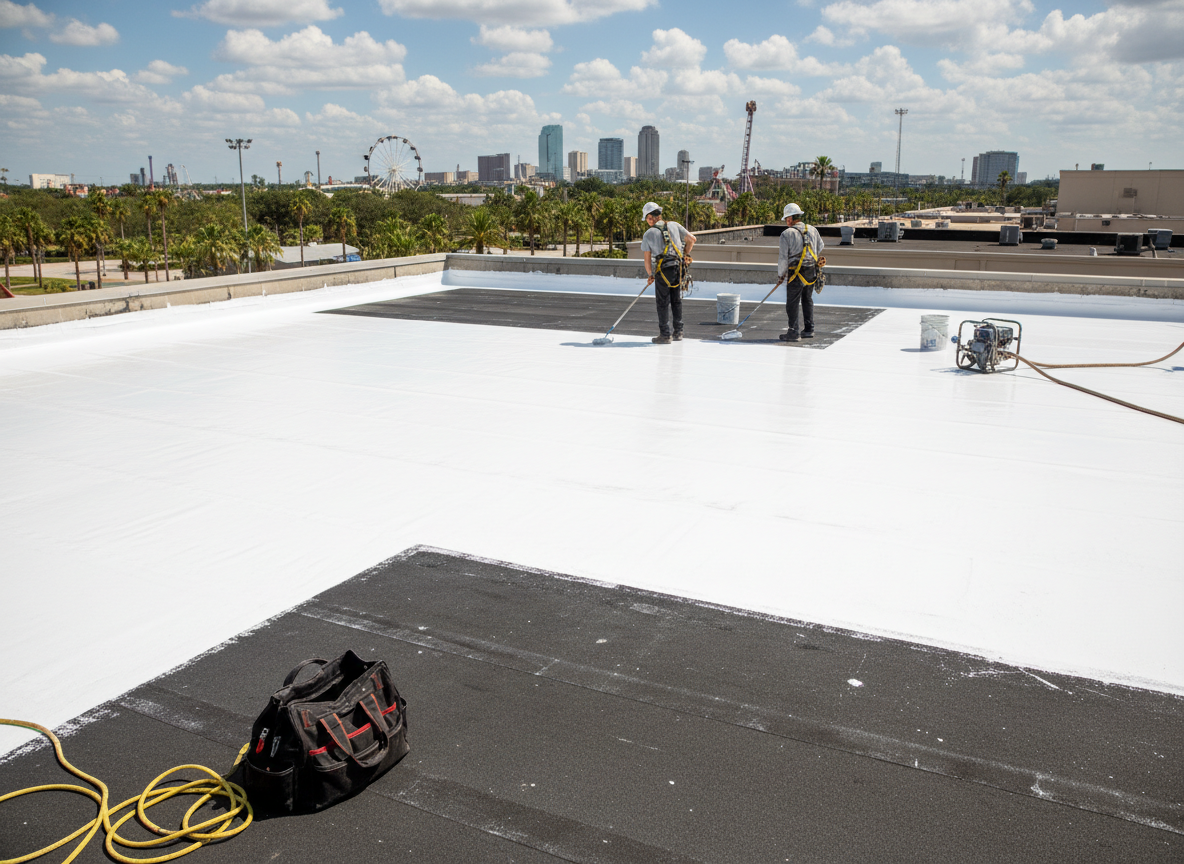
A roof coating is a liquid-applied layer that reflects sunlight and seals the surface it is applied to. On the right roof it is one of the most cost-effective things a building owner can do. On the wrong one it is a membrane that will blister, peel and take the evidence of the real problem with it. The difference between those two outcomes is decided before any coating is opened: by the moisture in the assembly, by the condition of the surface, and by what the building actually needs. Call (407) 557-4529.
What Does a Roof Coating Actually Do?
It reflects solar radiation, reduces surface temperature and seals small surface defects, provided the assembly beneath it is dry and sound.
Reflectivity is the measurable part. A white or light-coloured coating with high solar reflectance keeps the membrane cooler, which reduces the heat flowing into the building and the thermal stress on the roof. In Florida, where cooling load dominates and the sun is strong most of the year, that is a real effect rather than a marketing one.
Sealing is the second part, and it is where expectations go wrong. A coating bridges pinholes, hairline cracks and surface weathering. It does not bridge a moving joint, a failed lap, a blister or a hole. Nor does it restore the waterproofing of a membrane that has lost it.
The third part is protection of the surface it covers. On a metal roof, a coating can protect against further corrosion. On a modified bitumen roof, it slows the UV degradation of the bitumen. On a sprayed polyurethane roof, it is part of the system and gets renewed periodically.
What a coating cannot do is dry a wet roof. This is the single most important sentence on this page. If water is in the insulation or trapped between layers, a coating applied over it traps that moisture, and solar heat turns it into vapour with nowhere to go. The coating blisters, and the blister is the roof telling you the water was already there.
Why Coat a Roof Before It Needs Replacing?
Because the alternative to coating is not replacement, it is nothing, and doing nothing has a cost that shows up at the worst time.
An uncoated low-slope membrane in Florida takes full UV exposure. Bitumen oxidises, becomes brittle and cracks; the seams that were welded or lapped start to open; granules if present are lost. Coating renews the UV barrier and buys years of service, at a fraction of the cost of a re-cover, provided the membrane underneath still has integrity.
On metal, the calculation is different but the logic is the same. A coated metal roof with early corrosion can be cleaned, treated and re-coated, which stops the corrosion progressing. Left alone, the corrosion travels under the existing finish and takes panels with it, and panel replacement on a profiled roof is expensive and often involves matching a profile that is no longer made.
There is a temperature argument too. A reflective coating lowers the surface temperature of the roof, which reduces the heat load on the building and the thermal movement in the membrane. In a Florida summer that shows up in the attic and in the air conditioning, and it also slows the ageing of everything under the coating.
What coating is not is a way to avoid a repair. A roof with an active leak needs the leak fixed before anything is applied, and a roof with wet insulation needs the insulation addressed. Coating over either is a decision to spend money on a surface that will fail from underneath.
What Should a Coating Scope Include?
The product, the preparation, the moisture findings and the number of coats.
Ask what the assembly is: what membrane, how many layers, and whether there is insulation beneath. Ask how moisture was assessed across the roof, because a coating scope written without that assessment is a scope with a predictable failure in it.
Ask what surface preparation is included. Coating adhesion depends on the surface being clean, sound and compatible: pressure washing or sweeping, removing loose material, treating corrosion on metal, priming where the product requires it, and repairing defects before the first coat.
Ask how many coats, at what spread rate, and what the wet film thickness is. A single thin coat is a different product from a specified two-coat system, and the difference is invisible once it has dried.
Ask how the details are handled: terminations, parapets, penetrations, drains and walkways. Coating at a termination needs a reinforced detail, not just more product, and walkways need protection or they will wear through first.
Ours is written the same way every time: Florida Roof Repair Pros, 4720 Millenia Blvd, Suite 175, Orlando, FL 32839, (407) 557-4529.
The Coating That Blistered in Its First Summer
A building owner with a low-slope roof over a warehouse space has the roof coated in spring. By August there are blisters across the sun-facing half of the roof, some of them a metre across, and the contractor's answer is that the roof was already failing.
Both statements can be true, and the sequence matters. The coating was applied to a membrane that had been re-covered twice, over insulation that had been wet since a drain had blocked two seasons earlier. Nothing in the scope addressed moisture. The preparation was a sweep and a wash. The product was a reflective acrylic, correctly applied to a surface that should never have been coated.
What happened physically is straightforward. Solar radiation heated the dark membrane under the white coating. Water trapped in the insulation and between the old layers turned to vapour. Vapour pressure lifted the coating where adhesion was weakest, which is over the old blisters and the laps. By the end of the first summer the blisters had opened and the roof was leaking in more places than before.
The lesson is not that coatings fail. It is that the moisture survey is the whole decision. On that roof, the correct sequence was: restore the drainage, remove the wet insulation in the affected areas, repair the membrane, and then coat a dry assembly. That is more work and it costs more, and it is the only version that lasts.
There is a second, subtler lesson about preparation. Acrylic coatings need a clean, sound, compatible surface. A membrane that has been patched with a different product, or that has release agent or chalking on it, will not take a coating evenly. Adhesion failures start at those patches, and they open from the edges. Where the roof has a repair history, the preparation has to account for it.
For a homeowner or owner-occupier, the practical test is simple. Ask what the moisture reading showed and where it was taken. If the answer is that the roof looked dry, the coating is a gamble.
What a Coating Project Involves
Reflective Coatings and Cooling Load
A white or light coating with high solar reflectance keeps the roof surface cooler, which reduces heat flow into the building and thermal stress on the membrane.
The effect is measurable in attic temperature and in cooling demand, and it is strongest on low-slope roofs where the surface area is large and the membrane is directly under the sun.
Reflectance degrades as the coating collects dirt, so cleaning is part of maintaining the benefit. A coating that has gone grey is still sealing, but it is no longer reflecting as it did.
Moisture, Blistering and the Survey First
A coating traps whatever is beneath it. Where insulation or an old membrane layer holds water, solar heat turns that water into vapour and the coating lifts.
That is why a moisture survey belongs before a coating decision, not after a failure. It establishes which areas are dry and which need attention first.
Where moisture is localised, the affected area can be opened, dried or replaced, and then coated. Where it is widespread, the coating is the wrong project and the roof needs a re-cover.
Metal Roof Coating and Corrosion
On metal, a coating is a corrosion control measure as much as a reflective one. Cleaning, removing corrosion and restoring the finish stops the process that eats panels.
The vulnerable points are fastener heads, cut edges and scratches, and those need treatment before coating rather than paint over the top.
Where corrosion has already perforated a panel, coating will not close it. That is a panel replacement, and it should be identified before a coating scope is agreed.
What Should You Ask Before Agreeing to a Coating?
Ask what the roof is made of now, and how many layers are on it. A coating is only as good as the assembly beneath it, and the assembly has a history.
Ask what the moisture survey found, where it was taken, and what is being done about any wet areas. That single question separates a coating project from a surface treatment.
Ask what preparation is included, in specific terms: cleaning method, defect repair, corrosion treatment, priming. Coating over a dirty or chalked surface is the most common cause of premature failure, and it is invisible at handover.
Ask how the roof will be maintained afterwards. Coatings are renewable: they are a maintenance cycle rather than a permanent layer, and the interval depends on the product and the exposure. Knowing the interval is part of deciding whether coating is the right choice.
And ask what the alternative would cost over the same period. Where a roof has widespread moisture and failing seams, coating buys a short period of appearance and a longer period of problems. Where the assembly is sound, coating is the cheapest way to extend its life. Florida Roof Repair Pros, 4720 Millenia Blvd, Suite 175, Orlando, FL 32839, (407) 557-4529.
Roof Coating Services We Offer
✓Reflective Coating Application
Specified coats at the stated spread rate over a prepared, dry surface.
✓Metal Roof Re-Coating
Corrosion cleaned and treated, fastener heads and cut edges addressed before coating.
✓Moisture Survey Before Coating
Establishing where the assembly is wet, so the coating is not applied over trapped water.
How it works
- 1
Identify the assembly
Membrane, layer count and insulation established before anything is specified.
- 2
Survey moisture
Wet areas located and quantified, because a coating traps what it covers.
- 3
Prepare the surface
Clean, repair defects, treat corrosion and prime where the product requires it.
- 4
Apply the system
Coats at the specified rate, with reinforced details at terminations and penetrations.
- 5
Set the maintenance cycle
The renewal interval and cleaning routine handed over in writing.
Pricing
Coating is priced from the assembly and the preparation: area, moisture findings, defect repair and the number of coats. The written estimate separates preparation, primer, coating and detail reinforcement.