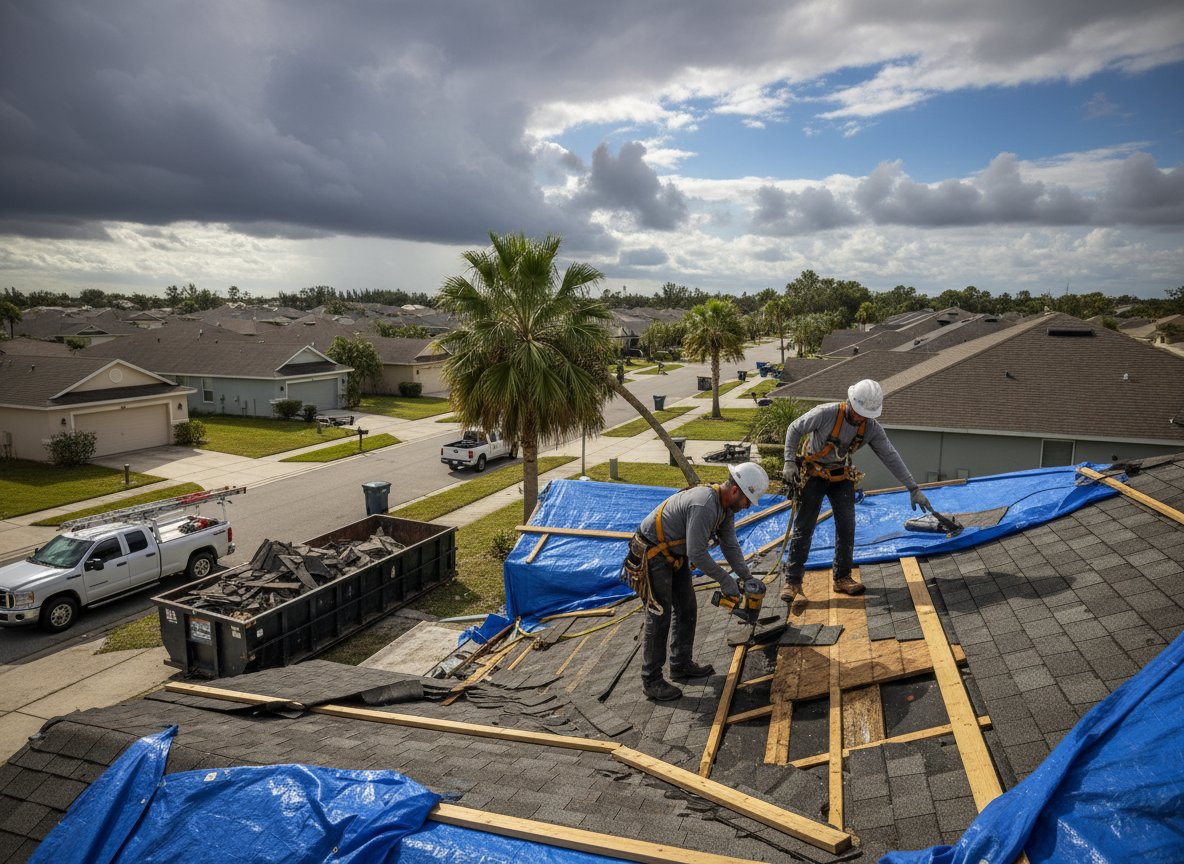
Port St. Lucie was drawn on a map before it was built. A land company platted a grid on pine and palmetto in the early 1960s and sold it lot by lot to people who mostly arrived years later, and the city has been filling in that plan ever since. The result is a roofing market narrower and more repetitive than anything forty miles south: street after street of single-family houses under asphalt shingle, built between the 1970s and the 2000s, with no 1920s tile quarter and almost no mid-century flat-roof stock. Roof repair in Port St. Lucie, FL is the business of reading one housing type very well.
The city belongs to St. Lucie County, which puts it north of the High-Velocity Hurricane Zone covering Broward and Miami-Dade, and directly in the path of the storms that shaped this coast. The code's wind provisions govern here; the salt of the barrier island does not reach this far inland. Florida Roof Repair Pros covers the city from Orlando, and (407) 557-4529 reaches the office.
Reading the City by Section
Roof age is legible from the address. River Park, close to the river, holds the oldest housing, much of it 1960s and 1970s. The streets off Port St. Lucie Boulevard and around Sandpiper Bay followed, then the western expansion through St. Lucie West, then the master-planned community at Tradition. A house in River Park and a house in Tradition can be forty years apart and share a postcode, and they need different work for different reasons.
That spread matters when a roof is being judged. The oldest streets are on their second or third covering and their decks have been through several wet seasons. The middle decades are reaching the end of a first or second roof. The newest are into repair territory rather than replacement. Knowing where a house sits in that sequence is more useful than knowing the city average, which means nothing on any particular street.
The 2004 Hurricanes Are the Local Reference
Most of the country knows 2004 as a Florida story. In St. Lucie County it is a local one: Frances and Jeanne both came ashore at Hutchinson Island, in this county, within weeks of each other in September 2004. That is unusual even by Florida standards — two landfalls in the same county in the same season — and it reset a great deal of the roof stock here. A roof replaced in the months afterwards is now past twenty years and due for a hard look. Wilma in 2005 crossed from the Gulf side and added to the tally.
What those storms exposed was not the shingle field so much as the edges, the ridge and the attachments. A roof that lost its ridge caps and its perimeter while the field survived told you where the weak points were, and the code and the trade both adjusted. On a house of that era the survey still starts at the perimeter for the same reason.
Shingle on Sandy Ground
Shingle is what this city builds with, and heat is what wears it. The south and west planes lose granules first, the mat stiffens, ridge caps crack where they fold, and boots fail long before the field does. A second layer traps heat and shortens every one of those intervals.
Ventilation is the variable that decides how bad it gets. These houses typically have soffit intake at the eaves and ridge or off-ridge exhaust at the top, and the system only functions if both ends are open. Insulation pushed into the eaves during a later upgrade, paint across the soffit vents, a screen nobody has cleaned: any of those closes the intake and the exhaust then draws nothing. The attic temperature climbs, the shingle cooks from beneath as well as above, and the roof fails first on the hottest planes.
The same restriction reads as moisture rather than heat. Damp sheathing, corroded fasteners, staining along the ridge that appears in the cooler months and dries out in summer. It looks like a leak and is not one, which is why the attic belongs in every survey here.
The Re-Cover Question
On a city of shingle roofs, the re-cover question comes up constantly, and it deserves a straight answer. A second layer is allowed in some circumstances and not others, and the deciding factors are how many layers already exist and what the sheathing looks like. Many houses here have been re-covered once, which means the deck has not been seen in decades.
Stripping to the deck costs more in labour and produces a roof that can be inspected, ventilated properly and expected to serve its full term. A re-cover keeps the old layer underneath, traps heat and hides the deck. That trade-off belongs in the written scope, with the deck's condition stated, rather than in a conversation on the morning the crew arrives.
Wind, Code and the County Line
St. Lucie County is outside the hurricane zone, so the specification here follows the Florida Building Code's wind provisions without the zone's additional chapter on underlayment methods and product approval. That widens the range of products available on some roofs. It does not make the city sheltered, as 2004 demonstrated, and the design wind speed for the site, the product approval for the covering and the fastening schedule are still the substance of the permit.
Wind damage has a signature on this stock. It lifts the perimeter first, at eaves, rakes and ridge, and once a corner opens the wind gets under the field and peels sheets rather than individual shingles. After a storm the survey starts at the edge and works inward, because that is where the failure began.
Where the Leaks Start
The entry points on a Port St. Lucie house are few and consistent. Pipe boots and vent collars lead, because the rubber perishes in the sun years before the surrounding shingle wears and a split collar sends water straight down the pipe into a ceiling. Ridge and hip caps follow, since they take wind first and crack at the fold. Valleys are third: every drop landing on two planes arrives in one channel. Fourth is the transition to a flat section over a porch, a carport or an addition, where one flashing does the work of two systems.
Water travels before it appears. A stain at a light fitting or a wall junction in one room frequently traces back to an entry point several metres away, which is why a repair that seals the visible mark returns with the next storm and why the attic is part of the diagnosis rather than an optional extra.
What a Shingle City Asks For
Almost every job here is a shingle job, which makes the work repetitive in a useful sense: the same details fail in the same order, and a surveyor who has seen one street knows what to look for on the next. Leaks come from boots, ridge caps, valleys and the join to a flat section. Age shows on the south and west planes first. Heat and ventilation decide how fast the rest follows.
Emergencies here are usually wind or trees. A limb through the deck after a summer storm, an edge peeled back along a rake, a collar split at the height of a downpour. Closing the opening comes first, and the permanent repair is scoped afterwards, with photographs taken while the damage is still fresh enough to read.
Replacement decisions turn on two facts: how many layers are up there, and what the deck looks like. Both are established by opening the roof rather than by looking at it. Where a house still carries its original covering, the deck has never been seen since it was built, and that is exactly the roof that most needs the attic and the sheathing inspected before a scope is written.
How the Work Goes
The visit begins in the attic as often as on the roof. Ventilation, staining, fastener condition and the underside of the sheathing are all visible from inside, and none of them can be judged from the driveway. The roof walk follows, with the ridge, the valleys, the penetrations and the perimeter photographed.
The scope that results is a short document with specific content: what comes off, what goes back, the underlayment and fastening specified, the number of existing layers recorded, what is assumed about the deck, and what is excluded. On a re-cover it states plainly what will not be visible once the work is done.
Applications go in before work starts. Inspections follow the schedule the city sets — deck and underlayment while they are open, then the finished roof. Where a permit is not required for a repair, the scope still records what was done, because the next owner will want to know.
Completion is documented rather than announced: the inspection record, photographs under the finished surface, and a walk of the property with the owner covering ridge, valleys, flashings and cleanup.
Who Reviews the Application Here
The City of Port St. Lucie issues permits for addresses inside the city. St. Lucie County handles unincorporated land, and the other municipalities in the county handle their own. Which desk takes the file decides the review time and the inspection stages, so the address is confirmed first.
The code beneath the permit is the Florida Building Code. North of the hurricane zone, its wind provisions apply without the zone's additional requirements: design wind speed at the site, approved covering, fastening schedule, underlayment specification. On a re-cover the existing layers are part of the application, not an afterthought.
The Two Cities on This Corridor
Fort Pierce sits north along the US-1 corridor, with White City and Lakewood Park in between, and the two cities have almost nothing in common in roof terms: one is a century-old downtown of masonry and tile, the other is forty years of shingle subdivisions. Stuart, Palm City and Jensen Beach lie south across the Martin County line. Each has its own permit desk.
Port St. Lucie is often described as one of the largest cities in the country by land area, and that size is the roof story. It was assembled from tracts rather than grown from a centre, so there is no old core with a single roof type: the sections east of the turnpike hold the 1980s and 1990s shingle subdivisions, the western sections are newer, and the corridor along US-1 carries the commercial low-slope. What the sections share is sand beneath them, a water table that sits high in places, and a building pattern where the roof is a system of trusses over a slab, which changes how a leak travels and where it surfaces.
What to Say First
Name the neighbourhood as well as the street, because in this city the section predicts the roof's vintage. Mention whether the house has been re-covered, if that is known, and whether the attic has ever been opened up. A photograph from the ground helps. The last permit date is the single most useful document an owner can bring. The office is at 4720 Millenia Blvd, Suite 175, Orlando, FL 32839, and Port St. Lucie calls come through (407) 557-4529.
Around Port St. Lucie
We regularly work near:
- 📍Tradition Square
- 📍St. Lucie River
- 📍Sandpiper Bay
- 📍Port St. Lucie Botanical Gardens
- 📍Clover Park
Roofing Company in Port St. Lucie — Local Notes
- •City of Port St. Lucie permits its own addresses
- •St. Lucie County is outside the High-Velocity Hurricane Zone
- •Frances and Jeanne both crossed the county in 2004