Port Charlotte is the community that General Development Corporation built first, and the shape it was given in the 1950s still governs everything that happens on its roofs. The company platted a grid across the peninsula between Charlotte Harbor and the Myakka, dredged a canal system through it, sold lots to buyers across the country, and left the building to whoever arrived. The result is a community of one-storey houses, many on canals, built over four decades, with no incorporated government of its own.
Two facts sit above all the others here. The first is that Port Charlotte is unincorporated Charlotte County, so every roof permit comes from the county rather than a city. The second is Hurricane Charley, which came ashore at Punta Gorda in August 2004 and crossed this community at close to full strength. A very large share of the roofs standing today were installed in the two or three years after that storm, which makes their age easy to establish and their condition easy to predict. Roof repair in Port Charlotte, FL, starts with those two facts.
A Community Without a City
Port Charlotte has no mayor and no city hall. It is a place defined by a plat, a canal system and a mailing address, governed by Charlotte County. That is not a detail — it decides which building department reviews a roof, which inspection stages apply, and where the records live when a homeowner needs to prove when a roof was last replaced.
Because the community grew lot by lot and street by street, the stock is uneven. A 1962 ranch can sit beside a 1985 house and a 2006 rebuild, and all three can be on the same canal. The survey has to establish which era it is looking at before anything else is discussed, because a 1960s roof and a post-Charley roof fail in different ways.
The Canal System
The canals are the reason people live here, and they are also a reason the roofs age the way they do. A canal lot faces water at the rear, which means salt in the air, an unobstructed wind path at the back of the house, and a seawall that concentrates whatever the wind brings. On a saltwater canal the metal parts of the roof age faster; on a freshwater canal the effect is milder but not absent.
The rear elevation is where a Port Charlotte roof is judged. Drip edge, the flashing at the wall, vent collars, the fixings on a metal panel, the frame of a pool enclosure. Those are the parts that fail under a field that still looks sound, and on a canal lot they fail first.
The Charley Cohort
Charley crossed in August 2004 and did to this community what a storm rarely does: it replaced almost every roof in it within two or three years. That produced a cohort of roofs with a shared installation date, and it means the community now moves through a shared replacement cycle as well.
A roof installed in 2005 or 2006 is now around twenty years old. On this coast that is the point at which a shingle roof is at or near the end of its service life, and it is the point at which insurers begin asking questions. The date on the permit is therefore the most useful single fact about a Port Charlotte roof, and it is worth finding before calling anyone.
Shingle on the Grid
Almost all of the housing is shingle, and the failure pattern is heat-led. The south and west planes take the sun, granules go, and the mat hardens. Because so much of the stock was installed at once and by many different crews, the quality of the ventilation varies from house to house, and that variation now shows as a spread in condition across a street of identical houses.
Ventilation is the diagnostic. A ridge vent needs intake at the soffit; where the intake is blocked, the ridge cannot draw and the deck cooks. On a post-Charley roof that has failed early, the cause is usually found there rather than in the shingle itself.
Tile on the Newer Streets
Some of the newer development and a minority of the rebuilds carry concrete tile, and those roofs present the familiar problem in this part of Florida: the tile is sound and the membrane beneath it is not. On a tile roof installed in the 1980s or 1990s, the underlayment has reached the end of its life while the field still looks new.
Opening the roof at a valley and a hip is the only way to establish that. On a tile roof the tile is usually worth keeping, and the work is a lift-and-relay over new membrane rather than a replacement of the covering.
Ian, Milton and the Harbor
Ian came ashore at Cayo Costa in September 2022 and crossed Charlotte County on its way inland, and Milton followed in October 2024 with surge up Charlotte Harbor and wind across the whole peninsula. Between them and Charley, the community has a storm record dense enough that most roofs can be dated by which event they followed.
Surge matters on the canal streets in a way it does not inland. Water that comes up a canal and over a seawall wets the structure from the ground up, and a roof over a flooded house is a roof over a wet assembly. The covering may be intact while the deck and insulation below are compromised, which is why the visit after a flood is a moisture survey before it is a roofing survey.
Enclosures, Carports and Additions
A great many Port Charlotte houses have a pool enclosure, a carport that became a room, or a lanai under the same roof as the house. Those are where the leaks start, because they are low-slope, they are built with less margin, and their junctions with the main roof were often flashed decades ago.
On a house that was repaired after Charley, those junctions may have been rebuilt then and may now be twenty years old. On a house that was never repaired, they may be original. Either way, the transition is where the diagnosis starts.
The Services Available Here
The work comes from the site's own list, applied to this stock. Roof leak repair is the diagnostic core. Emergency roof repair and emergency roof tarping cover the night a storm opens a roof and water is running. Storm and hurricane damage repair handles the documented sequence afterwards: make safe, photograph, repair, and keep a file an insurer can follow.
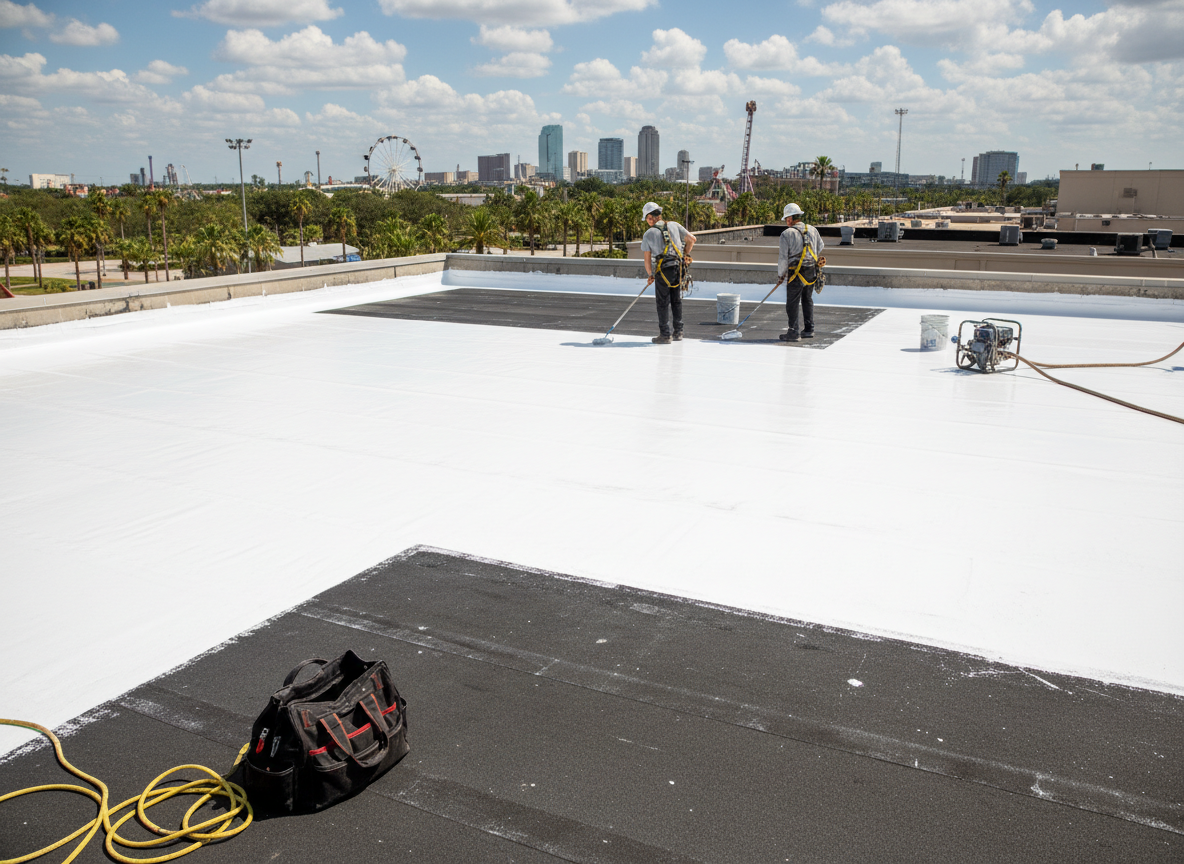
Roof repair is the everyday trade, and here it is often flashing and carpentry at an enclosure or a carport transition. Roof replacement and roof installation handle the end of the Charley cohort and the layered roofs that came before it. Shingle roofing covers almost all of the housing. Tile roofing covers the newer streets, mostly as underlayment work beneath tile that is kept. Metal roofing suits the canal-front rebuilds and the outbuildings. Flat roof repair and roof coating cover the lanais and the small commercial buildings along the Trail. Roof inspection is the visit that starts all of it, and after a storm it is the visit that produces the record.
How a Port Charlotte Job Runs
The first visit is a survey: the covering and its age, the deck at the eaves and around penetrations, the enclosure and carport transitions, and the attic where it can be reached. The permit history is checked at the same time, because on this community the date is often the whole story.
Then the written scope, which separates replacement from repair, names the underlayment and fastening method, records what is assumed about the deck, and lists exclusions. On a canal lot it also specifies the fastenings and the metals at the rear elevation, because that is where the exposure is.
The permit is filed with Charlotte County before work starts, and inspections follow the county's stages. The close-out is a walk with the owner covering ridges, edges, the seawall side and cleanup, plus photographs of what is now covered up.
One County Desk
Port Charlotte is unincorporated, so residential roofing permits go to Charlotte County's building department. Punta Gorda, immediately to the north, is a city with its own department, and the boundary between them runs through the middle of what looks like one urban area. North Port across the county line is in Sarasota County and permits its own work.
The Florida Building Code applies beneath the county permit. Charlotte County is outside the High-Velocity Hurricane Zone, which covers Broward and Miami-Dade, so the zone's extra underlayment chapter does not reach here. The wind provisions do, and the coastal strip along the harbor is in the wind-borne debris region, which brings product approval and opening protection into a replacement permit near the water.
Within Ten Miles
Punta Gorda to the north, Murdock and Deep Creek to the east, Harbour Heights and Cleveland along the Peace River, El Jobean and Charlotte Harbor to the west, and North Port across the county line. Each has its own permit desk or none, and the exposure changes as you move from the canals to the inland streets.
Insurance, Roof Age and the Paper Trail
On a post-Charley roof the paperwork is part of the job. Insurers increasingly ask for the age of a covering, and a homeowner who cannot produce a permit date is asked to prove it another way. The permit record, the inspection history and the photographs of the deck taken during the work are what answer that question, and they are worth keeping together in one place.
That is also why the survey here records the deck condition rather than only the covering. When a roof from 2005 is being assessed, the question is not whether the shingles look worn but whether the assembly beneath them is sound enough to carry another covering or needs to come off. The photographs answer it years later, when the roof is next discussed.
Calling About a Port Charlotte Roof
The address settles the permit route through the county, and on a canal lot it settles the exposure. The date of the last roof permit, if it can be found, is the single most useful fact, because it places the roof in the Charley cohort or outside it. The covering and its condition decide whether this is a repair or a replacement conversation. The office is at 4720 Millenia Blvd, Suite 175, Orlando, FL 32839, and Port Charlotte calls come to (407) 557-4529.
Around Port Charlotte
We regularly work near:
- 📍Charlotte Harbor
- 📍Port Charlotte Beach Park
- 📍Peace River
- 📍El Jobean
- 📍Charlotte Sports Park
Roofing Company in Port Charlotte — Local Notes
- •Port Charlotte is unincorporated — Charlotte County permits every roof
- •Most roofs date from the two years after Charley in 2004
- •Canal-front lots carry the salt and the wind at the rear elevation