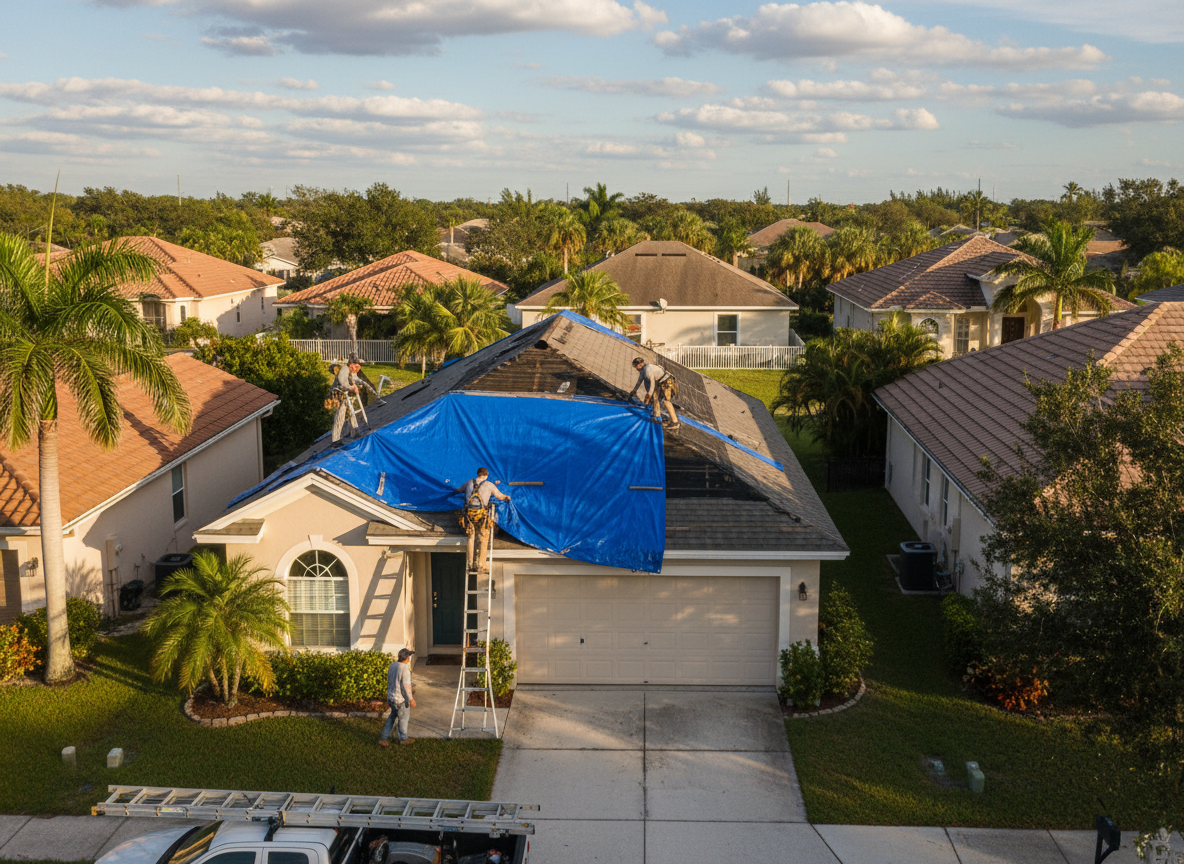
Pompano Beach has been roofed in four different eras and most of its buildings still carry the evidence. The city incorporated in 1908 and grew first on farming and fishing, so 1920s and 1930s cottages survive near the original settlement. The beach blocks filled in during the 1950s and 1960s with low apartment buildings and motels under flat roofs. The subdivisions to the west arrived between the 1970s and the 1990s under shingle. And the commercial corridors have been re-roofed so many times that the roof is now a maintenance history rather than a single assembly. Roof repair in Pompano Beach, FL starts by establishing which of those a building is, because the answer decides what is even possible.
Pompano Beach sits in Broward County, which places it inside the High-Velocity Hurricane Zone alongside Miami-Dade, and close enough to the ocean that salt reaches every roof east of the Intracoastal. Florida Roof Repair Pros works the city from Orlando, and (407) 557-4529 is the number for Pompano Beach work.
The Beach Blocks: A History of Patching
Between the ocean and the Intracoastal, the dominant building is a two or three storey apartment house or a motel with a flat or near-flat roof over a concrete deck, a parapet around the edge, and a scupper or two for drainage. That design was standard when these buildings went up, and it works — until the maintenance cycle takes over. A patch here, a coating there, another patch over the coating, a second coating over the patch. After thirty years the roof is a stack of repairs and the original membrane is somewhere underneath all of it.
This is the single most common situation in the city, and it changes the conversation. The question is not which coating to apply next. It is whether the assembly below the stack is still doing its job, and that can only be answered by opening it: lifting a section at the parapet, at a drain and at a seam, reading the membrane, and checking whether water has been sitting under it. On some buildings the answer is that a sound modified bitumen surface simply needs renewing. On others it is that the deck has been damp for years and the assembly has to come off.
Why the Parapet Comes First
On a beachside block the parapet is the part that fails earliest and the part nobody can see from the ground. It takes wind on two faces, salt on both, and it holds the flashing that keeps water out of the wall below. When that flashing separates, water goes behind it and into the wall cavity rather than onto the roof, which is why the stain inside often appears at a completely different elevation from the damage.
Scuppers fail next. A scupper that has silted holds water against the parapet, and standing water finds every weakness in a seam. On a building where the roof is also the ceiling of the top floor, the first sign is a stain in a unit, and by then the water has usually been travelling for a while. The order of inspection on these roofs is therefore: parapet, scupper, seam, penetration, field. That is the reverse of how most people think about a roof, and it is the order that finds the leak.
Inland: Shingle, Attic, Ventilation
West of the Intracoastal the city changes. Single-family houses from the 1970s through the 1990s, concrete block under stucco, low-pitch hip and gable roofs, asphalt shingle, more attic volume and a ventilation question that the beach blocks never have to ask. Tile appears across the older parts of the city and on some later construction, usually barrel or S-profile, and it brings its own set of assumptions with it.
Inland, shingle carries the load and heat sets the pace. Granules leave the south and west planes first, the mat stiffens until it cracks at the ridge, and boots fail long before the field looks worn. A second layer traps heat and brings every one of those failures forward.
Tile Assumptions Worth Correcting
Tile is the covering most often misread in this city, and the error is always the same. The tile sheds the rain and takes the sun; the membrane beneath it does the waterproofing. On a roof from the 1950s to the 1980s that membrane has usually expired while the tile above it still looks serviceable.
That changes what a repair is. On a sound tile field the work is often surgical: lift the tile over the affected area, replace the failed section of underlayment, relay the original tile. It preserves material that cannot be matched and it costs less than a new field. The decision is made on the condition of the membrane, not on the appearance of the tile, which is the opposite of how most owners have been taught to judge a tile roof.
Salt, Wind and What They Take
Salt is the invisible part of a beach-block problem. It does not touch the tile or the shingle; it consumes the metal — fastenings, valley and hip flashings, drip edge, vent collars, scupper liners, parapet coping. That is why a coastal roof fails at its hips and terminations while the field still photographs well.
Wind has a matching pattern. It lifts the perimeter first — eaves, rakes, ridge, parapet — and once a corner opens it gets under the field and peels sheets rather than shingles. On the beach blocks a lifted parapet coping takes the membrane with it, which is why the edge is inspected before the middle on every property east of the Intracoastal.
What the Storm History Tells You
Ask how old a Pompano Beach roof is and the answer is often a storm. Wilma's October 2005 crossing from the Gulf cleared whole streets in this county, and the roofs that replaced them are approaching twenty years. Irma's long push up the peninsula in 2017 loosened what Wilma had left. Andrew in 1992 is the reason the wind requirements in force today are stricter than the year on the deed.
Inside the hurricane zone the response is specified rather than improvised. Particular underlayment systems, a denser fastening pattern, coverings approved for the zone, and on a flat roof a defined method of attachment at the perimeter. That last point is where beachside buildings earn or lose their roof in a storm.
Two Trades in One City
A beach block and an inland street ask for different skills. On the block the work is membrane, flashing and drainage, with the parapet as the recurring problem and the coating question always in the background. On the inland street it is shingle, attic and ventilation, with the deck and the layers deciding the scope. The two are rarely confused once someone has been on the roof, and they are confused constantly over the phone.
The emergency work splits the same way. On a block it is usually wind: a coping lifted, a flashing torn, water through a ceiling the same night. Inland it is usually a tree, a lifted rake or a boot that has finally split. Either way the first visit closes the opening, and the repair is scoped once the damage can be read in daylight.
Coverings are not a menu here. The beach blocks take membrane or a renewed coating where the surface is still sound. The inland streets take shingle, or tile where the house already has it. The commercial corridors take flat work. On a block that has been patched for thirty years, the honest first question is whether the assembly under the patches is still doing its job.
The First Hour on the Roof
An hour on a Pompano Beach roof settles most of the argument. The parapet is examined from both faces, the scupper is tested for flow, the membrane is opened at a seam and at the low point, and the deck beneath is felt for softness. On an inland house the attic is entered and the soffit line checked before the shingle is judged at all.
What that hour produces is a short, specific scope: what comes off, what is renewed, what is repaired and what is left alone, which underlayment and fastening are specified, and what is excluded. On a stacked roof it also states how many layers will remain, since that is the fact a future owner will need.
Permits are filed before work starts. On a replacement the deck and underlayment are inspected while they are open, and the final inspection follows. On a coated roof the sequence is shorter but the record still matters, because a coating applied over a failed membrane is a fact worth knowing about a building.
Who Signs the Application
Pompano Beach has its own building department for addresses inside the city limits. Broward County handles the unincorporated pockets, and the surrounding cities each issue their own permits. The receiving office sets how long review takes and which inspections are required, and that is why the address is verified at the outset.
Underneath sits the Florida Building Code and the hurricane zone chapter that governs Broward. On a flat roof the perimeter attachment is the detail that matters most, since that is where wind load concentrates and where a parapet either holds or lifts. On a shingle roof it is the fastening schedule and the edge.
Nearby Towns
Lighthouse Point and Hillsboro Beach lie to the north, Deerfield Beach beyond them, and Lauderdale-by-the-Sea to the south. Inland, Coconut Creek, Margate and Coral Springs are all within a few minutes, and Fort Lauderdale is a short drive down the coast. The island towns are almost entirely coastal stock; the inland ones are newer and larger.
Pompano Beach carries two roof histories that barely touch. East of the Intracoastal the blocks were laid out around the fishing village and the beach, and the roofs there are small, steep and frequently patched, with additions behind them that were never drawn. West of the canal the city is later and more uniform, built out through the 1980s and 1990s in subdivisions where the same three or four plans repeat down each street. A crew that works one side all week and crosses the bridge on Friday is working on different buildings, different decks and often a different permit file, and an estimate written for one does not transfer to the other.
What to Say on the Phone
The address decides the permit desk. The building's era is the next most useful fact, since it usually predicts whether the roof is a patched flat assembly, a tile field or a shingle plane. Say whether the property is east or west of the Intracoastal. A photograph from the ground helps, and the permit history is worth more than the roof's appearance on a block that has been coated repeatedly. The office can be reached on (407) 557-4529, at 4720 Millenia Blvd, Suite 175, Orlando, FL 32839.
Around Pompano Beach
We regularly work near:
- 📍Pompano Beach Pier
- 📍Hillsboro Inlet Lighthouse
- 📍Pompano Beach Amphitheater
- 📍Sample-McDougald House
- 📍Intracoastal Waterway
Roofing Company in Pompano Beach — Local Notes
- •City of Pompano Beach permits its own addresses
- •Broward County: High-Velocity Hurricane Zone
- •Parapets and scuppers fail first on beachside blocks