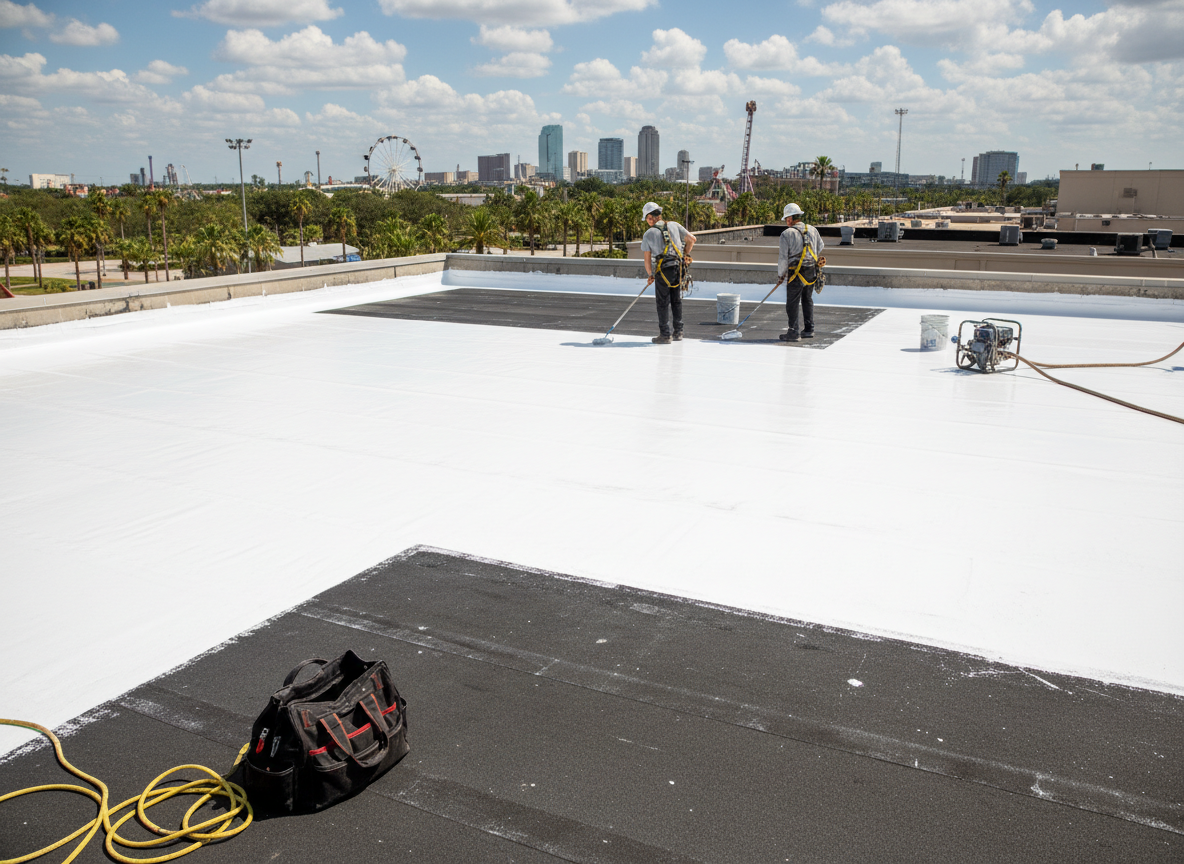
Panama City Beach incorporated in 1970, which makes it younger than most of the roofs on it and younger than almost every other city in this part of Florida. It is a resort city on a barrier peninsula, with the Gulf on the south side, Grand Lagoon and West Bay on the north, and a strip of beachfront hotels and condominiums running along the highway that gives the place its economy. Behind the strip there is a residential town of houses, duplexes and small complexes that most visitors never see. Roof repair in Panama City Beach, FL therefore covers two very different kinds of building, and the work on one has almost nothing in common with the work on the other.
The other defining fact is exposure. A barrier peninsula has water on both sides and no inland buffer, so wind arrives at full strength and salt arrives with it. The buildings here are designed for that, more or less, but design intent and current condition are different questions, and on a forty-year-old condominium the answer is usually found at the edges, the drains and the penetrations rather than in the middle of the roof.
A Resort Strip and the Town Behind It
The strip is the part everyone pictures: mid-rise and high-rise condominiums, hotels, restaurants and commercial buildings, most of them concrete or steel frame with low-slope roofs. The roofing there is membrane, coating, and in some cases a pitched overlay added for appearance or drainage. Below those roofs are occupied units, mechanical equipment and, frequently, a building envelope that has been patched in stages over decades.
Behind the strip the stock is residential and largely 1970s to 2000s: single-family houses, duplexes, small multi-family buildings, and the canal-front and bayou-front houses on the north side. Coverings are shingle on most of them, concrete tile on a significant minority, and metal on newer and higher-end construction. The older village areas at Laguna Beach and Sunnyside to the west are older again, with small cottages and a mix of whatever has been added over the years.
The two halves of the city share a permit office and a postcode but not a maintenance culture. A condominium has an association, a reserve schedule and a contractor relationship. A house has an owner who calls when something leaks. Both end up needing the same survey, but the decisions that follow are made differently.
High-Rise Roofs: Membrane, Coating and Drainage
On a low-slope roof the failure points are predictable. Seams fail first where the membrane has been lapped and sealed, particularly on a roof that has been recoated over a previous coating. Drains and scuppers are second: a drain set slightly high leaves water standing, and standing water finds every weakness in the assembly. Perimeter terminations are third, because that is where the wind gets a grip and where the wall junction has to do two jobs at once.
Coating is the common local answer to an ageing low-slope roof, and it is a good one when the assembly underneath is sound and dry. It is the wrong answer when moisture is already trapped, because a coating seals the surface and holds the moisture in. The difference is established by inspection — moisture readings, core samples where warranted, and a look at what the previous coating is hiding — rather than by appearance.
Ponding is the other local issue. On a building designed with a slight slope to drains, deflection over decades can leave low spots that never dry. Water that sits for days after rain breaks down a membrane far faster than sun does, and it is the reason a roof that looks fine in a photograph taken after a dry week can be failing in August.
Salt, Sun and the Fastener Line
On the residential streets behind the strip, salt is the material problem. It attacks fasteners, flashings, vents, gutters and the cut edges of metal, and on a house a few hundred metres from the beach it does so at a rate that people moving from inland are not prepared for. A metal roof here can have sound panels and a line of failed washers, with the leak appearing at the fastening rather than in the sheet.
Sun is the other half. A shingle roof on an exposed peninsula bakes through the summer with no shade and no inland cloud to soften it, and the mat ages from the top down. The same roof also ages from the attic up, because a poorly vented attic in this climate reaches temperatures that shorten the life of everything above it. A roof that is fifteen years old here can be further along than a twenty-year-old roof inland, and the survey judges condition rather than age.
On tile, the tiles usually outlast the underlayment beneath them, and a leak is a statement about the underlayment and the flashings rather than about the tile. Repair means lifting and re-laying tile, and matching it on an older roof is the usual constraint.
Michael, Opal and the Long Memory of This Beach
The beach has a storm history that goes back further than the condominiums. Hurricane Eloise came ashore west of Panama City in September 1975 as a Category 3, when much of what stands here now had not been built. Hurricane Opal crossed the coast further west in October 1995 and still brought wind and heavy surf to this beach. Hurricane Michael made landfall at Mexico Beach in October 2018 as a Category 5 — the first on record to affect the Florida Panhandle — and though its centre went ashore to the east, Panama City Beach took severe wind and water damage.
On the high-rise stock the damage pattern after a storm like Michael is at the perimeters: parapets and edge metal, balcony and roof junctions, mechanical screens and penthouses, and every penetration. On the houses it is the familiar list — shingle lost at ridges, hips and rakes, soffits and fascia pulled, carport and porch roofs lifted. What both have in common is that the damage is concentrated where the roof meets something else, which is why a survey that only photographs the field of the roof tells you very little.
Services and the Two Kinds of Building Here
The list on this site applies to both halves of the city, but what it means differs. On a condominium the work is membrane and coating: seams, drains, perimeter terminations and penetrations, with roof leak repair starting at the point of entry and roof coating only where the assembly beneath is dry. On a house it is the covering and the flashings, with flat roof repair for the shallow sections that the residential pattern produced.
Where a storm has opened a roof, emergency roof tarping comes first to keep the units or the rooms dry, then emergency roof repair where the opening closes in a visit, then storm and hurricane damage repair where the whole roof needs documenting and rebuilding. Roof replacement is the honest answer when an assembly has reached the end of its life, roof installation covers new buildings, and the residential choices are shingle roofing, tile roofing and metal roofing. Roof inspection is the service that produces something an owner or an association can act on.
How the Work Is Planned
A survey comes before a proposal. Roofs are walked where the pitch and surface allow, photographed from ladders and edges where they do not, and examined from the attic or plenum where access exists. On a low-slope building the survey also maps drains, scuppers and any ponding, since those decide more about the life of a membrane than the membrane does.
The written scope names what is removed, what is replaced, what is left alone, the products specified, and how the building will be protected while it is open. That last part matters on a condominium, where the units below cannot be exposed to a summer storm. Permission is applied for before work begins, and the sequence follows the city's or county's inspection order. The finish is documentary: signed inspection, photographs of what was covered, and a walk with the owner or the association's manager.
Permits, Code and the Association
Inside the city limits the City of Panama City Beach permits the work; in unincorporated Bay County the county does, in a separate system with its own queue. The High-Velocity Hurricane Zone belongs to Miami-Dade and Broward and does not reach this far, but design wind speed and exposure on a barrier peninsula sit at the demanding end of the statewide code. Coverings need a current product approval and a matching fastening schedule, and fasteners and flashings have to survive salt as well as wind. On a condominium the association approves the scope and the schedule before anything is ordered, and contract work opens with a notice of commencement.
Attic Heat and the House Stock Behind the Strip
On the residential side of Panama City Beach, a large share of the roof work is not about storms at all. It is about an attic that cannot breathe. A house built in the 1980s or 1990s behind the strip typically has soffit intake along the eaves and a ridge vent along the top, and both depend on being clear. Insulation blown tight against the roof deck at the eaves, a soffit painted over, or a ridge vent that was covered during a re-roof will stop the system working, and the attic temperature climbs through the summer.
The visible result is a roof that ages unevenly, with the south and west planes going first. The invisible result is condensation: damp sheathing, rusted fasteners and staining at the ridge that appears in the wet season and dries out afterwards. Homeowners often read that as a leak and are surprised when the survey finds no entry point. It is not a leak; it is a ventilation failure, and putting a new covering over it without correcting it wastes the covering.
The same survey also looks at how the house is used. A property let to visitors runs its air conditioning hard and its dryer and bathroom fans often, and where those exhaust into the attic rather than outside, the moisture load rises. Correcting the exhaust is part of making a roof last here, and it is better than replacing one early.
The Roof and the Balcony Are One Assembly
On the beachfront buildings here, the roof and the balconies meet, and water does not respect the line between them. A balcony slab projecting beyond the wall has a flashing at its junction with the roof or the wall above, and that flashing is one of the most exposed details on the building: it takes wind-driven rain from the Gulf, salt from the air, and the movement of a slab that heats and cools every day.
When it fails, the symptom appears inside rather than at the balcony. Water tracks back along the slab or down a wall cavity and shows up at a ceiling two floors below, which is why a leak on a high-rise is so often misdiagnosed from the interior. The survey therefore looks at the junctions, the coatings on the balcony decks, the drains and the terminations, not only at the roof field.
The same applies to parapets and mechanical penthouses. These are the parts of a beachfront roof that get replaced piecemeal and the parts that decide whether the assembly as a whole performs. A roof repair that ignores them is a repair to the easy half of the problem.
Around the Beach
Laguna Beach and Sunnyside sit west, Carillon Beach and West Bay northwest, Grand Lagoon and the state park east, and Panama City lies across the Hathaway Bridge. Seacrest and Inlet Beach are just past the county line. Housing changes with each, and so does the permitting office, which is checked before a date is offered.
Making the First Call
Have the address ready, because it decides who permits the work, then the covering type and its age if known, any permit history, and where water is showing inside. On a rental or a condominium, the manager's contact and the next occupancy date help plan around the building's calendar. Florida Roof Repair Pros is on (407) 557-4529, with the office at 4720 Millenia Blvd, Suite 175, Orlando, FL 32839.
Around Panama City Beach
We regularly work near:
- 📍Panama City Beach and the city pier
- 📍St. Andrews State Park
- 📍Grand Lagoon
- 📍Laguna Beach
- 📍Hathaway Bridge to Panama City
Roof Repair in Panama City Beach — Local Notes
- •Incorporated in 1970; the beachfront stock is 1970s onward
- •Two building types: low-slope condominiums and residential shingle
- •Salt drives fastener and flashing work