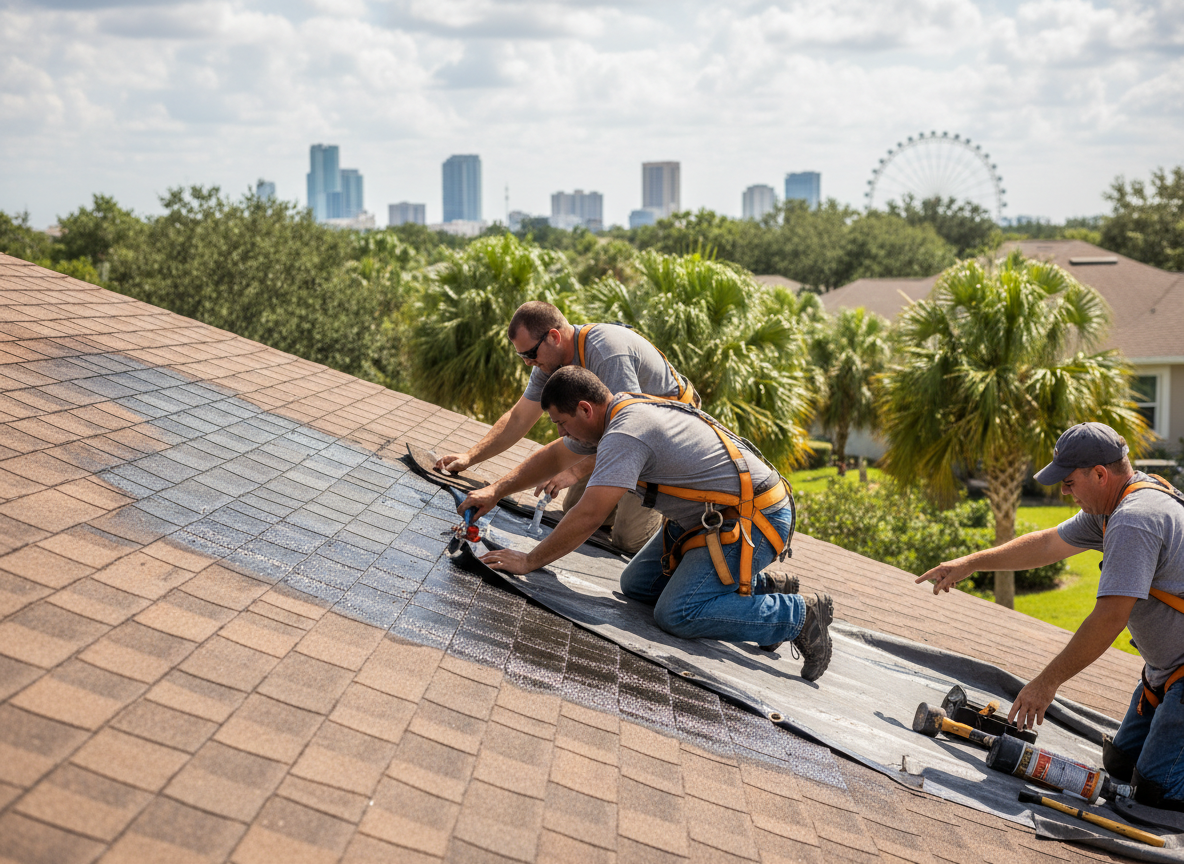
Palm Coast is younger than most of the roofs on it, which is the odd fact that shapes almost every job here. The city was only incorporated at the end of 1999, but the land was bought and platted three decades earlier, and a large share of the housing went up through the 1980s and 1990s under a single developer's plan. Those roofs are now passing the age at which a builder-grade shingle system reaches the end of its service life, in a city where nearly every street was laid out before the first house was built. Roof repair in Palm Coast, FL, is therefore less about patching old damage and more about managing a replacement wave across a very large, very uniform housing stock.
The city covers a long stretch of Flagler County, running from the Atlantic across the barrier and into the pine and marsh behind it. A canal network dug in the years after the land was assembled in 1969 puts a great many houses directly on salt water. The Hammock, the older settlement along the coastal road, sits under live oaks between the canals and the beach. Elevation is low throughout, and the water table is close enough that a roof here is always working in humid air.
The 1969 Plan and the Canal Lots
The land that became Palm Coast was assembled in 1969 and planned as a community of tens of thousands of homes, with a canal system excavated from that year into the mid-1970s. That history explains two things a roofer notices immediately. The first is the uniformity of the housing: similar lots, similar setbacks, similar roof forms, built in phases by a small number of builders. The second is the canals, which put a large number of houses on water in a city that is otherwise set back from the ocean.
A canal lot changes the maintenance profile. The air is salt-laden even several miles inland, the humidity is higher, and the roof spends more of the year wet. Fasteners, drip edge, vent collars and the metal on pool enclosures corrode earlier than they would on a dry inland lot. The covering itself is usually unaffected by salt, but everything holding it down and sealing its edges is not.
Builder Shingle and the First Replacement Cycle
Most of the housing from the 1980s and 1990s was built with a standard asphalt shingle system over a panel deck, on hip and gable roofs designed to be efficient rather than complex. Those roofs performed as intended. The issue is timing: a shingle system of that generation has a service life measured in a couple of decades in Florida heat, and an entire city built in one era reaches that limit in one era.
What that looks like in practice is a street where several houses are having roofs replaced in the same year. The failure is not dramatic. Granules go, the mat hardens, the shingle curls at the rake and the ridge, and the first leaks appear at valleys and pipe boots rather than across the field. Because the deck is a modern panel deck rather than the board deck of an older city, the substrate is usually sound, which makes these replacements relatively straightforward once the covering is stripped.
The Hammock is the exception to the pattern. It is the old settlement along the coastal road, north of the canals, where the houses sit under live oaks on ground that was never part of the platted grid. Roofs there are older, more varied and more shaded than the rest of the city. Where a 1990s canal-lot house has a straightforward hip roof over a panel deck, a Hammock house may have a steep gable, a metal roof that has been recoated twice, and a screen porch whose roof meets the main plane at a shallow angle that holds water.
What Fails First on a Palm Coast Roof
On the builder-era houses the sequence is fairly consistent. The pipe boots go first, because the rubber collar on a plumbing vent perishes in ultraviolet light long before the shingle around it fails. Valleys are next, since that is where the water volume concentrates and where the least material was used. Then the drip edge and the rake, where the edge metal has been taking salt and sun for twenty-five years. Ridge caps go around the same time, and the field is usually last. A homeowner who has had three separate leaks in three years on a roof that looks presentable is not unlucky; they are working through that sequence one item at a time.
Ventilation decides how long the rest lasts. The 1980s and 1990s roofs were built with soffit and static vents sized for the insulation of the period. Insulation has since been topped up, soffit intakes have been painted over or covered by landscaping, and the attic now runs hotter than it did. Heat from below ages the shingle mat faster than sun from above, and it shows on the west and south planes first. When a replacement is planned, the ventilation calculation is part of the scope rather than an afterthought, because a new covering over an attic that cannot breathe will age the same way.
The Services Available Here
The trade list on this site applies to Palm Coast as it stands, and the emphasis follows the housing. Roof leak repair is the everyday call: a stain on a ceiling after a summer storm, a boot that has split, a valley that has started to run. Emergency roof repair and emergency roof tarping cover the afternoon a limb comes through a deck or a storm opens a ridge, and in a city with this much canopy that is a real category rather than a theoretical one. Storm and hurricane damage repair handles the sequence after an event, from making the roof safe to producing the record an insurer can follow.
Roof repair is the localised work: valleys, penetrations, chimney flashings, ridge caps and the sections that fail before the rest. Roof replacement and roof installation are the larger conversation here, because a large share of the city arrives at that point within the same few years. Shingle roofing covers the builder-era stock and the newer subdivisions, tile roofing the houses built in the Mediterranean style and the properties where the structure has been checked for the weight, and metal roofing the Hammock houses and the owners who want a longer service life and are prepared to specify the fastening for it. Flat roof repair and roof coating serve the low-slope sections on the commercial corridors and the flat-roofed additions behind some of the older houses. Roof inspection is the visit that establishes whether a leak is a repair or a symptom, which on a 1990s roof is the question that decides everything else.
How a Palm Coast Job Runs
A job here starts with the permit history, because Palm Coast is young enough that the record is usually complete. The last re-roof date, the product that was installed and the inspection history are all in the city's system, and that record sets the expectation before anyone goes on the roof. On a canal lot the survey then pays particular attention to the fixings, the edge metal, the vent collars and any equipment on the roof, because those are the parts that fail first in this air.
The survey records the roof plane, the attic where there is access, and photographs at every valley, penetration, ridge and edge. The deck is checked from the attic side as well as from above, since a panel deck that has been wet for years delaminates before it sags. The written scope then sets out the covering and underlayment specified, the fastening pattern, what is assumed about the deck, what is excluded, and whether the work is a tear-off or a recover over an existing single layer. On a canal lot it also names the fixings, because specifying the covering and leaving the fasteners to whoever buys the boxes is how a coastal roof gets built twice.
The permit is filed with the right office, inspections are booked to the stages the work needs, and the job closes with a walk over the finished roof and photographs of everything that is now covered. That file matters more here than in most places, because the next owner of a 1995 house will want to know which cycle of the replacement wave it is on.
Permits, Associations and the Paper Trail
Addresses inside the city are permitted by Palm Coast Building Services, which treats a re-roof as its own permit and expects the roof-specific paperwork that goes with it. Addresses in unincorporated Flagler County, which includes the ground west of the city and parts of the coastal strip, are permitted through the county's office in Bunnell. Both apply the Florida Building Code, and neither is in the High-Velocity Hurricane Zone, though the code's wind provisions and the product approval system apply to every covering installed.
Many Palm Coast addresses also sit inside a community with an architectural review process, and that runs alongside the building permit rather than instead of it. The covering, the colour and the visible profile are the usual subjects. Establishing both approvals before material is ordered is the difference between a scheduled job and a pallet of tile that cannot be used.
Within Ten Miles
Flagler Beach to the north-east, Beverly Beach beyond it, the Hammock along the coastal road, Bunnell inland to the west, Grand Haven on the southern side of the city, and the canal neighbourhoods around Palm Harbor. Each has its own era of roof and its own exposure, and the beachside addresses carry the salt that the inland ones escape.
Two Roofs on the Same Street
The uniformity that makes a Palm Coast replacement straightforward in construction terms makes it awkward in scheduling terms. When several houses on a street are ready at once, the practical questions are the order of the work, where material and debris can stand without blocking a driveway, and how a household manages for the days the roof is open. A written programme that names the sequence and the staging is worth more here than on a street of mixed ages, because the neighbours are on the same timetable and the same access constraints.
It also matters for the material. Covering lines change, profiles are discontinued and colours are retired, and a shingle that matched the house next door in 1996 may no longer exist. Where a single plane or a small section is being replaced rather than the whole roof, the survey records what is actually on the roof and whether a match is available, and the scope says plainly what will happen if it is not. On a street where the houses were built together, an obvious patch is more visible than it would be elsewhere, and the honest options are usually a full plane rather than an invisible repair.
Calling About a Palm Coast Roof
The address decides whether the permit goes to the city or the county. The year the house was built decides which part of the replacement cycle the roof is on. The lot decides how much of the problem is salt, and the association decides what the new covering is allowed to look like. The office is at 4720 Millenia Blvd, Suite 175, Orlando, FL 32839, and Palm Coast calls come to (407) 557-4529.
Around Palm Coast
We regularly work near:
- 📍Washington Oaks Gardens State Park
- 📍Flagler Beach
- 📍The Hammock
- 📍Grand Haven
- 📍Palm Coast canals
Roofing Company in Palm Coast — Local Notes
- •City of Palm Coast Building Services requires a separate re-roof permit
- •Unincorporated Flagler County permits through the central office in Bunnell
- •Most housing was built in a few phases under the original 1969 plan