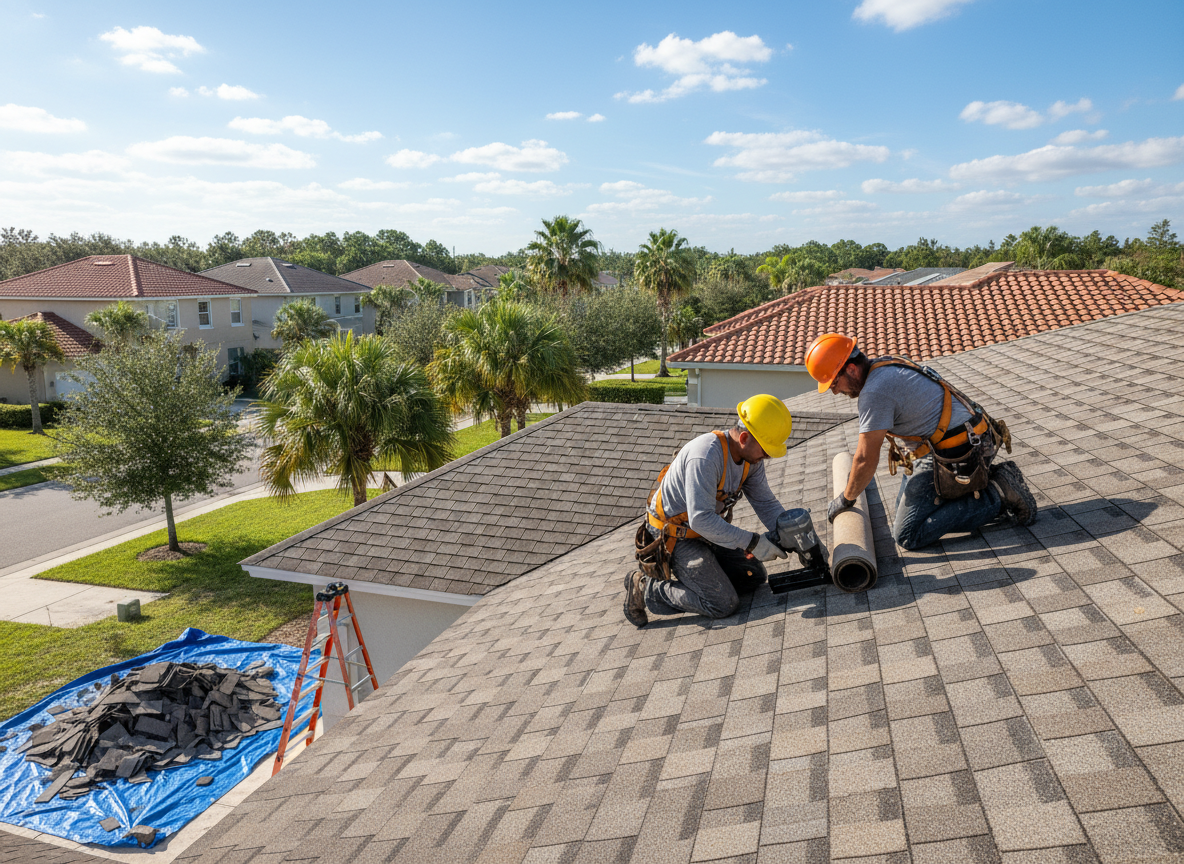
Palatka was a port before it was a town, and the river that made it is still the thing that decides how its roofs behave. The city sits on the west bank of the St. Johns, roughly thirty miles upriver from St. Augustine, at a point where the river is wide enough to have carried steamboats and deep enough to have made the place a rival to Jacksonville for two decades. Roof repair in Palatka, FL, has to account for three local facts that do not apply in the same combination anywhere else in this batch: a housing stock that is older than almost anything around it, a downtown rebuilt in brick after a fire, and a permitting arrangement in which the city and the county share one building department.
The first two shape the work. The third shapes the paperwork, and it surprises people. Palatka does not run its own building department in the way a city of its size usually would. Applications go to Putnam County first, and then to the city. Both offices are in Palatka, and the county's is a few streets from the courthouse, so the practical effect is a single town with a two-step process rather than a drive to another county.
A Port Town's Roof Stock
Palatka was incorporated in 1853, burned in the Second Seminole War, and then spent three decades after the Civil War becoming what its promoters called the Gem City of the St. Johns. By the mid-1880s seven steamboat lines worked out of the town, five railways reached it, and the hotels along the riverfront took the winter trade that later went south to Florida's east coast.
The Great Fire of 1884 ended one version of the town and produced another. Five blocks of the business district burned, including the hotels, the wharves and the bank, and the rebuilding that followed was in brick rather than timber. That is why the downtown presents masonry parapets to the street instead of the wooden storefronts of the boom, and why so much of the commercial roof stock here is flat and hidden rather than pitched and visible.
The Hammock and the South Historic District
The Hammock is the old name for the residential ground south of the business district, and it survives as the South Historic District: twenty-three blocks of late nineteenth and early twentieth century houses on streets laid out in the 1840s and 1850s. Queen Anne, Colonial Revival, Mediterranean Revival, bungalow and plain frame vernacular all appear within a short walk, and the district holds one of the larger collections of nineteenth-century housing in this part of the state.
For a roofer, that variety means the survey cannot be generic. A Queen Anne house with a turret and a complex hip-and-gable roof has valleys and wall junctions in places a simple gable does not. A Colonial Revival house with a low hipped roof and a deep cornice hides its ventilation and its eave details behind trim. The bungalows have wide porch roofs at shallow pitch that meet the main roof at exactly the angle that holds debris. And most of these roofs have been recovered more than once, so the number of layers, the condition of the deck beneath and the state of the original flashings are all open questions until someone looks.
Downtown Brick and the Roofs Behind Parapets
The commercial buildings on the main streets present a parapet, and behind it the roof is flat or barely pitched. Water does not run off a roof like that; it finds a drain, a scupper or a built-in gutter, and each of those is a detail that was designed for the volume of rain a hundred and forty years ago. When a scupper blocks, the roof ponds, and the pond finds the oldest lap in the membrane.
These roofs are repaired rather than replaced far more often than residential roofs are, because the building beneath is worth keeping and the roof is a serviceable assembly rather than a decorative one. Coating has a real role on a sound membrane with working drainage. It has no role on a roof that is ponding, because a coating that holds water against a failing lap accelerates the failure it was meant to postpone.
Bungalows, Porches and the Working Streets
North and west of downtown the housing changes character. The streets off Reid's Garden and the blocks behind the commercial frontage are filled with smaller frame houses from the 1900s to the 1930s, many of them bungalows with a single gable facing the street and a porch tucked under the main roof slope. A great many were built for workers in the timber and citrus trades, and they have been maintained in the way that working housing is maintained: repaired when it leaks, recovered when it cannot be repaired.
The porch is where these roofs fail. A porch roof at shallow pitch sheds slowly, its valley against the main roof is short and often flashed with whatever was available, and the ceiling beneath it is the first place a stain appears. The rear of the same house usually has an addition, sometimes two, each with its own low-pitch roof meeting the original at a junction that was never designed to be there. On a house like this the leak is a junction problem, and the covering is usually the last thing at fault.
River Air, Fog and Flood
Living beside a river this wide has consequences that a coastal city does not share. The air is humid year round, and in the cool months fog forms over the water and sits in the low streets until mid-morning. A roof that is wet for half the day, every day for weeks, is a roof whose details are being tested continuously rather than occasionally. Condensation on the underside of the deck is common in these houses, and it is routinely mistaken for a leak, particularly in the older ones where the attic ventilation was sized for a house with no air conditioning.
Flooding is the other half of it. Hurricane Irma in September 2017 pushed water up the St. Johns and flooded low ground along the river in this county, and the streets nearest the waterfront took water in places that had not seen it in living memory. The roof damage in that event was secondary but real: saturated walls, tested flashings, and water driven sideways into junctions for hours. Palatka roofs are rarely torn off by wind. They are soaked, and the soaked details are what fail.
Cypress, Pine and the Canopy
The timber trade built this town, and the trees that replaced the cut are still overhead. Live oak and pine close over the older streets, dropping debris into valleys and gutters, abrading the covering where limbs touch it and occasionally coming down on it. Shaded slopes stay damp and grow moss and algae. A valley that holds leaf litter holds water, and a valley that holds water fails at the laps long before the field does.
The Services Available Here
The trade list on this site applies in Palatka without alteration, and the emphasis follows the stock. Roof leak repair is the core of the work, and on a historic house it is investigative before it is physical, because water that enters at a parapet or a porch junction appears well away from where it entered. Emergency roof repair and emergency roof tarping matter after a storm has opened a plane or a limb has come down. Storm and hurricane damage repair carries the job from making the building watertight to producing a record an insurer can follow.
Roof repair covers flashings, valleys, penetrations and the localised sections that fail first, which on these houses is most of the work. Roof replacement and roof installation take over where the covering has reached the end of its service life, and on a historic building they are also a question about what the district will allow. Shingle roofing serves the bungalows and the postwar streets, metal roofing suits the nineteenth-century houses and the porches where the original covering was metal in the first place, and tile roofing appears on the Mediterranean Revival houses and the newer construction. Flat roof repair and roof coating serve the brick downtown and its parapet roofs. Roof inspection is the visit that produces the record everything else depends on, and on a building of this age that record has value beyond the job.
How a Palatka Job Runs
A job here starts with the records: the county's permit history, the city's file, and whatever the building itself shows. On a downtown commercial building that means establishing when the membrane was last replaced and what drainage was designed. On a historic house it means establishing how many coverings are on the roof and whether the deck beneath is original board sheathing.
The survey follows, with photographs at every junction: parapets, porches, valleys, chimneys, dormers and the wall heads. On a metal roof the seams and fasteners are examined by hand. On a flat roof the drainage is watched and the ponding recorded. The written scope then sets out what is replaced, what is retained, what is assumed about the deck, and what is excluded, because on buildings of this age the unknowns are structural rather than cosmetic. Where the address is in a historic district, the scope is settled against the review requirement before material is ordered.
The permit is filed with the county and then with the city, inspections follow the stages the work needs, and the job closes with a walk over the finished roof and a photographic record of every detail that is now hidden.
Permits: The County Desk in a City Building
This is the part of a Palatka job that catches people out. The city's planning department does not issue building permits itself. It works with Putnam County's building department, and applications must be filed with the county first before the city's own submissions follow. The county office is on Crill Avenue in Palatka, the city's planning office is on North Second Street, and both are dealing with the same roof from different angles.
The county's published requirements are worth reading before a scope is agreed. Roofing is on the list of work that requires a permit, with an exemption for residential roof-covering repairs that stay within a quarter of the roof area in any twelve-month period. Emergency repairs are allowed before a permit is issued, on the condition that the application follows on the next business day. For anything larger than a patch, the permit is the starting point rather than the afterthought, and the Florida Building Code applies underneath it.
Within Ten Miles
East Palatka across the river, San Mateo to the south-east, Satsuma further down the east bank, Bardin and the old Kings Road corridor to the west, Hastings toward the St. Johns County line, and the Hammock and Reid's Garden within the city itself. Each has its own era of roof and its own distance from the permit desk.
Calling About a Palatka Roof
Three things decide the shape of the job: whether the roof is flat behind a parapet or pitched, whether the building is in a historic district, and whether the covering is the second on the deck or the fourth. The first decides the survey, the second decides the approvals and the third decides how much is really being replaced. The office is at 4720 Millenia Blvd, Suite 175, Orlando, FL 32839, and Palatka calls come to (407) 557-4529.
Around Palatka
We regularly work near:
- 📍St. Johns River
- 📍Putnam County Courthouse
- 📍The Hammock
- 📍Ravine Gardens State Park
- 📍Palatka riverfront
Roofing Company in Palatka — Local Notes
- •Palatka and Putnam County share one building permit process, with the county application filed first
- •The South Historic District covers the old Hammock south of downtown
- •River humidity and flooding test flashings rather than the field of the roof