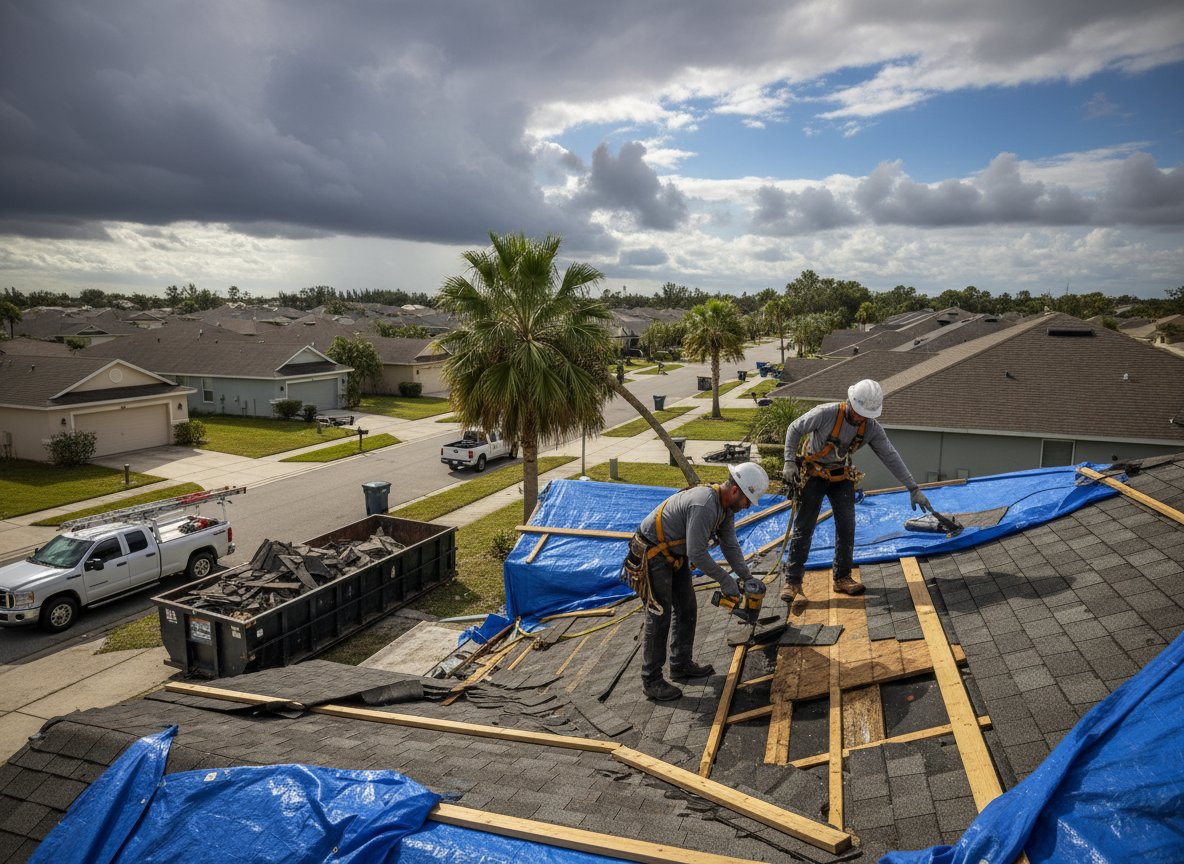
Orange Park is one of the smallest municipalities in this part of Florida and it sits inside one of the larger counties, and that mismatch is the first practical fact about roofing here. The town covers under four square miles between the St. Johns River and the Blanding Boulevard corridor. Clay County runs west and south from it for hundreds of square miles more, from Fleming Island out to Keystone Heights. Both contain roofs from the same decades under trees of the same species. Only one of them runs its own building department, and the line between them cuts through ordinary residential streets. Roof repair in Orange Park, FL, therefore begins with a question that has nothing to do with shingles: is this address inside the town limits or not.
The town was founded in 1877, when a company of Boston investors bought what remained of the old Laurel Grove plantation and subdivided it as a winter colony. Orange trees were planted across the new lots to make the prospect more attractive to buyers up north, and the name followed the crop. Two years later the town was incorporated. A hotel stood at the foot of Kingsley Avenue with a pier long enough to take steamboats, and the houses that survive from that first generation still sit on the lots the original plat created.
A Winter Colony's Roof Stock
The oldest houses in Orange Park date from the 1880s through to the First World War, and they were built for people who expected to spend a season rather than a lifetime. Their roofs are steep, with gable-front and hipped forms, deep eaves and wide porches, and many were covered in metal when they were new. Most have been shingled since, some more than once, and a few still carry a metal roof that has been recoated rather than replaced.
On these houses the roof is a set of junctions. The porch roof meets the main roof at a low valley. The deep eaves that sheltered the walls from sun and rain also collect leaf litter, and a century of it has rotted the fascia behind the gutter. Chimneys and vent stacks were added as the houses were modernised, and each addition made another hole in a plane that was watertight when it was built. When water appears on a ceiling in one of these houses, the entry point is nearly always at one of those junctions rather than in the field.
The Ranches and the Carport Tie-In
Most of the town's housing came later. The 1950s, 1960s and 1970s filled the streets between Kingsley Avenue and the river with single-storey ranch houses under asphalt shingle, on low-pitch hip and gable roofs. These were efficient buildings: a simple plan, a shallow roof, a carport rather than a garage, and a lanai or Florida room at the back.
Two details on those houses cause most of the trouble now. The first is the carport, whose roof meets the main roof at a shallow angle with a short run of flashing. Many carports have since been enclosed, which turns an open structure into a room and adds vents, a ceiling and sometimes a new roof plane over the top of the old junction. The second is ventilation. A shallow roof over a hot attic needs continuous intake at the soffit, and soffit vents are the first thing to be covered by insulation, paint or a new porch ceiling. Shingle that is cooked from below fails at the mat, and it fails on the west and south planes first, which is exactly what a homeowner sees from the driveway.
Oaks, Moss and the Shaded Plane
The canopy is the other local constant. Orange Park's older streets were laid out under live oaks, and the trees have had a century to close over them. Shade is a pleasure at ground level and a problem at roof level, because a plane that stays damp through the morning does not dry out before the next afternoon storm. Algae streaks follow the shaded slopes, moss establishes on the north-facing pitch, and debris collects in valleys and behind chimneys where it is never washed away.
Overhanging limbs do two things. In a normal week they abrade the surface where they touch it, and in a storm they come down. A limb through a deck is the most common emergency call in a town with this much tree cover, and the work that follows is not just closing the hole: it is checking whether the impact has moved the framing, cracked a truss and opened the plane several feet away from the visible damage.
River Water and the Clay Behind the Town
Orange Park faces the St. Johns River on its eastern side, with Doctors Lake cutting in from the south. The ground is flat and the water table is close, and the soil is a heavy clay that holds water rather than draining it. That combination sets the humidity the roof works in. In the low streets near the river, a roof spends the year in air that is close to saturated, and the attic can show condensation on the deck in the cool months. Condensation is routinely mistaken for a leak, and chased for months at the wrong detail.
Hurricane Irma in September 2017 pushed water up the St. Johns and flooded low ground across the region, and the streets nearest the river here took water in a way that most residents had not seen. Roof damage from that event was mostly at penetrations and wall junctions, where rain was driven sideways for hours. The lesson that stuck is that a roof which has never leaked in a summer storm is not necessarily sound; it has simply not been tested from the right direction yet.
Weather Between the Named Storms
Named storms are rare and the everyday weather is not. Summer thunderstorms arrive in the afternoon, drop a large volume of rain quickly and leave. Winter is the other pattern: nor'easters sit offshore and drive rain at the north and east elevations for a day or more. The two events test different details. A summer storm finds the valley that is undersized; a nor'easter finds the wall junction, the soffit and the window head that were never flashed for sideways rain.
The Services Available Here
The trade list on this site applies across the town without alteration, and the emphasis shifts with the housing. Roof leak repair is the everyday work, and on the older streets it is investigative before it is physical. Emergency roof repair and emergency roof tarping cover the limb through the deck and the storm that opens a ridge. Storm and hurricane damage repair carries a job from making the roof safe through to a record an insurer can follow.
Roof repair handles valleys, penetrations, chimney flashings, ridge caps and the localised sections that fail first. Roof replacement and roof installation take over where the covering has reached the end of its service life or the deck has softened, which is a common finding on the oldest houses and on any roof that has been re-covered rather than stripped. Shingle roofing covers the ranch streets and the later subdivisions, metal roofing suits the pre-war houses that were built for it and the properties that want a long service life, and tile roofing appears on the newer and larger houses where the structure has been checked for the weight. Flat roof repair and roof coating serve the low-slope additions behind the ranches and the commercial frontage along Blanding Boulevard. Roof inspection is the visit that establishes what is actually happening, and on a house that has been added to three times that visit is the whole job in miniature.
How a Job Runs Here
The first step is a records check, and it matters more here than in most places because of the boundary. The town and the county keep separate permit histories, and an address that carries an Orange Park mailing code may be permitted by either. Pulling the right file establishes when the roof was last replaced, what was installed and whether the work was inspected, which sets the expectation before anyone climbs a ladder.
The survey follows: the roof where it can be walked, the attic where there is access, and photographs at every junction. On a carport conversion the survey looks at how the new roof was tied into the old one, because that is where the water gets in. On a pre-war house the wall heads and the fascia behind the gutters are examined, since a century of leaf litter has been quietly rotting them. The written scope then separates what is replaced from what is retained, names the underlayment and fastening pattern, states what is assumed about the deck, and lists the exclusions.
The permit is filed with whichever office has jurisdiction, inspections are booked to the stages the work needs, and the job closes with a walk across the finished roof and a photographic record of every detail now covered. On a house with a carport conversion and a porch roof, that record is the part the next owner will want.
Permits: Town Hall or Green Cove Springs
Addresses inside the town are permitted by Orange Park's own Building Inspection and Permitting Division, which operates from Town Hall on Park Avenue and applies the Florida Building Code along with the town's ordinances. Everything outside the town boundary, including Lakeside, Fleming Island and the unincorporated subdivisions that use Orange Park mailing addresses, is permitted by the Clay County Building Division from its office in Green Cove Springs.
One recent change is worth knowing. Florida now exempts some small residential work from a building permit, and Clay County's published guidance is explicit that roofing is not among the categories that qualify, whatever the value of the job. A roof is permitted here in every case, and an unpermitted re-roof becomes a problem at the point of sale rather than at the point of installation. Northeast Florida is outside the High-Velocity Hurricane Zone, but the code's wind provisions and the product approval system apply to every covering installed.
Within Ten Miles
Lakeside and Bellair-Meadowbrook Terrace immediately west and south, Fleming Island across Doctors Lake, Doctors Inlet on the way to it, Oakleaf Plantation and Argyle Forest to the south-west, Chimney Lakes to the north, and the Jacksonville Westside across the river. Each has its own era of roof, and the county addresses among them have their own permit desk.
Calling About an Orange Park Roof
Three things decide how this goes: whether the address is inside the town or in the county, which era the house belongs to, and whether the roof has been covered over rather than stripped at some point in its life. The first is a question about jurisdiction, the second about materials and the third about how much is hidden. The office is at 4720 Millenia Blvd, Suite 175, Orlando, FL 32839, and Orange Park calls come to (407) 557-4529.
Around Orange Park
We regularly work near:
- 📍St. Johns River
- 📍Doctors Lake
- 📍Kingsley Avenue
- 📍Orange Park Town Hall
- 📍Blanding Boulevard
Roofing Company in Orange Park — Local Notes
- •The Town of Orange Park runs its own building and permitting division
- •Unincorporated Clay County, including Fleming Island and Lakeside, permits through Green Cove Springs
- •Many Orange Park mailing addresses sit outside the town limits