North Port is one of the largest cities in Florida by land area and one of the least dense. It was platted from 1959 onward by a development company that drew a grid across tens of thousands of acres of pine and palmetto, sold the lots individually, and left the building to whoever came along. Sixty years later the grid is still partly empty: a house, then two vacant lots, then another house, then a hundred acres of preserve.
That pattern decides the roofing work. Houses here were built one at a time by many different builders over five decades, so the stock is varied and the records are uneven. Drainage is a constant theme, because the ground is flat and low and the city sits at the head of a creek system that has flooded in living memory. And because North Port is inland of the barrier islands, the storm story is rain and wind rather than surge. Roof repair in North Port, FL, is mostly a matter of reading one house carefully in a city where the next house is a different story.
The Grid and the Vacant Lots
The original plat assumed a city that never arrived at the density it was drawn for. Streets run for miles through ground that is still wooded, and the city has spent decades trying to consolidate services across that spread. For a homeowner the practical effect is that the roof is often the newest thing on the block, or the oldest, with nothing in between to compare it to.
It also means that adjacent lots, empty for decades, have grown trees that now lean over a roof. A limb that rubs a ridge cap for a season will wear through it, and a pine that drops needles into a valley will block the drainage that the valley exists to provide. On a lot with mature growth, the maintenance question starts above the roof rather than on it.
What Was Built and When
The earliest houses date from the 1960s and 1970s, when the first lots were built on: small single-storey ranches, concrete block, low-pitch gable roofs, carports. The 1980s and 1990s brought larger houses on wider lots, and the 2000s brought the first genuinely large properties in the north and west of the city.
Asphalt shingle is the covering on almost all of it. Tile appears on a minority of newer and larger houses, and metal on outbuildings, carports and a few custom homes. The result is a city where the default conversation is about shingle, decking and ventilation, and where tile work is the exception rather than the rule.
Heat, Ventilation and a Shingle Failure
On a North Port roof the failure is heat-led, and the mechanism is the attic. Most of these houses have low truss spaces with soffit vents and, often, insulation blown to the eaves. Where the intake is blocked, the ridge cannot draw, and the deck above the insulation runs hot through the summer. The shingle then ages from below: it loses its oils, the mat hardens, and the tabs crack before the granules are gone.
That is why two houses of the same age on the same street can be in different condition. The one with clear soffits and a working ridge vent has a roof with life left. The one with painted-over vents and a full attic has a roof that is finished. Checking the ventilation is part of the survey, not an optional extra.
Water, Creeks and the 2022 Flood
North Port is flat and low, and it drains through a creek system rather than into the sea. The Myakkahatchee runs through the city, and in September 2022, when Ian crossed the state, that system could not take the rain. Streets and houses flooded well beyond the mapped flood zones, and the event is now the reference point for water damage here in the way that Ian's surge is on the coast.
For a roof, flooding matters in two ways. Water that reaches a wall from outside wets the stucco and the wall cavity, and water that cannot drain from a roof edge backs up under the covering. After a flood event the roof inspection is really a moisture inspection: the covering may be intact while the deck, the insulation and the ceiling below are wet. That is why the visit after a flood is different from the visit after a windstorm.
Wind Without the Sea
Because the city is inland, the wind exposure is lower than on the islands, and the design wind speed for a North Port address reflects that. It is not a small difference: a roof specified for an inland site is not the same specification as one on the Gulf, and the fastening schedule changes accordingly.
What does not change is the way wind finds a weakness. Ridge caps lift, edge metal peels, and the corners of a hip take the load. On a simple gable roof the gable end is the vulnerable edge, and on a hip roof it is the four corners. After a storm, those are the places to look before the middle of the field.
Repairs on a House Built by Many Hands
Because the city was built lot by lot, a great many houses have a repair history that no single contractor knows. A carport enclosed in 1988, a room added in 1996, a re-roof in 2004 by a firm that no longer trades. Each of those left a join, and the joins are where water enters.
On a house like that the survey has to be forensic. The covering is dated by its profile and its condition, the joins are examined one by one, and the attic is read where it can be reached. Where the record is unclear, the permit history is checked, because an unpermitted addition changes what a later owner or insurer will accept.
Low-Slope Sections and Carports
The carport is a North Port institution, and a carport roof is a low-slope roof with very little margin. Where a carport has been enclosed, the roof above it is often original and often the first thing to leak. The same applies to the lanai and to the small utility roofs at the back of the lot.
On these roofs the details decide everything: the junction with the main roof, the edge at the open side, the penetration for a light or a fan. Coating can extend a sound low-slope surface, and it cannot fix one that ponds. Where water stands, re-sloping is the repair.
The Services Available Here
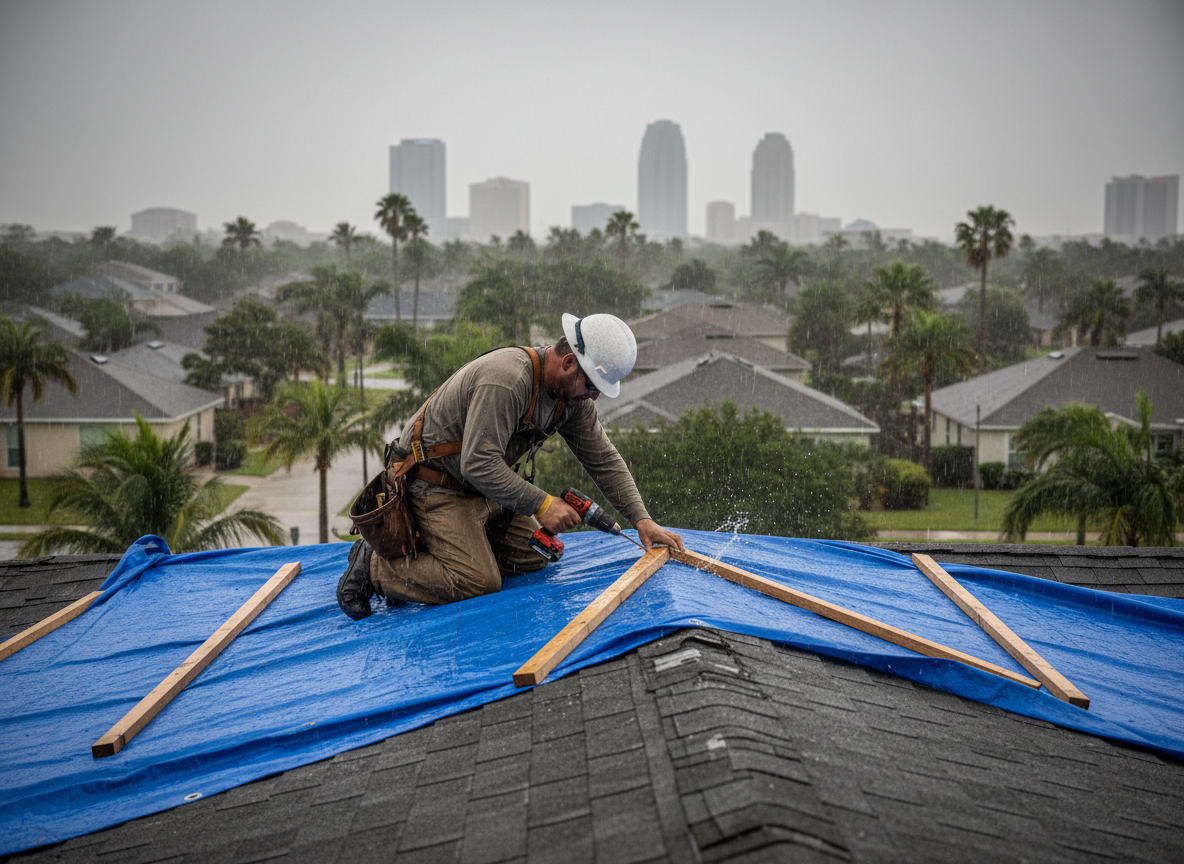
The work comes from the site's own list, applied to this stock. Roof leak repair is the diagnostic core, and on a house with a shallow attic it starts with tracing rather than patching. Emergency roof repair and emergency roof tarping cover the night a limb opens a deck and rain is coming in. Storm and hurricane damage repair handles the documented sequence after an event: make safe, photograph, repair, and keep a file an insurer can read.
Roof repair is the everyday trade, and here it is often carpentry at a join or a flashing detail. Roof replacement and roof installation handle the end of a layered shingle roof or a covering that has reached its limit. Shingle roofing covers almost all of the housing. Tile roofing covers the newer and larger properties, mostly as underlayment work beneath tile that is kept. Metal roofing suits the carports, outbuildings and a minority of houses. Flat roof repair and roof coating cover the carport and lanai sections where the fall is short. Roof inspection is the visit that starts all of it, and on a house with an unclear history it is the visit that establishes what is actually there.
How a North Port Job Runs
The first visit is a survey: the covering and its age, the deck at the eaves and around penetrations, the joins where additions meet, and the attic where it can be reached. The permit history is checked at the same time, because an unclear record changes what can be confirmed later.
Then the written scope. It separates what is replaced from what is repaired, names the underlayment and fastening method, records what is assumed about the deck, and lists exclusions. On a house with three previous repairs that document is the difference between a price and a guess.
The permit is filed with the city before work starts, and inspections follow the city's stages. The close-out is a walk with the owner covering ridges, edges, vents and cleanup, plus photographs of what is now covered up.
Permits in the City
North Port is its own jurisdiction, and the city's building division permits residential roofing across the whole grid. That makes it simpler than the county, where unincorporated ground surrounds the city on three sides. Port Charlotte to the south and east is Charlotte County, and Venice to the north is a separate city.
The Florida Building Code applies beneath the city permit. Sarasota County is outside the High-Velocity Hurricane Zone, which covers Broward and Miami-Dade, so the zone's extra underlayment chapter does not apply here. The wind provisions do, and because the city is inland the design wind speed is lower than on the coast — one of the few respects in which this is an easier specification than a barrier-island job.
Within Ten Miles
Port Charlotte and Murdock to the south, Warm Mineral Springs and North Port Estates within the city, El Jobean and Deep Creek to the south-east, and the Charlotte Harbor shoreline to the west. Venice and Englewood are further than ten miles, but both are within the county and both have their own permit desks.
Calling About a North Port Roof
The address settles the permit, and the age of the house settles how much of the repair history is likely to be undocumented. The covering and its condition decide whether this is a repair or a replacement conversation. A photograph from the ground helps when the answer is visible. The office is at 4720 Millenia Blvd, Suite 175, Orlando, FL 32839, and North Port calls come to (407) 557-4529.
Around North Port
We regularly work near:
- 📍Warm Mineral Springs
- 📍Myakkahatchee Creek Environmental Park
- 📍Deer Prairie Creek Preserve
- 📍North Port Estates
- 📍Charlotte Harbor
Roofing Company in North Port — Local Notes
- •City of North Port permits the whole grid
- •Inland site — lower design wind speed than the barrier islands
- •2022 creek flooding reached houses outside the mapped flood zones