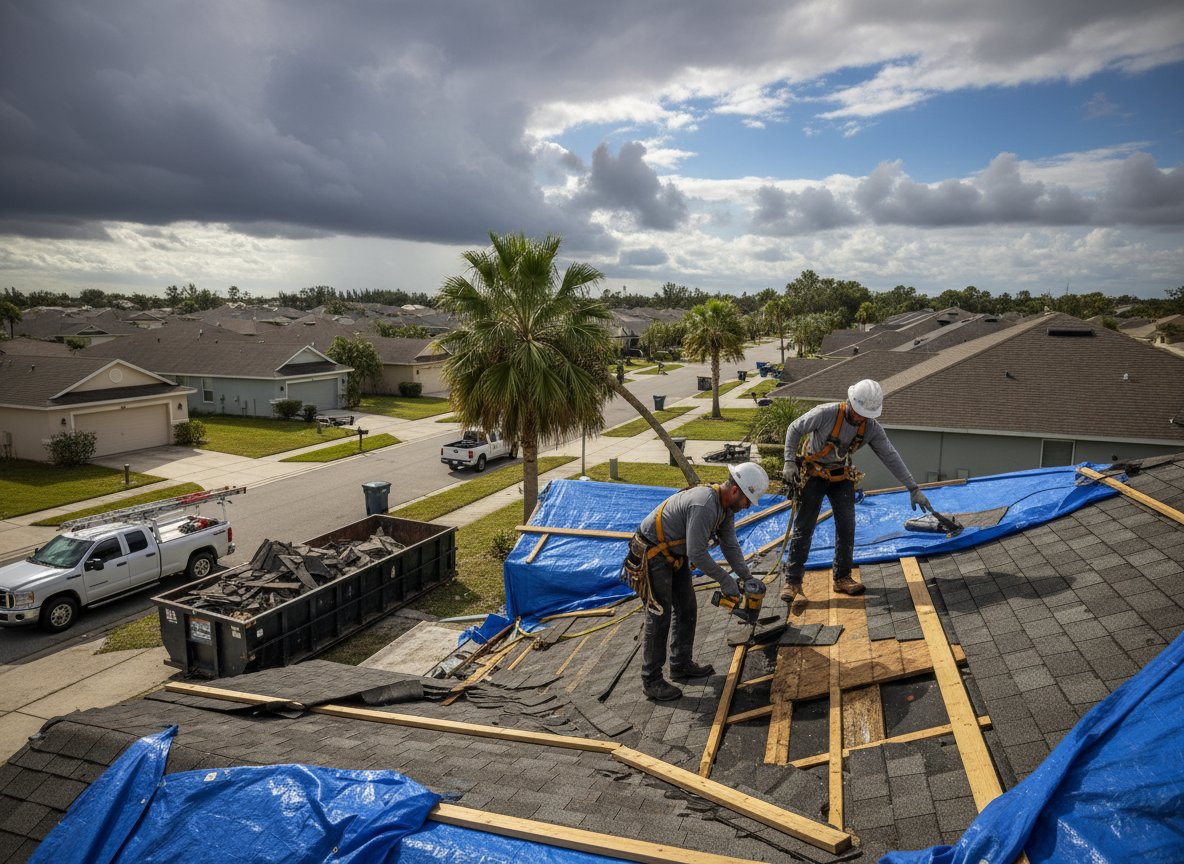
Naples is a small city with a wide shadow. The municipality covers a few square miles between the Gordon River and the beach, but the name runs north through Pelican Bay and Vanderbilt Beach and east along Golden Gate Parkway into unincorporated Collier County, and a great deal of what people call Naples sits outside the city limits. The roofs carry the split. Old Naples and the numbered avenues behind Fifth Avenue South hold 1920s and 1930s houses under barrel tile or an older low metal roof. The Moorings and Port Royal hold 1950s and 1960s ranches. Park Shore and Pelican Bay hold 1970s and 1980s villas and mid-rises. The eastern grid holds 1990s and 2000s subdivisions under architectural shingle. Roof repair in Naples, FL, is therefore rarely one trade applied to one kind of house — it is a judgement about which of those roof stocks the address belongs to.
The second constant is water. Naples faces the Gulf, with the Gordon River behind downtown, mooring basins and canals through the western neighbourhoods, and a water table close to the surface almost everywhere. A roof here is a drainage system as much as a covering. When the ground cannot absorb a summer downpour, water stands against the wall, wicks into stucco and shows as a tide mark at the base of a wall that has nothing to do with the roof above it. Florida Roof Repair Pros works this coast from an Orlando office, and Naples calls come to (407) 557-4529.
A Small City and a Wide Roof Map
The city limit is the first thing to establish, because it decides the permit desk and, often, the era of the house. Inside the limit the stock is old and close together: narrow lots, mature trees, roofs that have been repaired more than once. Outside it the stock is newer and larger, with the tile estates of Pelican Bay and the shingle subdivisions off Livingston Road and Immokalee Road at opposite ends of the same market.
That spread is why a proposal here should describe the house before it describes the work. A 1930s cottage with a barrel tile roof and a 2004 villa with the same covering are different jobs: one has original tile over battens and a shallow pitch, the other has a modern underlayment and a code-compliant fastening schedule. Treating them alike is how a repair ends up costing more than the roof is worth.
Barrel Tile and the 1920s Inheritance
Old Naples was built in a Mediterranean idiom, and the barrel tile roofs that came with it are now close to a century old. On those houses the tile is usually original and often irreplaceable. The clay is brittle, the profiles are no longer made in the same dimension, and every broken piece is a piece that has to be salvaged from somewhere. That changes the arithmetic of a repair: the work is surgical, the tile is lifted and set aside by hand, and the membrane underneath is replaced in sections rather than stripped wholesale.
The failures on these roofs cluster at the mortar. Ridge and hip tiles bedded in mortar crack and let go, and the crack is where water enters. The battens that hold the tile rot where a leak has been running for years. And the underlayment, whatever it was in 1930, has long since stopped shedding water. Owners often describe a leak that appears only in a driving rain from the southwest, which is the signature of water being forced under the tile rather than falling between the courses.
Walk a barrel tile roof and you will break tile. That is not carelessness, it is arithmetic, and it is why a survey on these houses is done from a ladder, from the ground with a camera, and from the attic, rather than by walking the field. A contractor who offers to walk it is telling you something about how the repair will be done.
Shingle Across the Eastern Grid
East of Airport-Pulling Road the city gives way to the county and the roofs change era. The subdivisions built through the 1990s and 2000s are architectural shingle over a plywood deck, and their wear pattern is predictable. The south and west planes take the sun, the granules go first, and the mat behind them hardens until it cracks at the ridge. A second layer from an earlier re-cover accelerates all of it, because the roof cannot shed the heat it collects.
Ventilation decides how fast that happens. A ridge vent with closed or painted-over soffits draws nothing. Insulation packed to the eaves does the same. The attic then holds its heat, the deck cooks from below, and a shingle that should have lasted its full term fails years early. In January the same trapped moisture shows as staining along the ridge, which owners read as a leak and which is usually condensation.
The repair question on these roofs is whether the deck is sound. Shingle comes off quickly; what is underneath decides whether the job is a re-cover, a full replacement, or a repair of one plane where a valley or a chimney has been letting water in. A scope that does not mention the deck is a scope written before anyone looked.
Low Ground and the 2005 Record
Naples sits within a few feet of sea level across most of its area, and the storm record here is written in water rather than wind. Wilma came ashore near Cape Romano in October 2005 and pushed surge through the low streets south of the city. Irma crossed the state in September 2017 and put water into places that had not seen it. Ian made landfall well to the north at Cayo Costa in September 2022, and its surge still reached the Collier coast.
Surge does not strip shingles the way wind does. It does something slower: it saturates the structure from the ground up, it leaves salt in the wall cavities, and it turns an attic into a damp box. A roof that looks untouched after a surge event can still be a roof with wet decking and a membrane that has begun to delaminate. That is why the inspection after a flood is different from the inspection after a windstorm, and why the two should not be priced as the same visit.
Salt, Sun and the Western Edge
Within a few streets of the Gulf, salt is the agent that ages a roof. It settles on every surface and attacks the metal rather than the covering: drip edge, valley metal, hip and ridge flashings, vent collars, the fasteners on a metal pan, the aluminium frame of a lanai roof. On the western streets and on the beach blocks these are the parts that fail first, and they fail out of sight under a field that still looks sound.
Ultraviolet light does the rest. It perishes the washers under metal fasteners, hardens sealant at terminations, and bleaches a coating until it chalks. The practical answer is not a better covering but compatible metal at every junction, stainless or coated fastenings, and a specification that treats the details as the parts that wear. On a Naples roof the details are the maintenance item; the field usually is not.
Lanai Roofs and the Flat Transitions
A large share of the calls from this city are not about the main roof at all. They are about the lanai, the screen enclosure and the small flat section that joins the house to the pool deck. Those roofs are low-slope, they pond, and they are where the detail work is hardest: a transition from a pitched plane to a flat one, a beam penetration, a door head that has to be flashed into a wall.
Flat work here fails at the seams and at the drainage. A membrane that has been patched three times is usually a membrane that has lost its fall, and adding another patch buys a season. Coating will extend a sound but tired surface; it will not rescue a ponding one. The distinction matters because the two are often sold as the same product.
Where a Naples Roof Fails First
Water enters a Naples roof at a short list of places, and the list is the same whether the house is old or new. Wall junctions above stucco, where a hairline crack opens as the building moves. Valleys, where two planes deliver their water to one channel. Hip junctions on tile. Plumbing boots and vent stacks, where a rubber collar perishes in the sun. Skylights and their curbs. And the join between a pitched roof and a flat lanai or porch roof, which is the single most common source of a leak that appears in a living room ceiling.
Water travels before it appears. On a house with several roof levels that distance can be ten or twelve feet, which is why the survey photographs junctions rather than only the field, and why a repair that only seals the visible stain tends to return within a season.
The Services We Bring to This City
Roof repair is the core of the work, and on this coast most of it is leak diagnosis before it is carpentry. Roof leak repair starts with finding the entry point rather than the stain. Emergency roof repair and emergency roof tarping are for the nights when water is coming in and the answer is to close the opening, document it, and return in daylight for the permanent fix.
Storm and hurricane damage repair follows its own sequence: make safe, photograph, repair, and keep a file that an insurer or a buyer can read. Roof replacement and roof installation are the planned end of the same road, and they are where the covering conversation happens. Shingle roofing covers the eastern subdivisions and the postwar streets. Tile roofing covers the old city and the villa communities, and much of that work is underlayment replacement beneath tile that is kept. Metal roofing suits the waterfront houses and the rebuilds, in standing seam where the exposure is real. Flat roof repair and roof coating cover the lanais, the low-slope sections and the small commercial buildings along the US 41 corridor. Roof inspection is the visit that starts all of it, and on a house being bought or insured it is the visit that matters most.
How a Naples Job Runs
The first visit is a survey with a ladder, a camera and an attic. Planes are read from the ground where walking them would break tile. The deck is read from below. Junctions are photographed, and on a tile roof the quantity of spare material is counted, because a repair may depend on tile nobody makes any more.
Then the written scope. It names what is replaced and what is kept, which underlayment and fastening method are specified, what is assumed about the deck, and what is excluded. On a tile roof it also sets the sequence: membrane opened at a valley and a hip, photographed, then relayed. That document becomes the permit application, and it is the only part of the process that protects both sides when the deck turns out to be softer than the attic suggested.
The permit is filed before work starts, and inspections are booked where the jurisdiction requires them. At the end there is a walk of the property with the owner, covering edges, terminations, drainage and cleanup, plus a file with the photographs of everything now covered up. On an old Naples house that file is also a record of what has already been replaced, which is useful the next time the roof is discussed.
Permits in Two Jurisdictions
Addresses inside the City of Naples are permitted by the city's building department. Unincorporated Collier County addresses — North Naples, Golden Gate, much of the eastern grid — are permitted by Collier County. Marco Island and Everglades City run their own desks. The boundary is a municipal line rather than a distance, so it is checked before a date is offered, because review queues and inspection stages differ between them.
Beneath the local permit sits the Florida Building Code. Collier County is outside the High-Velocity Hurricane Zone, which applies in Broward and Miami-Dade, so the zone's extra underlayment chapter does not reach here. The wind provisions do, in full, and the coastal part of the county falls within the wind-borne debris region, which brings product approval and opening protection into the conversation on a replacement. On a barrier-island or beach-block property the design wind speed for the site is part of the specification, not an afterthought.
Within Ten Miles
Pelican Bay and Vanderbilt Beach to the north, Park Shore and the Moorings along the bay, Port Royal and Old Naples at the western end, Golden Gate and Golden Gate Estates inland, East Naples and Lely to the south-east, and Naples Park between Vanderbilt and the beach. Each has its own roof stock and its own exposure, and the ones on the water are a different job from the ones a mile inland.
Calling About a Naples Roof
The address settles the permit desk. The covering settles how the first visit is planned. The age of the roof, or the date of the last permit, settles whether this is a repair or a replacement conversation. A photograph taken from the ground helps when the answer is visible. Reach the office at 4720 Millenia Blvd, Suite 175, Orlando, FL 32839, or call (407) 557-4529 to arrange a Naples survey.
Around Naples
We regularly work near:
- 📍Naples Pier
- 📍Fifth Avenue South
- 📍Gordon River
- 📍Vanderbilt Beach
- 📍Naples Botanical Garden
Roofing Company in Naples — Local Notes
- •City of Naples permits its own addresses; Collier County takes the unincorporated ones
- •Collier County is outside the High-Velocity Hurricane Zone
- •Barrel tile in Old Naples is often original and no longer made in the same profile