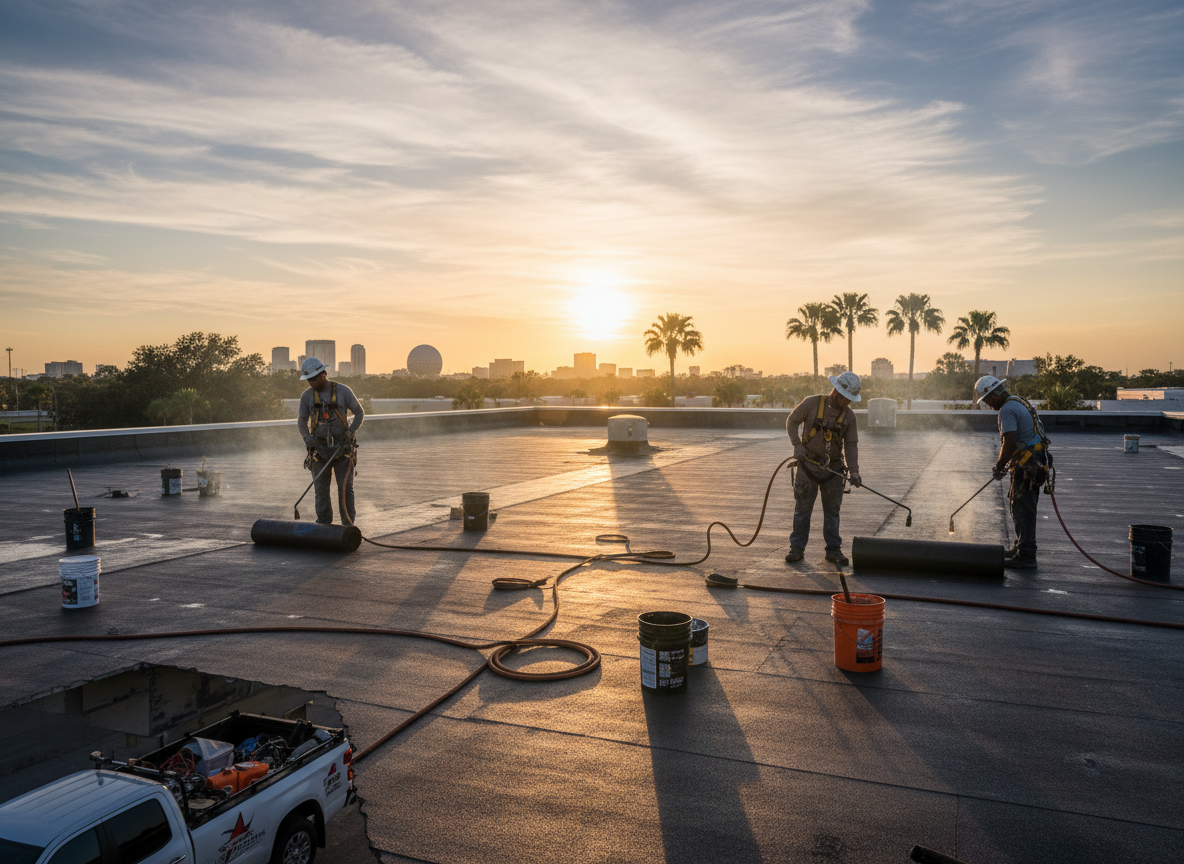
Milton has been incorporated since 1844 and is the county seat of Santa Rosa County, sitting in the geographic centre of the county where the Blackwater River runs down toward Blackwater Bay and the Gulf beyond it. The town grew as a river town and a mill town, with lumber and naval stores moving down the water and the settlements of Bagdad and East Milton forming alongside it, and its streets still carry a good deal of early twentieth-century housing. Roof repair in Milton, FL is a river-valley problem rather than a beachfront one: no salt spray and no surf, but a great deal of humidity, a lot of trees, and a river that has flooded its banks more than once in living memory.
The city is inland and low — around sixty feet above sea level on the banks above the river — and the land falls away toward the water. That shape matters after a storm. Wind is the event that damages roofs, but water is the event that decides how quickly a building dries out and how much of the interior has to be opened up afterwards. In a river town the two arrive together, and a roof repair that is done here is usually part of a larger recovery.
A River Town on Its Banks
The Blackwater River is the defining feature. It runs through the city, wide and slow at the bottom of a wooded corridor, and the older neighbourhoods sit on the higher ground above it. Mill history is still visible in the building stock — the mill village of Bagdad to the west has a historic district of company houses, and East Milton across the river keeps a separate identity of its own. Roofs in these areas are older than the city average, and they have been repaired in the local way: by adding and patching rather than by stripping back to the deck.
The practical consequence is that a Milton survey spends as much time on what is under the covering as on the covering. On a 1920s mill house the deck may be boards, the framing may have been altered, and the flashings may be a mixture of original metal and later sealant. On the newer subdivisions to the west and north the question is different: whether the original shingle has reached the end of its life and whether the ridge vent is doing anything at all.
Water also arrives from the ground in this town. The river floods, and the low streets near it have taken water in past events. A roof replacement after a flood is often paired with interior work, and the two have to be sequenced so that the building is closed to the weather before anything inside is put back.
Mill Village, Downtown and Subdivision
The oldest stock is in the blocks near the river and in Bagdad: modest one and two storey houses with hipped and gabled roofs, board decking, porches under shallower roofs, and chimneys that are often original. These roofs are frequently on their third or fourth covering, and the composition of the layers matters as much as the surface. Adding another layer to a roof that has three is a decision the code governs and the deck informs.
The middle band is the postwar housing that filled in through the 1950s, 1960s and 1970s, including the streets around the schools and the highway corridors: brick ranch houses under asphalt shingle, low pitched and wide, frequently with a carport or an enclosed porch at the side. They are straightforward roofs to work on and easy to defer, because nothing looks wrong until water is inside.
The newer stock is the subdivision growth on the edges, mostly 1990s onward, shingle on truss framing with attached garages and rear lanais. Concrete tile appears on a minority of newer and larger houses, and metal is common on rural property and outbuildings across the county. Low-slope membrane covers the commercial downtown and the porch and addition roofs that the older pattern produced everywhere.
What the Trees and the River Do to a Roof
Santa Rosa County is heavily wooded, and Milton's roofs sit under it. The failure that follows is cumulative rather than dramatic. Leaf litter and pine straw collect in valleys, behind chimneys and in the pan of a lower roof, holding water against the surface and keeping the area damp long after the rest of the roof has dried. In shade that never fully dries at all. The underlayment beneath the debris ages faster than the rest of the roof, and the first sign is a stain on a ceiling in a room with nothing obviously wrong above it.
Shade also grows things. Algae and moss on north-facing slopes are common, and while the staining is cosmetic the damp surface it indicates is not. A limb resting on a roof abrades the covering and keeps the area wet, and after a wind event the first inspection should include the places where something has been lying on the roof, not only the places where something is missing.
River humidity compounds all of it. Attic air in this valley stays humid for months, and sheathing that has been wetted once takes longer to dry than it would on higher, drier ground. That is why a small leak here so often turns into a deck repair: the wood stays wet long enough to soften, and by the time the leak is found the sheathing is the bigger problem.
Storms That Reached Milton
The coast is half an hour south, but the county has taken the same run of storms as the rest of the western Panhandle. Hurricane Ivan came inland across this region in September 2004 and drove wind and rain through Santa Rosa County. Hurricane Dennis came ashore on Santa Rosa Island near Navarre Beach in July 2005 and moved north across the county. Hurricane Sally in September 2020 moved slowly, and the rain that came with it produced river and creek flooding across Santa Rosa County as well as wind damage.
Inland, the damage pattern is trees and edges. Limbs through the deck, ridge caps and ridge vents lost, shingle stripped at hips and rakes, gutters and soffits pulled, and water driven into wall junctions from an angle the roof was not shedding. The difference from the coast is that the same storm also puts water in the streets, so a building may be dealing with a wet roof and a wet floor at the same time.
What Milton Roofs Actually Need
The full service list applies here; the survey decides the order of it. Water coming through after rain is roof leak repair, worked from the entry point outward. A roof opened by a limb or by wind is emergency roof tarping to hold the building, then emergency roof repair where the opening is closable in one visit, then storm and hurricane damage repair where the whole roof has to be recorded and rebuilt.
Past that, the deck and the layers answer the question. Roof repair is right while the sheathing is sound and the covering has time left. Roof replacement is right when timber is soft and the underlayment has aged out, and roof installation covers a building that never carried a covering. Shingle roofing is the default across the town; metal roofing suits rural buildings, barns and outbuildings; tile roofing appears on a minority of newer houses; flat roof repair and roof coating handle the shallow porch, addition and commercial roofs; roof inspection is the step that tells you which of those you are looking at.
What Happens Once Work Is Agreed
First the roof is read. A walk where it is safe, an attic visit where there is a hatch, photographs of every plane and penetration, and an examination of the sheathing from below. On a house in the older blocks the attic also shows how many coverings are overhead and whether the framing has been altered at any point.
Then a scope in writing: removals, repairs, exclusions, products and assumptions. The permit application is drawn from it, carrying the product approval and fastening schedule the code requires. Work runs in the order the building department inspects — sheathing and underlayment before the covering closes on a replacement, then the final — and the job closes with the signed inspection, the photographs and a walk of the property.
Who Permits the Work
Inside Milton it is the city; outside it, Santa Rosa County, which covers Bagdad, East Milton, Point Baker and Pace. Two offices, two sets of queues, and the address checked before a start date. The High-Velocity Hurricane Zone stops at Miami-Dade and Broward, so it does not reach here, but the statewide wind provisions still govern design wind speed and fastening, and the layer question — how many coverings may stay — is answered by the code and the sheathing together. Contract work normally opens with a notice of commencement on file.
Layers, Weight and the Question of Another Cover
The single most consequential decision on an older Milton roof is whether the existing covering comes off. A second layer can be faster and less disruptive, and it is sometimes the right answer. On a house that has already been covered three times it usually is not, and the reasons are practical rather than theoretical.
Each layer adds weight to a structure that was framed when the first covering went on, and the framing was not designed with the third in mind. Each layer also traps whatever is beneath it. A shingle or tile layer over an old one hides the deck, so a soft patch, a repaired valley or a flashing that has been leaking for years cannot be seen or assessed. And the layer beneath an old one is where the real failure usually is: the underlayment, not the surface.
There is also a code question. The Florida Building Code limits how many layers may remain, and the limit depends on the covering and the assembly. Where a roof has been re-covered twice, the practical answer is generally that the covering comes off and the deck is inspected directly, because that is the only way to know what the new roof is being fixed to.
Removing a covering is more work up front and less over the life of the roof. It also produces a document — photographs of the deck, the repairs, the underlayment and the flashings before they are closed — that is worth having when a house is sold, insured or assessed after a storm.
After the Water Goes Down
Flood recovery in a river town has an order to it, and roofs sit in the middle of that order rather than at the end. A building that has taken water at floor level and rain at the roof has two problems, and they are not solved at the same speed. The roof has to be closed first, because interior work put back under a leaking ceiling is work that will be done twice. Once the building is watertight, the interior can dry.
The proof of a closed roof is not a visual impression. It is the flashings and the penetrations being sound, the underlayment complete, and the covering fixed to a deck that is dry enough to hold a fastener. That is why a post-flood survey looks at the sheathing with more care than usual: timber that has been wetted and dried repeatedly holds a nail poorly, and a covering fixed to it will not stay put in the next wind.
It also pays to record what was found before anything is covered again. Photographs of the deck, the repairs and the new underlayment are the evidence a policy or a buyer will ask for later, and they are worth having at the time.
The Ten-Mile Ring
Milton is the centre, with Bagdad immediately west, East Milton across the river, Point Baker and Pea Ridge northwest, Pace to the west, Wallace and Chumuckla north, and Avalon Beach south toward the sound. Each has its own mix of housing and its own permit office, and the address is checked before anything is planned.
Starting the Conversation
Give the address first, because it decides the permit office, then the roof's age if a permit record exists. If the house also took water at floor level in a flood, say so, because it changes the order the work has to happen in. A photograph from the ground and a note of where water is showing inside are useful before the first visit. Florida Roof Repair Pros works from 4720 Millenia Blvd, Suite 175, Orlando, FL 32839, and the number is (407) 557-4529.
Around Milton
We regularly work near:
- 📍Blackwater River
- 📍Downtown Milton and the riverwalk
- 📍Bagdad Village Historic District
- 📍East Milton
- 📍Blackwater River State Forest
Roof Repair in Milton — Local Notes
- •County seat of Santa Rosa County, incorporated 1844
- •Blackwater River flooding is part of the local history
- •Older mill-era housing near the river and in Bagdad