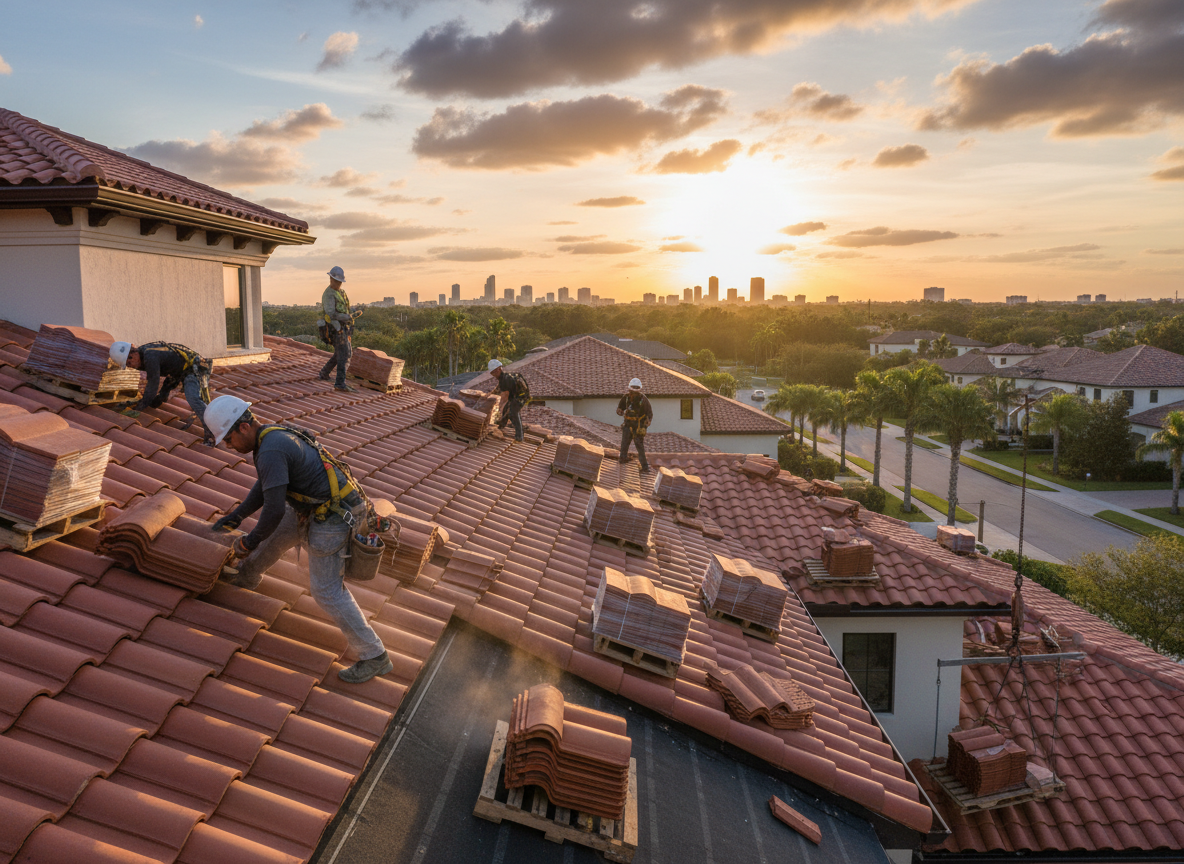
In Miami Gardens the street is the unit of analysis, not the house. The subdivisions that fill the county's northern edge went up in a compressed run between the 1950s and the 1980s, on lots surveyed together and roofs framed by the same handful of crews, so the shingles on one side of a road were usually laid within a season or two of the shingles opposite. When one roof on a block reaches the end of its life, the neighbours are not far behind it. Roof repair in Miami Gardens, FL is mostly the management of that shared clock: shingle over concrete block, low pitch, hurricane-zone assemblies, and a deck underneath that nobody has seen since the day it was closed.
The city itself is young — incorporated in 2003 out of unincorporated county land — but almost none of its housing is. That gap between municipal age and roof age is where most confusion starts. A homeowner who has lived in the same house for thirty years may still think of the county as the permit authority, and a roof that was replaced after a storm in the mid-2000s can look newer than it is. Florida Roof Repair Pros works across the city from an office in Orlando, and the number for Miami Gardens is (407) 557-4529.
One Long Buildout, One Shared Clock
The typical house here is single storey, sometimes two, concrete block finished in stucco, slab on grade, with a low hip or gable roof carried on trusses and covered in asphalt shingle. Carports were standard and many have been closed in since, which added a low-slope roof tied into the main plane. Later phases brought barrel and S-profile tile on some streets, and the main roads carry small apartment blocks and strip retail with membrane or coated built-up roofs.
Uniformity has an advantage: the faults are predictable. The same pipe boots, the same valleys, the same ridge detail, the same underlayment specification. It also carries a specific risk. On a block where every house has been re-covered once, every house is now sitting on a deck that has not been inspected from below since the original build. The shingle above may have another decade of appearance in it while the sheathing below has none, and the difference only shows when somebody opens the roof.
Shingle Country, and What Heat Does to It
Asphalt shingle suits this pitch and this structure, and it is the covering most often judged by how it looks from the kerb. A fifteen-year-old shingle roof can still photograph well while the granules are gone from the south and west planes, the mat has gone brittle and the felt beneath has baked out. Granule loss is the visible symptom. The brittle mat and the expired underlayment are the parts that decide when water arrives.
This is a heat story before it is a rain story. A shingle deck in Miami-Dade runs hot for most of the year, and a roof with blocked soffit ventilation runs hotter. That is why the south and west slopes usually go first, why the ridge cap is often the earliest crack, and why a roof that was laid over an existing layer tends to fail sooner than one stripped back to the deck. None of it is visible from the driveway, which is the reason the attic belongs in the survey rather than in the conversation afterwards.
Four Details, Most of the Leaks
Pipe boots and vent collars lead the list. The rubber perishes in this sun years before the surrounding shingle wears, and a split collar sends water straight down the pipe into a ceiling. Ridge and hip caps come next, because they take wind first and crack at the fold. Valleys are third: every drop landing on two planes arrives in one channel, and on a shallow roof that channel is short and loaded. Fourth is the transition where a shingle plane meets a low-slope surface — an enclosed carport, a porch, a rear addition — and one flashing is asked to do the work of two systems.
Wind has a pattern of its own. It lifts the perimeter first, at eaves, rakes and ridge, and once a corner opens the wind gets beneath the field and peels sheets rather than individual shingles. What an owner finds afterwards is a clean line of missing shingles along one edge and a gutter full of granule, which is why a post-storm survey starts at the edge and works inward.
Ceiling stains here are frequently not below the damage. Water enters at a boot or in a valley, tracks along the deck or down a truss, and appears at a light fitting or a wall junction in another room. A leak repair therefore begins on the roof and in the attic, not at the stain, and a repair that only seals the visible mark tends to return with the next easterly squall.
How the Storm Record Dates a Roof
Three hurricanes set the terms, and each one leaves a date on a roof. Andrew in August 1992 wrecked the southern county around Homestead and Florida City, well south of here, but the code and the product approval system that followed it govern every roof in Miami-Dade, including this city's. Wilma in October 2005 came across from the Gulf side with sustained wind and driving rain over Miami-Dade and Broward, and it is the storm most often named when a roof here is dated to the mid-2000s. Irma in September 2017 tracked up the state and delivered a long stretch of wind, with damage concentrated in trees, edge metal, ridge caps and anything already loose.
The practical result is that a permit date answers more questions than an inspection of the surface. A roof replaced after Wilma has passed the twenty-year mark; one replaced after Irma has not. When a buyer, an insurer or an adjuster asks, that date is the first thing worth finding, and it is worth finding before a scope is written rather than after.
Ventilation, and the Roof That Wore Unevenly
Owners here often describe a roof that failed on one side. The cause is usually air rather than water. A low-pitch roof over a block house leaves a shallow attic, and when the soffit intake is blocked — insulation packed into the eaves, paint across the vents, a screen that has never been cleaned — the ridge vent has nothing to draw. Attic temperature climbs, the shingle mat on the western and southern planes cooks ahead of the rest, and the roof ages at two different rates on the same house.
The same blockage reads as condensation: damp sheathing, corroded fasteners, staining along the ridge that appears in the cooler months and dries out in summer. It belongs in the survey because it changes what a replacement must include. A new covering laid over an attic that cannot breathe simply restarts the same countdown, and on a house that has already been re-covered once, that is the difference between a roof that lasts its term and one that comes back early.
The Work, as It Is Actually Done
A handful of services carry most of this city. Leak repair is the everyday request, and here it means reading the attic and the details rather than sealing a stain. Inspection is the second, triggered by a sale, a purchase or an insurer, and it is the only way to establish where a roof sits between re-cover and replacement.
Tarping and emergency repair cover the sudden events: a limb through the deck, an edge lifted by a squall, a collar split during a storm. Storm and hurricane damage repair is the wider engagement, and in this county it always produces documentation, because separating wind damage from wear is a question someone else will ask later. Replacement applies when the shingle field and its underlayment have both gone, and installation is the same work on new construction or an addition.
Coverings are the ones the streets already carry: shingle on the pitched roofs, tile where a house was built with it or later upgraded, metal on a minority of properties, and flat repair on enclosed carports, additions and the low commercial buildings along the main roads. Roof coating renews a sound low-slope or metal surface that does not yet warrant rebuilding. None of these is the default answer; the survey names the one the roof needs.
Most jobs here come down to two questions, and they are worth stating plainly. How many layers are already on the roof, and what does the deck look like underneath. A re-cover is allowed in some circumstances and not in others, and the deciding factors are the existing layers and the condition of the sheathing rather than anyone's preference. Stripping back to the deck costs more in labour and produces a roof that can be inspected, ventilated correctly and expected to serve its full term. That trade-off belongs in the written scope, not in a conversation on the day the crew arrives.
How the Job Is Sequenced
The survey opens it. Every plane gets walked, the attic gets read, and photographs record each valley, penetration, edge and junction. On a house with an enclosed carport or an addition, the low-slope section and its drainage are part of the same visit, because that is where the two roof systems meet and where the flashing has the least room to work.
Then the written scope. It names the covering, the underlayment and the fastening schedule; it states what is being replaced and what is being repaired; it records what the work assumes about the deck; and it lists what is excluded. Where a permit is needed, this is the document the application is drawn from, so anything left vague becomes a delay at the counter rather than a discussion on the roof.
The permit is filed before work starts, and the inspection stages after it are set by the building department rather than by the crew's calendar. On a replacement, the deck and underlayment are inspected while they are open, and the final inspection follows completion.
Sign-off is a file and a walk. The completed inspection, photographs of everything now hidden under the finished roof, and a joint check of flashings, valleys and terminations with the owner. On a single-storey house that is a short visit, and it is the step that determines whether the next wet season is uneventful.
Which Department Sees the Application
Property inside Miami Gardens is permitted by the city's own building department, which runs as a one-stop shop for construction and development inside the municipal boundary. Unincorporated county addresses, and other cities, go to Miami-Dade or to their own department. Because the city was carved out of county land in 2003, plenty of residents still assume the county is their authority; the boundary decides it, and it is checked before a date is offered.
Beneath whichever department takes the application sits the Florida Building Code and, in this county, the High-Velocity Hurricane Zone chapter. Approved products, a specified underlayment system, a denser fastening pattern than an inland roof would carry. It also means a repair must use approved materials rather than merely similar ones, which is a distinction that shows up in the paperwork and, eventually, in how the roof behaves in wind.
Neighbours Within Ten Miles
Carol City, Norland and Bunche Park are neighbourhoods inside the city itself. Opa-locka and Ives Estates sit minutes away, Andover and Aventura lie east, and the Broward line is close enough that Miramar and Pembroke Pines fall inside the same radius. Each has its own permit office and its own roof stock, and work in any of them is planned the way work here is.
Before the First Visit
The address decides the department, so have it ready. The age of the roof, if it is known, decides most of the rest, and on a street where every house went up in the same year that date is often the single most useful thing an owner can bring to the call. A photograph from the ground helps, and so does a note of where water is showing inside and whether it appears only when the wind comes from one direction. Florida Roof Repair Pros works from 4720 Millenia Blvd, Suite 175, Orlando, FL 32839, and Miami Gardens calls reach (407) 557-4529.
Around Miami Gardens
We regularly work near:
- 📍Hard Rock Stadium
- 📍Calder Casino
- 📍Miami Carol City Park
- 📍North Dade Regional Library
- 📍Golden Glades interchange
Roofing Company in Miami Gardens — Local Notes
- •City of Miami Gardens permits its own addresses
- •Shingle over truss framing dominates the 1950s-1980s stock
- •Roofs were built in one wave, so they age together