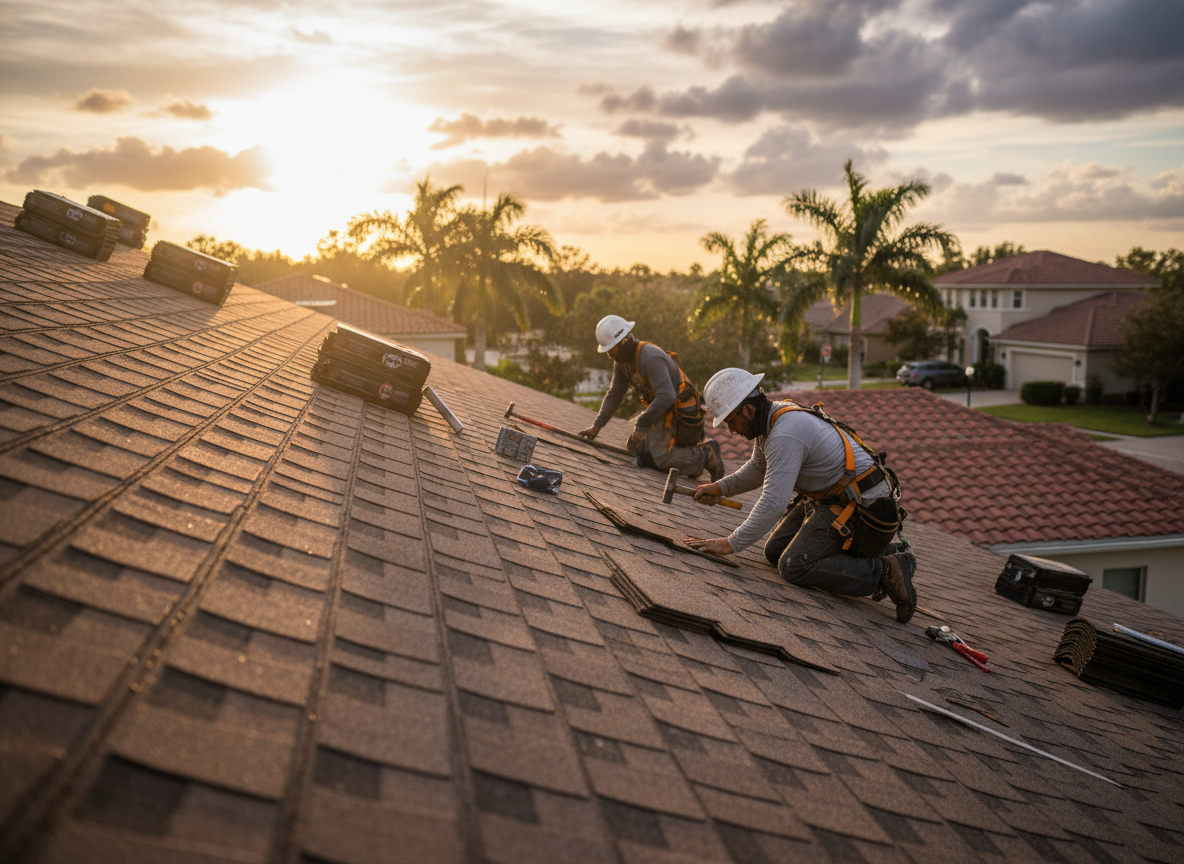
A Miami roof is decided by two things that have nothing to do with each other: how tall the building is, and which chapter of the Florida Building Code it sits under. Height tells you what kind of roof you are standing on. The chapter tells you what may legally go back onto it. Neither answer is available from the kerb, and both are settled long before anyone talks about scheduling. Roof repair in Miami, FL begins with that split, because a 1940s bungalow off Calle Ocho and a membrane deck on an Edgewater tower are not variations of one job. They are two different trades that happen to share a postcode.
What arrives by phone reflects the split. A ceiling stain in Shenandoah that appeared after a squall and has not spread. A barrel tile field on a Roads house lifting along the ridge after a windy night. Standing water on a Health District roof deck every afternoon in August. A shingle roof in Westchester that an insurer's inspector photographed and asked questions about. A parapet coping on a Brickell terrace that let go in a gust. Each of those needs a different person, a different set of approved materials and a different permit file, and the address is usually enough to tell which. Florida Roof Repair Pros covers the whole city from an office in Orlando, and the line is (407) 557-4529.
Where the Low City Ends and the High City Begins
Below about four storeys, Miami is a low-rise city built between the First World War and the mid-1970s, with newer infill dropped into the gaps. Shotgun houses and bungalows fill Little Havana and Allapattah. Mediterranean Revival villas sit under Coconut Grove's tree canopy. Modest ranch houses run west through Westchester, Kendall and Fontainebleau, and mid-century apartment blocks line the bay. Their roofs are pitched tile, pitched shingle, or flat built-up and modified bitumen over a concrete slab, and they fail the way low-slope and pitched roofs have always failed: at the membrane, at the edge, at a hole someone cut for a vent.
Above four storeys the city changes species. Brickell, the downtown core, Edgewater and the Biscayne corridor are towers raised mostly since 2000, with concrete decks, tapered insulation, single-ply waterproofing, parapets, mechanical penthouses and a great deal of ancillary metal. A leak up there is rarely domestic roofing. It is drainage, a penetration, or a parapet termination, and by the time a roofer is called the building engineer and the association are already involved. Advice written for one half of this city is usually wrong for the other.
What the Zone Chapter Adds
Miami-Dade shares the High-Velocity Hurricane Zone with Broward, and inside that zone the code stops treating a roof as a generic assembly. Underlayment systems are named. Attachment methods are named. The covering and its fasteners must carry an approval valid for the zone, and Miami-Dade runs its own product control regime on top, so a material approved for the rest of Florida is not automatically approved here.
The practical effect is that a Miami specification reads differently from one written in Tampa. Heavier underlayment, a denser fastening pattern, a shorter list of permitted assemblies. It also means a proposal cannot be judged on the tile or the shingle alone, because the layer doing the waterproofing is underneath and the part holding the roof down is the attachment. Repairs are not exempt from the logic: the materials used to close a hole have to be approved for the zone as well, which is why a bucket of sealant from a hardware shop is not a repair in this county.
Four Coverings, Four Ways to Fail
Clay and concrete barrel tile is the signature of the older city, in barrel, S-profile and flat interlocking shapes, on boom-era villas and on the tract housing that followed. It is also the covering most often misread. The tile sheds the bulk of the rain and absorbs the sun; it does not waterproof anything. Underneath is a membrane, and on a roof that is forty or fifty years old that membrane is usually finished while the tile above it still looks sound. Water gets past the tile in driving rain, runs down the battens and along the deck, and shows up as a stain some distance from the tile that let it in.
Asphalt shingle carries the postwar west and southwest, on the low hip and gable roofs of Kendall, Westchester and the streets around the Palmetto. Its failures are ordinary and predictable: pipe boots, ridge caps, valley metal and the join where a pitched plane meets a flat porch or addition. Flat and low-slope assemblies — built-up, modified bitumen, and single-ply on anything recent — cover the mid-century apartments, the commercial strips, the rear additions and the entire high-rise stock. There the failure is almost never the field. It is a drain set slightly high, a scupper packed with grit, a seam at the low point, a curb around a condenser.
Metal is a minority covering here, on some newer houses and on industrial buildings, usually standing seam or a coated panel. It fails at the fasteners and at the terminations rather than in the pan. And across every covering in this city, salt is the quiet accelerator: it does not eat tile or shingle, but it corrodes fasteners, flashing, edge metal and vents, so a coastal roof can be rotten at its hips and ridge years before the field looks worn. Within a few blocks of the bay, the corrosion rating of the fixings belongs in the specification rather than in the conversation afterwards.
Water Reaches the Edge First
Ask where Miami roofs leak and the honest answer is that most of them leak at a boundary rather than in the middle. Roof edge, parapet, wall junction, penetration, drain. The edge is where wind gets its first grip, and lifted edge metal or a separated termination puts driven water behind the flashing, which means inside the wall rather than on the roof. Stucco is the wall finish almost everywhere in this city, and stucco cracks; a hairline above a flashing is a doorway.
Penetrations come second by volume and first by variety. Pipe boots, vent stacks, conduit stands, mechanical curbs, satellite mounts, the equipment forest on a tower roof. Every one of them is a hole in the waterproof layer that somebody had to make, and every one is a maintenance item that nobody owns. On a concrete deck the water can travel a long way before it finds a ceiling, which is why the stain and the leak are frequently in different rooms.
The Storms That Wrote the Code
Two hurricanes explain the roof stock more than any other event. The 1926 storm ended the boom that produced the Mediterranean Revival city, and the masonry buildings it left behind have had their roofs replaced several times since. Hurricane Andrew in August 1992 did its worst damage well south of the city centre, but its consequence reached every address in the county: the tightened code and the product approval system that govern Miami roofing today are Andrew's legacy.
Hurricane Irma in September 2017 crossed the peninsula and gave Miami-Dade a long night of wind and driving rain, with damage concentrated in trees, edge metal, displaced tile and anything already loose. Hurricane Wilma in October 2005 arrived from the Gulf side and hit Broward and Palm Beach hardest, but it still peeled edges here. The lesson from that record is not that storms are common. It is that the edge, the attachment and the underlayment decide survival, and those are the three things a homeowner can never see from the ground.
What People Actually Ask Us to Do
The calls that turn into work are narrower than a service list suggests. Leak repair is the bulk of it: water at a ceiling, a stain that grew since morning, a tenant who has stopped being patient. On tile that means lifting the field to read the membrane instead of sealing the surface. On a flat roof it means checking how water leaves before checking the sheet.
Where the roof is open to weather — an edge peeled back, tile scattered by wind, a limb through the deck, a membrane torn at a corner — the first visit is tarping to stop water entering the structure, with emergency roof repair where the opening can be closed properly during that visit. Storm and hurricane damage repair is the wider engagement: reading what the wind did across every plane, separating fresh damage from wear that was already there, and rebuilding only what needs rebuilding. In this county that record often has a second reader, because an insurer or an inspector will ask for it later.
Replacement enters the conversation when the underlayment has gone across a whole field, or when the deck is soft in more than one place, and it is the honest answer at that point rather than an upsell. Roof installation is the same work on a building that has never carried a roof. The covering is then chosen from shingle, tile, metal and flat assemblies, with roof coating reserved for sound low-slope or metal surfaces that need renewing rather than rebuilding. Underneath all of it sits roof inspection, which on a purchase, a sale or an insurer's request is frequently the only thing anyone needs.
How a Miami Job Is Run
A survey opens every job. Every plane that can be walked safely gets walked, the deck is read from below where there is access, and photographs record each junction, penetration, edge and drainage point. On a condominium or commercial building the survey also maps the roof plan, the equipment layout and the intended path water takes off the roof.
Then comes the written scope, and in this county it is a technical document rather than a quotation. It names what is replaced, what is repaired, what is left alone, which approved materials are specified, and what the work assumes about the deck. That document becomes the permit application: the approved assembly, the underlayment system and the fastening schedule are all named in it. The permit is filed before anyone climbs, and the inspection stages afterwards are set by the jurisdiction rather than negotiated on site.
On a replacement the deck and underlayment are inspected while they are still open, and the final inspection follows completion. Sign-off is a file, not a handshake: the completed inspection record, photographs of everything that is now hidden under the finished surface, and a walk of the property with the owner covering flashings, drains, terminations and cleanup. Associations and commercial owners keep that file, and they are right to.
Two Permit Offices, One Code
Inside the City of Miami, roofing permits come from the city's building department. Miami-Dade County's building department takes unincorporated addresses and a number of the smaller municipalities. The line is a municipal boundary, not a distance, and it is not always guessable from a street address, so it is checked before anything is booked — the review queue, the inspection stages and the paperwork differ between them.
Under both sits the Florida Building Code and, in this county, the zone chapter of it. The questions that come up on a house are consistent: design wind speed for the site, approved product for the covering, the fastening schedule that goes with that product, and the underlayment specification. All four are answered in the permit file rather than agreed between homeowner and crew.
The Ring Around Downtown
Most of Miami's neighbours fall inside ten miles of the centre. Coral Gables, Coconut Grove and Little Havana are minutes away, and Wynwood, the Design District, Overtown, Allapattah and Liberty City are closer than that. The barrier islands lie across the causeways, Key Biscayne to the southeast, and Hialeah, Miami Springs, Doral and Hialeah Gardens to the northwest and west. Each has its own building department and its own roof stock, and work in any of them is planned the way work in the city is.
What to Have Ready
The address settles the permit authority, so have it to hand. The height of the building settles whether this is a residential roof or a commercial one. A photograph of the covering taken from the ground saves a trip if the question is obvious, and the date of the last roof permit is worth digging out of a closing folder if it exists. Florida Roof Repair Pros operates from 4720 Millenia Blvd, Suite 175, Orlando, FL 32839, and Miami calls reach (407) 557-4529.
Around Miami
We regularly work near:
- 📍Brickell City Centre
- 📍Little Havana, Calle Ocho
- 📍Coconut Grove
- 📍PortMiami
- 📍Miami International Airport
Roofing Company in Miami — Local Notes
- •City of Miami and Miami-Dade County permit separately
- •High-Velocity Hurricane Zone: approved assemblies and NOAs
- •Tile underlayment, not the tile, is the waterproof layer