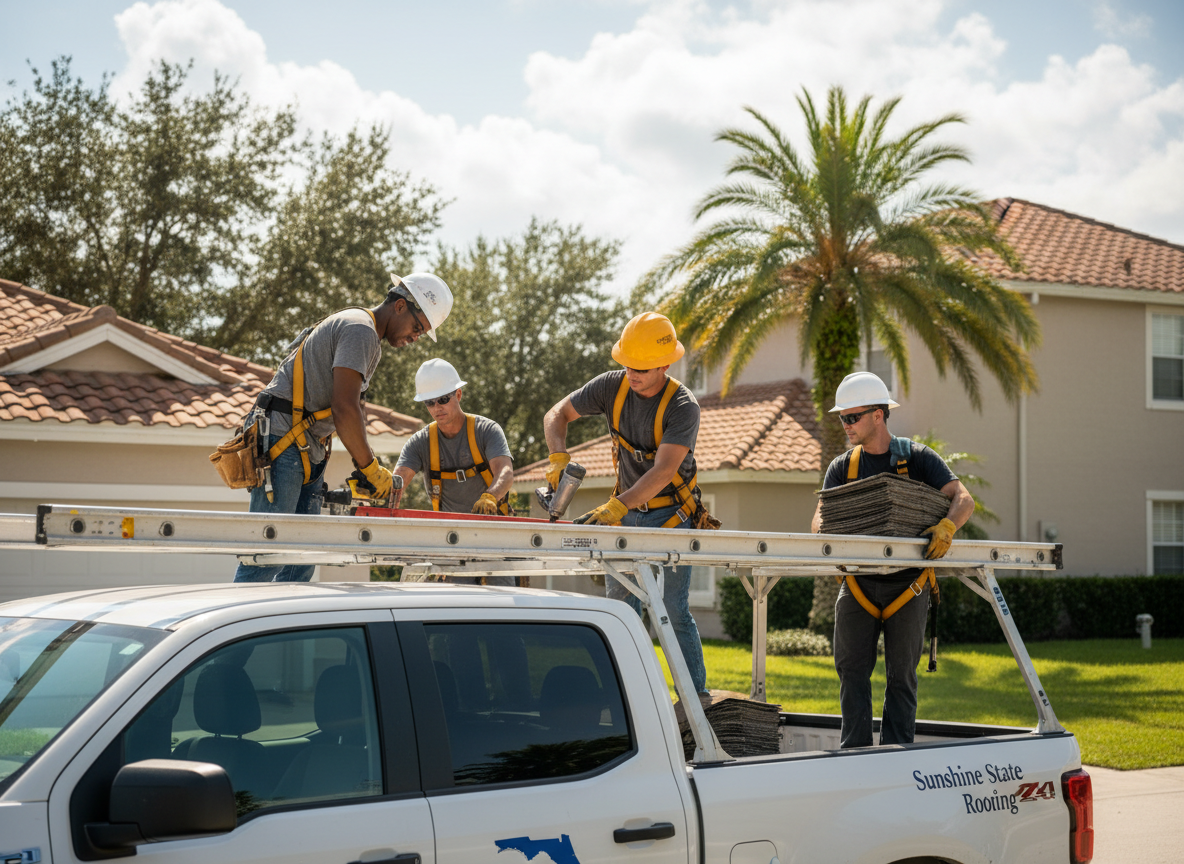
Lehigh Acres is the largest community in Lee County and it has no city government at all. There is no mayor, no council and no municipal building department; the community is a census-designated place inside unincorporated Lee County, spread across roughly ninety-six square miles of flat, sandy ground east of Fort Myers. That single fact shapes every roofing conversation here, because the permit, the inspection and the code enforcement all come from the county rather than from a city hall down the road.
The place was platted in the 1950s, when a land company subdivided the ground into tens of thousands of small lots and sold them by mail to buyers who often built years later, one house at a time, on a street that might still have been unpaved. The result is a housing stock with no uniform era: a 1970s ranch can sit beside a house finished last year, and both can sit beside an empty lot. Roof repair in Lehigh Acres, FL, is therefore less about a district style and more about reading one house carefully.
A Place Built by the Lot
Because the lots were sold individually and built on individually, the quality of what stands on them varies more than in a subdivision built by one contractor. Some houses were built by established builders to a permit and inspected at every stage. Others were finished by owners with help, extended over the years, and re-roofed by whoever was available. None of that is visible from the street, and all of it matters when a roof is opened.
The practical consequence is that the permit record is part of the survey. A roof that was installed under permit has an inspection history and a date. A roof without one has neither, and the difference affects what an insurer will accept and what a buyer will ask. Checking that record before a repair is proposed is not bureaucracy; it is how a homeowner avoids paying twice for the same work.
Inland Heat Rather Than Salt
Lehigh is far enough inland that the salt story of the coast does not apply. What replaces it is heat. The ground here is higher and sandier than the coastal strip, the sun is unobstructed, and a shingle roof on a house with a low attic and closed soffits will bake from the inside out. Granule loss on the south and west planes is the first visible sign, and it usually appears years before a leak.
Storms arrive differently too. There is no surge this far inland, so the damage pattern is wind and rain: shingles lifted at a ridge or an edge, a ridge vent torn open, water driven under a cap, a tree limb through a deck. After Ian in September 2022 and Milton in October 2024, the calls from this side of the county were wind calls rather than flood calls, and the repairs were covering, decking and edge metal.
The Covering on Most Houses
Asphalt shingle is the covering on the great majority of houses here, and it is the right place to start the conversation. The stock divides into three rough groups: 1970s and 1980s houses that may be on their second or third roof, 1990s and 2000s houses on architectural shingle that are now at or near the end of their first covering, and newer houses where the question is not repair at all.
On the older group, the deck is the unknown. A house that has been re-roofed twice may have a deck that was never replaced, and the second layer may have hidden soft spots at the eaves and around penetrations. On the middle group, the failure is the shingle itself: the mat hardens, the seals let go at the tabs, and the first wind event lifts courses that had looked flat the week before.
Metal appears on outbuildings, carports and a minority of houses, usually as an exposed-fastener panel rather than standing seam. Tile is uncommon outside a few newer and larger properties. Flat or low-slope work is mostly limited to carport roofs, additions and small utility structures, where the details matter more than the covering because there is so little fall to work with.
What Previous Work Looks Like
When a roof here has been repaired by three different people over twenty years, the evidence is in the details: patches of a different shingle, valleys that were sealed rather than replaced, flashing that was bent on site, a vent boot that was painted instead of changed. None of that is unusual, and none of it is a reason to condemn a roof. It is a reason to survey before quoting.
The other local pattern is the addition. A carport enclosed, a room added at the back, a porch roof built over a slab. Each creates a join where two roofs meet, and the join is usually the first thing to leak. On a Lehigh house the transitions are where the diagnosis starts, not the field.
Reading a House With a Low Attic
Many of these houses have very little attic: a low truss space, insulation to the eaves, and no safe way to move through it. That limits what can be seen from below, and it changes the survey method. Where the attic cannot be read, the roof is examined from above at the eaves, at the penetrations and at every transition, and the deck is checked by feel and by opening a small section where the evidence points.
The absence of a readable attic is also why moisture problems here are sometimes discovered late. A slow leak into a shallow attic wets the insulation, the insulation holds it against the deck, and the first sign inside is a stain on a ceiling that has already been damp for a season. When a ceiling stain appears, the roof has usually been leaking for longer than the owner thinks.
Wind, Rain and the Tree Line
The lots here are large and many carry mature pines and oaks, which is both a benefit and a risk. Shade extends the life of a shingle roof on the shaded planes. It also puts limbs over the roof, and a limb that rubs a ridge cap for a season will wear through it. After a wind event, the first inspection question is not how the field looks but what has been dropped on it.
Rain-driven leaks follow the same logic as anywhere else on this coast, with one difference: because the roofs are simple gables and hips, the entry points are concentrated. A valley, a plumbing vent, a chimney or a furnace flue, the join to an addition, and the edge at a gable end. On a simple roof those five places account for most of the water that gets in.
The Services Available Here
The work comes from the site's own service list, applied to this stock. Roof leak repair is the diagnostic core, and on a house with a shallow attic it starts with tracing rather than with a patch. Emergency roof repair and emergency roof tarping cover the night a limb opens the deck and rain is coming in. Storm and hurricane damage repair handles the documented sequence afterwards: make safe, photograph, repair, and keep a file an insurer can read.
Roof repair is the everyday trade, and here it is often carpentry at an addition joint or a carport transition before it is covering. Roof replacement and roof installation handle the end of a roof on its third covering or a first covering that has reached its limit. Shingle roofing covers almost all of the residential stock. Metal roofing suits the outbuildings and the carports. Flat roof repair and roof coating cover the low-slope additions and utility roofs where there is no room for error in the fall. Roof inspection is the visit that starts all of it, and on a house with an unclear permit history it is also the visit that establishes what is actually there.
Running a Lehigh Job
The first visit is a survey: the covering and its age, the deck at the eaves and around penetrations, the transitions at additions and carports, and the attic where it can be reached. The permit history is checked at the same time, because a roof installed without one changes what a later owner or insurer will accept.
Then the written scope. It separates what is replaced from what is repaired, names the underlayment and fastening method, records what is assumed about the deck, and lists exclusions. On a house with three previous repairs that document is the difference between a price and an estimate.
The permit is filed with Lee County before work starts, and the inspections are booked to the county's stages. The close-out is a walk of the property with the owner covering ridges, edges, vents and cleanup, plus photographs of what is now covered. On a house with a shallow attic those photographs are the only record of the deck that will exist.
Permits Through the County
Lehigh Acres has no municipal building department, so residential roofing permits go to Lee County's building and permitting services, with applications handled through the county's online portal. Fort Myers addresses go to the city instead. The community's own special district, the Lehigh Acres Municipal Services Improvement District, deals with drainage, waterways and some infrastructure rather than building permits, which is a distinction that catches people out.
Beneath the county permit sits the Florida Building Code. Lee County is outside the High-Velocity Hurricane Zone, which covers Broward and Miami-Dade, so the zone's extra underlayment chapter does not apply here. The wind provisions do, and this far inland the design wind speed is lower than on the coast, which is one of the few respects in which a Lehigh roof is an easier specification than a Cape Coral one.
Within Ten Miles
Gateway to the west, Fort Myers and its eastern neighbourhoods beyond that, Buckingham and Alva to the north, Olga and Fort Myers Shores along the Caloosahatchee, and the county's rural spread to the east and south. Each has its own permit desk or none, and the housing stock changes as the lots get larger.
Calling About a Lehigh Acres Roof
The address settles the permit route, which here means the county rather than a city. The covering and its age settle whether this is a repair or a replacement conversation. The permit history, if it can be found, settles what an insurer or a buyer will want to see. A photograph from the ground helps when the answer is visible. The office is at 4720 Millenia Blvd, Suite 175, Orlando, FL 32839, and Lehigh Acres calls come to (407) 557-4529.
Around Lehigh Acres
We regularly work near:
- 📍Harns Marsh Preserve
- 📍Frank Mann Preserve
- 📍State Road 82
- 📍Orange River
- 📍Lehigh Acres Trailhead
Roofing Company in Lehigh Acres — Local Notes
- •No city government — Lee County issues every roofing permit
- •Inland heat ages shingle from below; salt is not the local factor
- •Houses were built one lot at a time, so permit histories vary