Lake City calls itself the Gateway to Florida, and the name is a description of a road junction rather than a compliment. Interstate 75 runs south to Gainesville and north to Valdosta, Interstate 10 crosses it on the way to Jacksonville and Tallahassee, and US 90 and US 441 meet in the middle of town. All of that traffic explains why the city has more motels, warehouses and truck stops per head than a town of its size would otherwise carry, and it explains a good deal about the roofs. Roof repair in Lake City, FL, covers two very different kinds of building: the older residential streets around the courthouse square, and the low commercial stock that grew up to serve the interchange.
The city sits on high ground for Florida, close to two hundred feet above sea level, in Columbia County. There is no salt in the air, no surge at the end of any street and no beach traffic. What replaces those coastal problems is heat, tree cover, thunderstorms that arrive with hail, and a winter that is genuinely colder than the peninsula's. A roof here is not fighting corrosion. It is fighting sun, limbs and water that arrives faster than the drainage can take it.
Inland Weather, Inland Roofs
The storms that matter arrive weakened. Hurricane Irma crossed the whole state in September 2017 and passed through north-central Florida with tropical-storm winds, leaving tree damage and outages across this county. Idalia in August 2023 came ashore in the Big Bend and crossed the Suwannee Valley to the west, close enough to bring tropical-storm conditions and downed timber through the same area. In both cases the roofs that failed were failed by limbs, by shingles lifted at ridges and rakes, and by water driven into details that had never been tested from that direction.
The absence of a coastal designation changes the specification. Lake City is well outside the High-Velocity Hurricane Zone and outside the wind-borne debris region, so a replacement here is not driven by the same product approval and opening protection requirements that apply on the coast. The Florida Building Code's wind provisions still apply, and the design wind speed for the site is a published figure the fastening pattern has to suit, but a roof that would be marginal at the beach can be entirely appropriate on this ground. Inland heat does more to shorten a roof's life here than wind does.
Downtown and the Flat Roofs Behind Parapets
The courthouse square and the streets around it hold the city's oldest commercial buildings, a mix of brick and early twentieth-century storefronts with the Hotel Blanche among them. Most of them present a parapet to the street, and behind the parapet the roof is flat or very low-pitched. That construction hides the roof from the pavement and hides its problems from the owner as well: water sits behind a parapet instead of running off, the built-in gutter that drains it is often original, and the membrane beneath is out of sight until a ceiling gives way two floors down.
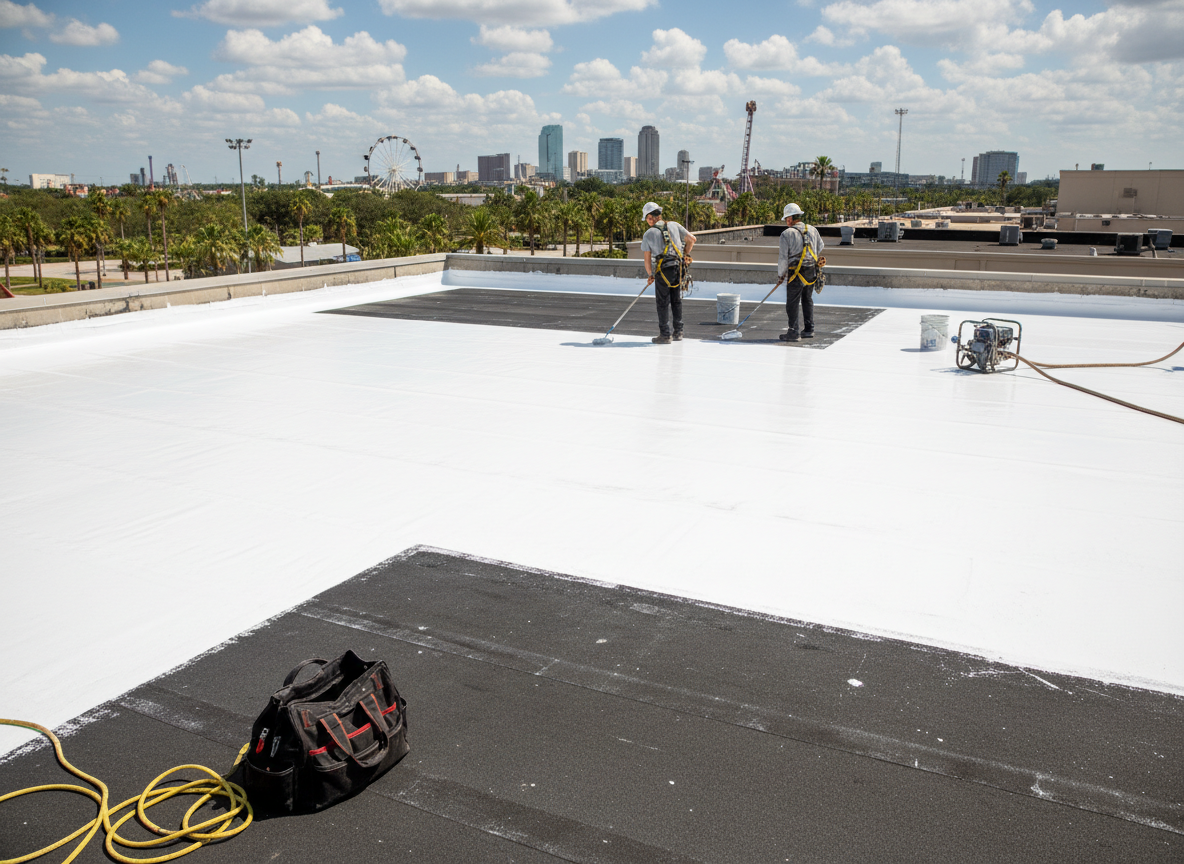
On these buildings the failure is at the terminations. A parapet coping that has lost its seal lets water into the wall. A scupper or a roof drain blocked by debris turns a flat roof into a pond after a summer storm, and a pond finds every lap that was never properly sealed. Coating has a place here, but only over a membrane that is still sound and a drainage system that works; coating a ponding roof is a way of postponing the conversation, not of having it.
The Bungalow and Prewar Streets
Away from the square, the residential streets date mostly from the first three decades of the twentieth century. These are frame houses with gable and hipped roofs, often with a porch under its own roof at the front, and many were built over board sheathing rather than panel decking. The original covering was frequently metal; most have been shingled at least once since.
Two things go wrong on houses of this age. The first is the porch junction, where a shallow roof meets the main plane and the flashing has been patched rather than rebuilt for decades. The second is the deck. A board deck moves with the seasons, and nail heads that have worked loose over a century show up as ridges and popped fasteners across the plane. A re-roof is the only moment when that deck can be inspected properly, and covering a tired board deck with a new layer is a decision that will be lived with for twenty years.
Postwar Ranches and the Highway Corridor
The 1950s and 1960s filled in the streets east and north of downtown with single-storey ranch houses on low-pitch hip roofs, and the same decades put up the motels, restaurants and warehouses along the highways. The residential roofs fail from heat and ventilation: a shallow pitch over a hot attic needs continuous soffit intake, and later insulation work usually blocks it. The commercial roofs fail from drainage and from equipment. A flat roof carrying air-conditioning units, vents and a sign frame has a dozen places for water to enter, and every one of them depends on a curb or a boot that was installed when the building was new.
Manufactured Housing and Low-Slope Metal
Outside the city limits a good share of the housing is manufactured, and it is roofed differently from the houses in town. The typical covering is a low-pitch metal panel over purlins, fixed with screws that carry a neoprene washer. Those washers perish in the sun, and a roof that is watertight in its tenth year can be leaking at thirty screw lines in its twentieth. The repair logic is different as well: the panels are usually sound long after the fixings are not, so the work is often a systematic replacement of fasteners and sealant rather than a new covering.
That difference matters when a manufactured home is being sold or insured, because the question asked is rarely whether the roof looks presentable. It is whether the fixings, the edge trim and the roof-to-wall junction are intact. A survey that photographs each of those is worth more than a general opinion.
Heat, Hail and the Pine Canopy
Columbia County is pine and oak country, and the canopy over the older streets does what canopy does everywhere: it shades the roof, fills the valleys, and drops limbs in every storm strong enough to matter. Debris that sits in a valley holds water against the covering and starts the laps failing from the outside in. Moss and algae follow the shaded slopes, and gutters that are never cleared back water under the eave and into the fascia.
Hail is not an annual event here, but spring storms do produce it, and the damage is bruising rather than puncturing. A shingle struck hard loses its granules at the impact point and begins to fail there within a few seasons, which is why a post-storm inspection looks closely at the slope that faced the storm rather than at the roof as a whole. Close photographs of the bruised area support an insurance claim far better than a description of it.
The Services Available Here
The trade list on this site applies in Lake City as it stands, and the split between the two kinds of building shows in how the work is used. Roof leak repair is the everyday call on the residential streets, and on the commercial stock it is usually a drainage investigation before it is a membrane repair. Emergency roof repair and emergency roof tarping cover the limb through a deck and the storm that opens a ridge. Storm and hurricane damage repair runs from making the roof safe to producing the record an insurer will ask for.
Roof repair covers valleys, penetrations, chimney flashings and the localised sections that fail first. Roof replacement and roof installation take over where the covering has reached the end of its life or the deck has softened, which on the prewar streets is a common finding. Shingle roofing covers most of the city, metal roofing suits the rural edges, the manufactured housing and the owners who want a long service life, and tile roofing appears on the newer and larger houses where the structure has been checked for the weight. Flat roof repair and roof coating serve the downtown parapet buildings and the highway commercial stock. Roof inspection is the starting point for all of it, and on a building with a parapet it is the only way to know what the roof is doing.
How a Job Runs Here
A job in Lake City begins with the permit record, which for a town of this age is usually informative. The last re-roof date, the product installed and the inspection history establish whether the current covering is the first, the second or the third, and that changes what the survey is looking for. On a prewar house the answer often decides whether the deck can be reused.
The survey then records the roof plane, the attic where there is access, the deck from below as well as above, and photographs at every junction. On a commercial building it records the drainage: where the water goes, where it ponds after rain, and what is sitting on the membrane. The written scope separates what is replaced from what is retained, names the underlayment and fastening pattern, states the assumption about the deck, and lists what is excluded. On a manufactured home it lists the fixings and the edge trim as separate items rather than folding them into a general repair.
The permit is filed with the right office, inspections are booked to the stages the work needs, and the job closes with a walk over the finished roof and photographs of everything now covered. In this county the closing paperwork is not a formality: the finished work is documented with images that show fastening and overlaps, and that record is what an insurer or a buyer will read years later.
Permits: Two Offices in the Same Town
Addresses inside the city are permitted by Lake City's Building Safety Department, which handles building, roofing, mechanical, electrical and plumbing review from its office on Hillsboro Street. Addresses outside the city limits are permitted by the Columbia County Building Department, whose office is a few blocks away on Hernando Avenue, in the same town. Both apply the Florida Building Code, and both sit outside the High-Velocity Hurricane Zone.
The county's published roofing guidance is unusually specific, and it is worth knowing before a scope is agreed. A roofing affidavit has to be signed affirming that sheathing, nailing, dry-in, venting and flashings will follow the code and the product approval, the application has to name the underlayment method for sealing the deck, and the final inspection requires photographs with the permit number or address visible and a rule in frame to confirm nail spacing, overlap, drip edge and valley flashing. Very small jobs fall under a published exemption, but the documentation habit does not change, and a roof without a permit becomes a problem at sale.
Within Ten Miles
Watertown immediately to the north-west, Five Points and Ellisville out along the old roads, Lulu to the north-east, McAlpin toward the Suwannee side of the county, and the US 90 and US 441 corridors that carry most of the commercial stock. Each has its own mix of housing and its own distance from a permit desk.
Calling About a Lake City Roof
Three facts settle most of the questions here: whether the address is in the city or the county, whether the building is residential or commercial, and whether the covering is the first on the deck or the third. The first decides the office, the second decides the survey, and the third decides how much of the roof is really being replaced. The office is at 4720 Millenia Blvd, Suite 175, Orlando, FL 32839, and Lake City calls come to (407) 557-4529.
Around Lake City
We regularly work near:
- 📍Columbia County Courthouse
- 📍Hotel Blanche
- 📍Lake DeSoto
- 📍Olustee Battlefield Historic State Park
- 📍Interstate 75 and Interstate 10
Roofing Company in Lake City — Local Notes
- •Lake City and Columbia County run separate permit offices a few blocks apart
- •Inland exposure: no salt, no surge, no wind-borne debris region
- •Manufactured housing outside the city is roofed in low-slope metal over purlins