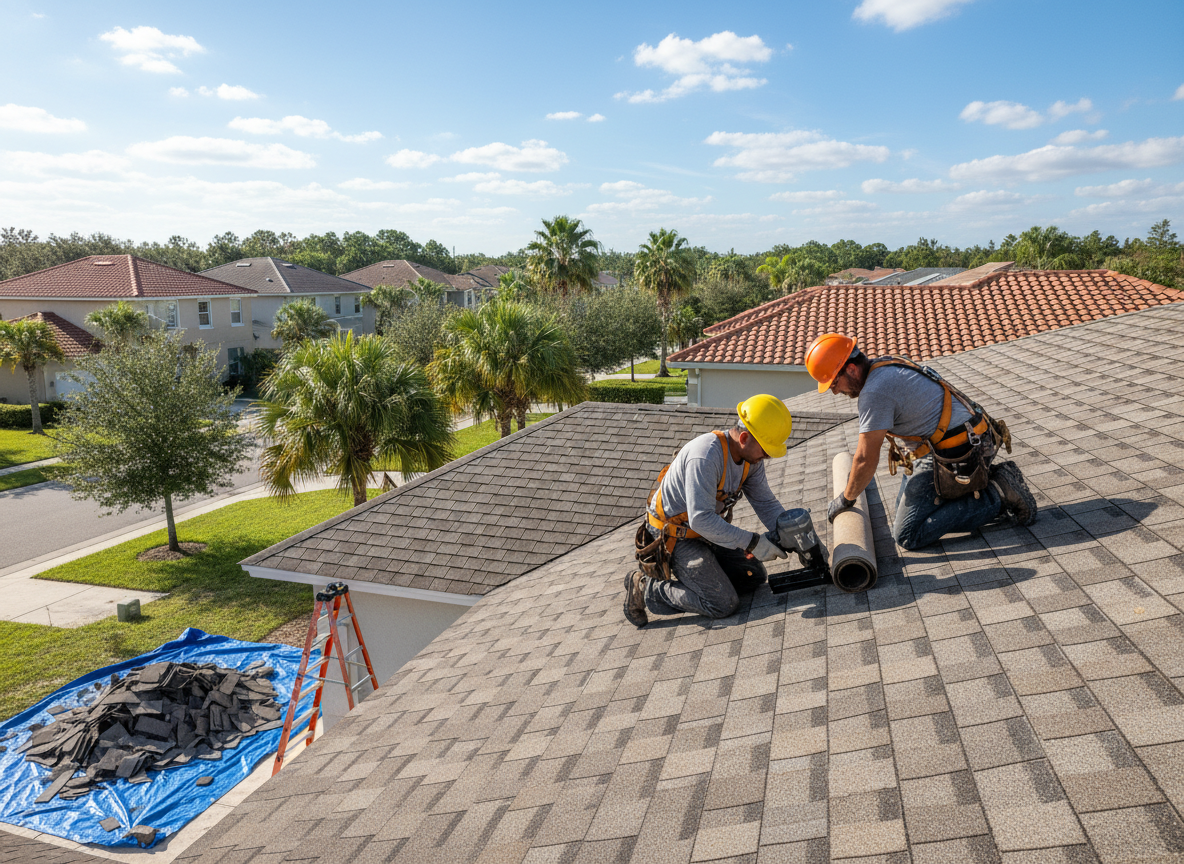
Jupiter is the last town on this coast before the county line, and it is built around a river mouth rather than a land boom. The Loxahatchee comes down to the Atlantic through a narrow, jettied inlet here, the ground rises into a bluff on the river's south bank, and the settlement grew along the roads that ran back from the beach. That geography shapes the roofs: a stock that runs from 1950s and 1960s cottages through 1980s subdivisions to large newer houses on the river and the golf courses, a great deal of tile, a visible share of metal, and salt in the air on every property east of the railroad. Roof repair in Jupiter, FL is a coastal trade with a small-town permit office behind it.
Jupiter belongs to Palm Beach County, which places it north of the High-Velocity Hurricane Zone covering Broward and Miami-Dade. The zone's extra chapter on underlayment methods and product approval therefore does not reach here, though the code's wind provisions do, in full. What the town has instead of that paperwork is exposure: an inlet, a river mouth and open ocean within a short walk of most of its eastern streets. Florida Roof Repair Pros works Jupiter from an Orlando office, and Jupiter calls come to (407) 557-4529.
Two Waters and a Ridge
The town's geography is two bodies of water with higher ground between them. The Loxahatchee still runs largely wild in its upper reaches, the inlet is held by jetties, and the older residential streets sit on the south bank and along the roads running back from the beach. Newer development spreads west and north onto former farmland and scrub, where the roofs are bigger, the lots are larger and the exposure is different.
That elevation matters more than it sounds. A house on the bluff drains away from itself; a house on the low ground near the river and the canals does not, and a roof that discharges onto saturated ground keeps the wall and the foundation damp long after the rain has stopped. On the low streets the roof and the site have to be considered together, which is not a conversation you have on higher ground.
Metal, and Why It Suits This Town
Jupiter carries more metal roofing than most of South Florida, and the reason is straightforward: within sight of the inlet, metal is a sensible answer. It does not granulate or rot, it sheds the volume that a tropical downpour delivers, and its failure modes are concentrated at the fasteners, the terminations and the pan details rather than spread across the field. Standing seam dominates the newer work; older formed panels survive on some of the cottages and on outbuildings.
A metal roof does not look after itself, whatever the sales literature suggests. Fixings back out under thermal movement, washers perish in the sun, termination sealant hardens and cracks, and foot traffic can distort a pan enough to pond water at a rib. On this coast the screws are the weak point and the pan is the durable part, so they are what an inspection examines first. Coating refreshes aged but sound metal; it cannot substitute for fixings that have let go.
Tile, and the Underlayment Question
Concrete and clay tile covers a large share of the 1980s and 1990s housing and much of the newer stock on the river and the courses. On those roofs the tile is rarely the problem. The membrane beneath it is. A tile field installed in the late 1980s or 1990s is now at the age where the underlayment is at or past the end of its service life, even where the tile is intact and the roof has never leaked.
Staining that appears after a wind-driven downpour, and not after an ordinary one, is the usual first report, and it means water is being forced under the tile rather than simply running off it. That pattern almost always predates the stain by several seasons. Opening the field at a valley and at a hip junction is the only way to grade the membrane, and a proposal that never opens the roof is not an inspection.
Shingle on the Inland Streets
Where shingle covers the inland streets, the wear pattern is predictable. Sun on the south and west planes, granules in the gutter by the handful, a mat that hardens until it cracks at the ridge. Add a second layer from an earlier re-cover and the whole process runs faster, because the roof beneath has no way to shed the heat it collects.
Ventilation sets the pace. A ridge vent with closed soffits draws nothing, and closed soffits are common on houses that have been re-insulated or re-landscaped — insulation packed to the eaves, paint over the vents, a screen that has never been cleared. The attic then holds its heat, the deck above it cooks, and the shingle fails years early. In the cooler months the same trapped moisture shows as staining along the ridge, which owners usually read as a leak.
Salt and the Inlet
Proximity to the inlet decides how much salt a roof carries. It settles on every surface and attacks the metal rather than the covering: fastenings, valley and hip flashings, drip edge, vent collars, and the screws on a metal pan. Within a few streets of the water those are the parts that fail first, and they fail out of sight, which is why a Jupiter roof is judged at its hips and terminations before its field.
That is why the specification on a Jupiter roof leans on the fixings rather than only the covering. Stainless or coated fasteners, compatible metals at every junction, and no mixing of aluminium and copper where water runs between them. On a house within a few streets of the water, those details outlast the covering discussion.
What the Hurricanes Left Behind
The local record is short and sharp. Wilma crossed from the Gulf in October 2005 and put much of the county back under new roofs over the following year. Frances and Jeanne came ashore at Hutchinson Island in 2004 and drove wind and rain across this coast for days. The town's position at the county's northern edge means both were felt here rather than watched from a distance.
On a river-front or beachfront property the exposure is what matters. A roof facing open water takes the load without shelter from anything opposite, so the edge, the ridge and the terminations are where a specification earns its keep.
The Entry Points
Water finds the tile roofs at the underlayment in a valley, a hip or a wall junction; the metal roofs at a fastener or a termination; the shingle roofs at a boot, a ridge cap or the join to a flat section over a porch or lanai. On all three, the wall junction deserves attention, because stucco cracks as a building moves and a hairline above a flashing leads straight into the cavity.
Water travels before it appears, so the stain inside is rarely under the entry point. On a large house with several roof levels, that distance can be considerable, which is why the survey photographs junctions rather than only the field and why a repair that only seals the visible mark tends to return.
The Work This Town Needs
Most calls are leaks, and most leaks are traced rather than guessed. A metal roof is read at its fastenings and terminations; a tile roof at its membrane; a shingle roof at its details and its attic. The diagnosis decides whether the answer is a repair, a sectional replacement or a new covering, and on a river-front property it also decides how much the fixings matter in the specification.
Storm work follows its own rhythm. A lifted panel, a torn termination, a limb through the deck: the first visit is about closing the opening so water stops entering, and the second is about the permanent repair. Between those two visits sit photographs, because an insurer or a buyer will want to know what the wind did and what was already worn when it arrived.
Coverings here are chosen from a short list. Metal where the exposure is real, in standing seam or a coated panel, with the fastenings treated as the part that wears. Concrete tile where the house was built with it. Architectural shingle on the inland streets. Flat work and coating on the lanai transitions and the small commercial buildings. The survey decides, and the deck is seen before anything is specified.
How the Work Is Ordered
The first visit is a survey, and it is deliberately unhurried. Planes are walked where they can be walked, the deck is read from below, and the details are photographed — valleys, hips, penetrations, terminations, edges. On a metal roof the fasteners are checked at several points rather than one, since corrosion is rarely even. On tile, the profile and the quantity of spare material are recorded, because a repair may depend on tile nobody makes any more.
Then the paperwork. The scope names what is replaced and what is repaired, which underlayment and fastening method are specified, what is assumed about the deck, and what is excluded. It becomes the permit application, and on a tile roof it also sets out the sequence: membrane seen and photographed before the field is relayed.
The permit is filed before work starts. Inspections are scheduled where the jurisdiction requires them rather than where the crew would prefer, and the final inspection closes the job.
At the end there is a file. The completed inspection, photographs of what is now covered up, and a walk of the property with the owner covering edges, terminations and cleanup. On a river-front house that file is also the record of what the salt has already taken, which is useful when the next roof is discussed.
Permits and the Town Desk
Addresses inside the Town of Jupiter are permitted by the town's building department. Palm Beach County takes the unincorporated ones, and the neighbouring municipalities take their own. The boundary is a municipal line rather than a distance, so it is checked before a date is offered — review queues and inspection stages differ between the desks.
Beneath the local permit sits the Florida Building Code. Outside the hurricane zone, the wind provisions apply without the zone's extra requirements: design wind speed for the site, product approval for the covering, fastening schedule, underlayment specification. On a metal roof the fastening schedule carries most of the weight, and near the water the exposure of the edge is part of the same conversation.
Along the Coast and Inland
Tequesta is the next town south, with Jupiter Inlet Colony and Juno Beach beyond it, and Palm Beach Gardens inland to the south-west. The Martin County line is a few miles north, with Hobe Sound and Jonathan Dickinson State Park across it. Each has its own permit desk and its own roof stock — the island communities are coastal and exposed, the inland ones newer and larger.
What We Need From You First
The address settles the permit desk. How close the property sits to the inlet or the ocean settles how much weight the fixings carry in the specification. What covers the roof — metal, tile or shingle — settles how the first visit is planned. A photograph from the ground helps if the answer is obvious, and the last roof permit date is worth digging out. Reach the office at 4720 Millenia Blvd, Suite 175, Orlando, FL 32839, or call (407) 557-4529 for Jupiter work.
Around Jupiter
We regularly work near:
- 📍Jupiter Inlet Lighthouse
- 📍Loxahatchee River
- 📍Carlin Park
- 📍DuBois Park
- 📍Jonathan Dickinson State Park
Roofing Company in Jupiter — Local Notes
- •Town of Jupiter permits its own addresses
- •Palm Beach County is outside the High-Velocity Hurricane Zone
- •Salt load highest near the inlet and the ocean