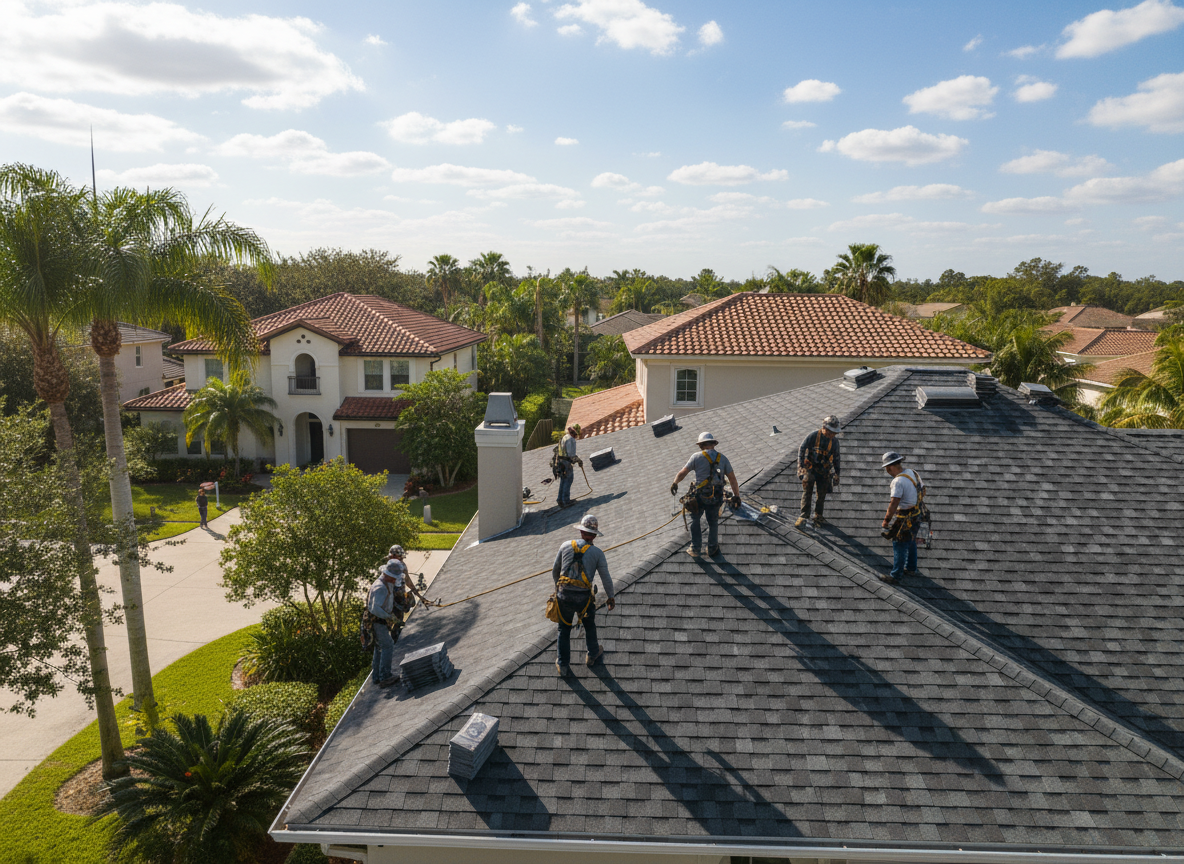
Jacksonville covers more ground than any other city in the contiguous United States, and that scale is the first thing a roofing conversation has to absorb. The consolidated city and Duval County share one government and one building department, but they do not share one climate. A house in Springfield, four miles from the river, a ranch off Beach Boulevard on the Southside, and a cottage behind the dunes at Mayport are all in the same city and all face different loads on the same afternoon. Roof repair in Jacksonville, FL, therefore starts with the address rather than the covering.
The St. Johns River runs through the middle of the city and turns north before it reaches the Atlantic, which puts a great deal of Jacksonville at low elevation beside a wide, slow river. The beach communities sit on a barrier island. Inland, the ground is flat pine flatwood over sand. Water has nowhere to go quickly in any of those places, and a roof that sheds correctly still has to survive the humidity that comes with standing water nearby.
One Government, Many Kinds of Roof
Because the city and county are consolidated, almost every address in Jacksonville is permitted by the same office, the Building Inspection Division on North Hogan Street. That is a convenience for a contractor and a fact worth knowing as an owner, because it removes the confusion that exists in regions where a city and its county run separate desks. The exception is the beach municipalities, Atlantic Beach, Neptune Beach and Jacksonville Beach, which are separate cities inside Duval County with their own building departments.
What the consolidation does not flatten is the housing. Jacksonville grew outward in waves, and each wave left a distinct roof behind. The oldest surviving neighbourhoods date from the streetcar era and the 1920s boom. The postwar subdivisions spread east and south. The 1980s and 1990s filled the Southside and the Westside with larger houses on larger lots. Roofs from those three eras fail in three different ways.
Springfield, Riverside and the Streetcar Roofs
Springfield was laid out in the late nineteenth century and rebuilt after the Great Fire of 1901, and its houses carry the steep hip and gable roofs of that period, many with deep eaves and exposed rafter tails. Riverside and Avondale, developed a decade or two later, hold a mix of Mediterranean Revival houses under clay tile and Tudor and Colonial Revival houses under slate or heavy asphalt. Ortega and San Marco belong to the same generation.
On a Springfield house the usual failure is at the penetrations and the wall junctions rather than the field. A century of additions, dormers, chimneys and vent stacks has punctured the roof plane repeatedly, and each puncture is a place where flashing was installed once and never revisited. On a Riverside tile roof the failure is underneath: the tile is sound and the underlayment beneath it has gone, so the roof leaks at valleys and hips while the surface looks intact. On the slate and heavy-shingle houses, the question is usually whether the remaining material can be matched at all.
Both Springfield and Riverside Avondale are locally designated historic districts, and exterior work in them is subject to the city's historic preservation review. A roof replacement is exterior work. That review is not an obstacle so much as a constraint that has to be established before material is ordered, because the approved covering and profile shape the entire job.
The Postwar Shingle Belt
Arlington, Lake Shore, Murray Hill, Cedar Hills, Englewood and the older parts of the Southside were built between the late 1940s and the 1970s, mostly as three-bedroom ranch houses under asphalt shingle on simple gable and hip forms. Many of those roofs are on their second or third covering. A great number were originally built with plank or spaced sheathing rather than plywood, and a re-roof over that deck requires a decision about whether to add a solid substrate.
The failure pattern in this belt is heat and ventilation. Jacksonville's summers are long, the attic under a low-pitch hip roof gets very hot, and a roof that was vented adequately in 1962 may not be vented adequately now that the attic has been re-insulated and the soffit intakes have been covered over. Shingles that are cooked from below fail at the mat, and the failure shows first on the west and south planes. When a homeowner says the shingles look fine but the roof is leaking, the answer is usually that the underlayment has reached the end of its life under a surface that still photographs well.
Dora, Matthew and Irma
Hurricane Dora came ashore at Jacksonville in September 1964 as a Category 2 storm, and it remains the only hurricane on record to make landfall on the extreme northeast coast of Florida. That record is worth holding onto, because it is often misread. The absence of frequent direct landfalls does not mean the city is sheltered. It means the damage usually arrives in other forms.
Matthew in October 2016 stayed offshore but pushed surge up the St. Johns and onto the beaches, and the historic flooding in downtown and the older riverfront neighbourhoods came from water rather than wind. Irma in September 2017 crossed the whole state and set a record river crest in Jacksonville, flooding low streets far inland. Neither storm took many roofs off. Both found the ones that were already tired, and both left behind a large volume of work at wall junctions, valleys and penetrations where driven rain had been forced sideways for hours.
The everyday weather matters as much as the named storms. Jacksonville gets strong summer thunderstorms and, in winter, nor'easters that sit offshore and drive rain at the north and east elevations for a day or more. A roof that has never leaked in a summer downpour can leak steadily through a nor'easter, because the two events test different details.
What the River and the Trees Do
Live oaks and pines overhang a large part of the city, and the combination of shade and humidity is hard on a roof. Shaded planes stay damp longer, which is where algae streaking and moss establish. Debris collects in valleys and behind chimneys instead of washing away, holding water against the covering. Overhanging limbs abrade the surface in wind and drop during storms. On a lot with heavy canopy, clearing the valleys and the gutters is part of keeping the roof, not an optional extra.
The river adds a different problem. In the low neighbourhoods near it, the attic humidity is high year round, and a roof with poor intake ventilation will show condensation on the deck in winter. That condensation is frequently mistaken for a leak and chased for months. The distinction matters, because a leak needs a flashing repair and condensation needs ventilation.
The Services Available Here
The trade list on this site applies to Jacksonville without alteration, but the emphasis shifts by neighbourhood. Roof leak repair is the most common call, and in the historic districts it is a diagnostic exercise before it is a repair. Emergency roof repair and emergency roof tarping cover the afternoon a limb comes through a deck or a storm opens a ridge. Storm and hurricane damage repair handles the sequence after an event, from making the roof safe to documenting it in a form an insurer can follow.
Roof repair is the everyday work: valleys, penetrations, chimney flashings, ridge caps and the localised sections that fail first. Roof replacement and roof installation take over where the covering has reached the end of its service life or the deck beneath it has softened. Shingle roofing covers the postwar belt and the newer suburbs, tile roofing the Mediterranean Revival houses of Riverside and Avondale, metal roofing the older rural edges and the properties where exposure justifies it. Flat roof repair and roof coating serve the commercial stock downtown, the low-slope additions behind many older houses and the mid-century buildings along the main corridors. Roof inspection is the visit that establishes what is actually happening, and in a historic district it is also the document the review process will want.
How a Jacksonville Job Runs
A job here begins with a records check. Duval County's permit history is public, and for an older house it usually shows when the roof was last replaced and what was installed. That record sets the expectation before anyone climbs a ladder, because a 1955 ranch that has been re-roofed twice is a different proposition from one that still carries its original deck.
The survey follows: the roof where it can be walked, the attic where there is access, and photographs at every valley, wall junction, chimney and penetration. On a tile roof the field is opened at a hip so the underlayment can be seen. On a low-slope addition the survey records the drainage and any ponding after rain. The written scope then sets out what is replaced, what is kept, which underlayment and fastening pattern are specified, what is assumed about the deck and what is excluded. Where the address is in a historic district, that scope goes to preservation review before material is ordered.
The permit is filed through the Building Inspection Division's online portal, inspections are booked to the stages the work requires, and the job closes with a walk over the finished roof and a photographic record of everything that is now covered up. On an older house that record is the useful part, because the next person to work on the roof will not have to guess.
Permits and Inspections
Addresses in Jacksonville and the rest of Duval County are permitted by the city's Building Inspection Division. The three beach municipalities, Atlantic Beach, Neptune Beach and Jacksonville Beach, issue their own permits, so a beachside address needs the right jurisdiction named on the application. The Florida Building Code applies beneath all of them. Northeast Florida is outside the High-Velocity Hurricane Zone, which is limited to Broward and Miami-Dade, but the code's wind provisions and the product approval system apply to every covering installed.
Within Ten Miles
Riverside and Avondale to the south-west of downtown, Ortega across the river from them, Murray Hill and Cedar Hills to the west, San Marco and Southside to the south, Springfield and Brentwood to the north, Arlington across the St. Johns to the east, and the beaches municipalities out on the barrier island. Each has its own era of roof and, at the beaches, its own permit desk.
Calling About a Jacksonville Roof
The address decides the permit office and, at the beaches, whether it is a city or a county application. The neighbourhood decides the covering, because a Riverside tile roof and a Southside shingle roof are surveyed differently. The permit history decides what can be repaired and what has reached the end. The office is at 4720 Millenia Blvd, Suite 175, Orlando, FL 32839, and Jacksonville calls come to (407) 557-4529.
Around Jacksonville
We regularly work near:
- 📍St. Johns River
- 📍Riverside Avondale Historic District
- 📍Springfield Historic District
- 📍Jacksonville Beach
- 📍EverBank Stadium
Roofing Company in Jacksonville — Local Notes
- •Jacksonville and Duval County share one consolidated government and one building department
- •Atlantic Beach, Neptune Beach and Jacksonville Beach issue their own permits
- •Hurricane Dora in 1964 is the only recorded hurricane landfall on this coast