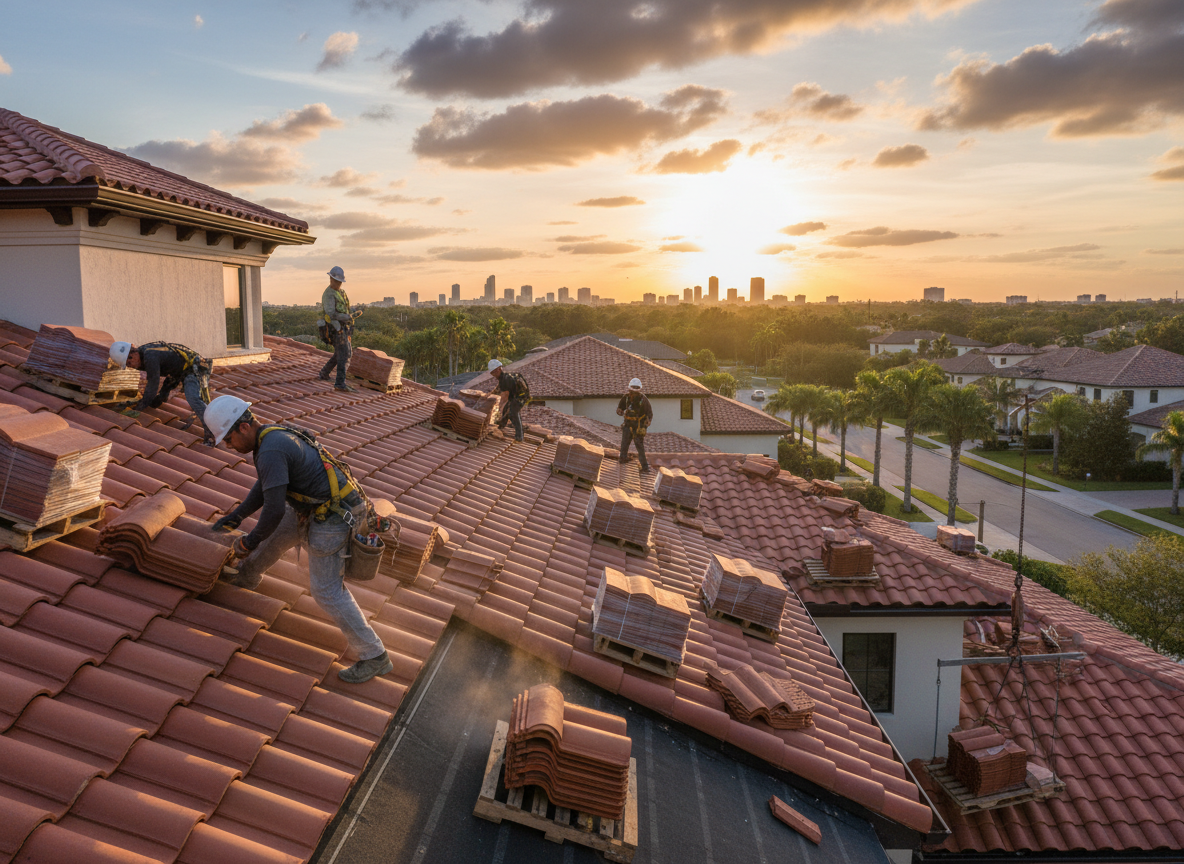
Hollywood is the rare Florida city where the roof on your house is decided by which side of two roads you live on. East of the Intracoastal, the stock is 1920s plan and 1950s infill: flat-roofed apartment blocks behind parapets, Mediterranean Revival houses under barrel tile, and a beachfront strip where salt arrives with every onshore breeze. West of the turnpike, the city is 1970s to 2000s subdivisions, pitched shingle with tile on the pricier streets, more attic and more roof area. Roof repair in Hollywood, FL is two trades wearing one postcode, and the address usually tells us which one is on the phone.
Both halves sit in Broward County, which means both are inside the High-Velocity Hurricane Zone alongside Miami-Dade. That is not a footnote to the work. It fixes the underlayment systems, the fastening pattern and the list of products that may legally be installed, whether the roof is a parapet deck four streets from the sand or a hip roof in a gated western subdivision. Florida Roof Repair Pros covers the city from an office in Orlando, and the number for Hollywood work is (407) 557-4529.
The Eastern Half: Parapets and Salt
Between the Intracoastal and Federal Highway the buildings sit close together, mostly two and three storeys, with flat or near-flat roofs over concrete decks. The period that built most of them, roughly 1945 to 1970, treated the flat roof behind a parapet as the obvious answer for an apartment block near the beach. The surface is built-up or modified bitumen, sometimes coated; the parapet is masonry or stucco on frame; and the roof carries more equipment than a house ever does — stair penthouses, vent stacks, water heater stands, dishes, and increasingly solar arrays bolted through the membrane.
A flat roof in this position is asked to do three jobs at once. Shed tropical rain, tolerate sun that never relents, and survive an atmosphere that corrodes every fixing it owns. The failure order is consistent. The membrane checks and turns brittle. The seams open. The flashing at the parapet lifts away from the wall. A scupper packs with grit and water stands against the parapet until it finds the seam it likes. Because the roof is also the ceiling of the top floor, the first symptom is usually a stain in a unit, which brings an association, an owner and a tenant into a conversation that started as a roofing question.
Coating gets proposed early on these roofs, and sometimes it is the right call: a sound modified bitumen or metal surface that has aged without failing can be renewed and earn another stretch of years. It is the wrong call when the membrane has split, when the deck beneath has softened, or when the entry point is a parapet that has separated from the wall. On a beachside block the parapet is usually the real culprit, because it takes wind and salt on two faces and is the part of the assembly nobody can see from the ground.
The Western Half: Shingle, Heat and Layers
Past the turnpike the city changes era. Single-family houses from the 1970s through the 2000s, concrete block under stucco, low hip and gable roofs, asphalt shingle with tile on some of the later and larger streets. There is more roof per house, more attic volume, and a ventilation question that the eastern half of the city never has to ask.
West of the turnpike, shingle wears on a heat schedule. The south and west planes lose granules first, the mat stiffens, ridge caps crack at the fold, and boots fail years before the field looks old. A second layer traps heat and accelerates all of it.
Tile Is Not the Waterproof Layer
Barrel and S-profile tile appears on the Mediterranean Revival houses east of Federal Highway and on a share of mid-century roofs across the city, and it is the covering most often misread from the ground. Tile sheds the bulk of the rain and absorbs the sun. What stops water is the membrane beneath it, and on a 1950s or 1960s roof that membrane is long past its design life even when the tile above it looks untouched.
The consequence is that tile work here is often surgical rather than wholesale. Lift the field over the affected area, read the membrane, replace the failed section, relay the original tile. That preserves a roof that cannot be matched in kind and avoids discarding material that has decades left in it. It also means the decision is made on the condition of the underlayment rather than on the appearance of the tile, which is the opposite of how most homeowners are taught to think about a tile roof.
Where the Water Comes In
Ranked by how often they turn up: parapet flashing, scupper and drain, membrane seam, then penetration on the flat roofs. On tile, the membrane at a valley, a hip or a wall junction. On shingle, boots, ridge caps, valleys, and the join to a flat porch roof.
Two rules run across all three. Water travels before it shows, so the stain inside is rarely under the entry point. And stucco is part of the roof. It is the wall finish on nearly every building in this city, it cracks as structures move, and a hairline above a flashing is a doorway into the wall cavity. On a building that has been painted and patched for fifty years, the flashing can be intact while the wall above it is not, which is why a survey photographs junctions rather than only the field.
Salt, and What It Actually Attacks
Salt does not eat tile or shingle. It eats metal, and it eats it where a roof can least afford to lose it — fastenings, valley and hip flashings, drip edge, vent collars, scupper liners, parapet coping. A coastal roof therefore fails at its hips and terminations while the field still looks presentable.
The Storms That Date a Roof
Roof ages in this county can be read from three storms. Wilma crossed from the Gulf in October 2005 and hit Broward hard, so anything installed in 2006 is now near twenty. Irma pushed wind and rain north in 2017 and took the loose edges off older roofs. Andrew, far south in 1992, is the event that rewrote the state's wind provisions, which is why the assembly specified here is heavier than the date of a house suggests.
Inside the hurricane zone, the answer to that record is specified rather than improvised: particular underlayment systems, a denser fastening pattern, coverings approved for the zone. On a beachside building the specification earns its keep at the roof edge and the parapet, because a parapet that lifts in wind takes the membrane with it and the water is then inside the wall rather than on the roof.
What We Are Asked For, and What It Turns Into
The calls arrive in plain language — a stain, a drip, a ceiling that has gone soft — and they resolve into one of a few jobs. A membrane seam on a beach block. A parapet flashing that has separated. A tile field whose membrane has expired. A shingle plane that has reached its last season. Which one it is decides everything that follows, including who else needs to be in the conversation.
Storm work is its own category. A coping lifted in a squall, an edge peeled back, a limb through a deck: the first visit closes the opening, and the permanent repair is scoped once the roof can be read. Photographs taken then are what an adjuster asks for later, and they are worth taking whether or not a claim follows.
Coverings are dictated by the building rather than chosen from a catalogue. Membrane and coating on the beach blocks and the low commercial stock. Tile on the Revival houses and the mid-century fields, with the original tile reused where it is sound. Shingle across the west. Metal on a minority of newer and renovated properties.
Four Questions Before Any Number
First, which half of the city is this? That usually settles the roof system. Second, what is under the covering — a membrane, a deck, how many layers? Third, who else has an interest: an association, a neighbouring unit, a commercial tenant? Fourth, what does the permit office require, and does anything else need approving before material is ordered?
Answering those four produces a scope rather than a guess. It names what comes off and what goes back, the underlayment and fastening method, what is assumed about the deck and the parapet, and what is excluded. On a beach block it also says how the perimeter will be detailed, because that is where the wind will test the work.
The permit is filed before anyone climbs, and inspections fall where the jurisdiction puts them. On a replacement the deck and underlayment are seen while open; the final inspection follows completion.
The job ends with a package: the inspection record, photographs of what is now hidden, and a walk of the property covering flashings, scuppers, parapets and cleanup. On a condominium or commercial building that package goes to the association, who will need it again in a few years.
The Permit Office
Permits for property within Hollywood go to the city's own building department. Unincorporated addresses fall to Broward County, and each neighbouring municipality runs its own desk. Which office receives the file determines the review queue and the inspection sequence, so the address is checked before any start date is discussed.
Underneath sits the Florida Building Code and the hurricane zone chapter that governs all of Broward. On a flat roof the perimeter attachment gets the closest reading; on a shingle roof the fastening schedule and the edge do. Both are written into the application rather than agreed on the roof.
The Neighbouring Cities
Dania Beach and Hallandale Beach border the city directly. West Park, Pembroke Pines, Miramar, Davie and Cooper City sit a short drive inland, Aventura is across the county line to the south, and Fort Lauderdale is a few miles north. The coastal neighbours share this roof stock; the inland ones are newer and larger.
Hollywood was laid out by Joseph Young in the 1920s as a planned resort, and the grid he drew still decides where the roof problems sit. The circles and the broad avenues near the beach carry Mediterranean Revival buildings with low-pitched tile and heavy parapets; the streets behind them filled in later with modest bungalows and, from the 1960s, with low condominium blocks along the sand. Inland, west of the Intracoastal and then west of I-95, the city becomes ordinary single-family shingle, built mostly between the 1950s and the 1980s. Three different roof vocabularies inside one municipality, and one permit desk that handles all of them.
What to Tell Us First
The address decides the permit office. Whether the building is east of Federal Highway or west of the turnpike usually decides the roof, so say which. A photograph from the ground helps when the answer is obvious, and the last permit date is worth finding — in this city it dates a roof better than its appearance does. Reach the office on (407) 557-4529, or write to 4720 Millenia Blvd, Suite 175, Orlando, FL 32839.
Around Hollywood
We regularly work near:
- 📍Hollywood Beach Broadwalk
- 📍Downtown Hollywood Historic District
- 📍Anne Kolb Nature Center
- 📍Hollywood Circle
- 📍West Lake Park
Roofing Company in Hollywood — Local Notes
- •City of Hollywood permits its own addresses
- •Broward County: High-Velocity Hurricane Zone
- •Flat parapet roofs east, shingle west of the turnpike