Gainesville is the largest city in north-central Florida and the only one in this batch that is genuinely inland, and that single fact reorganises the roofing conversation. There is no salt in the air and no surge at the end of the street. What there is instead is a very large tree canopy, a long hot season, a university that fills and empties whole neighbourhoods every year, and a storm pattern that arrives weakened but not harmless. Roof repair in Gainesville, FL, is therefore less about corrosion and more about water management, ventilation and the age of the deck.
The city sits on rolling ground in Alachua County, higher and drier than the coastal counties to the east. The terrain is karst limestone under a thin soil, which is why sinkholes are a local preoccupation, and the tree cover is dense enough that many roofs spend part of every day in shade. Shade is pleasant at ground level and hard on a roof, because a plane that stays damp does not dry out between rains.
An Inland City With a Different Weather Problem
Storms reach Gainesville after crossing the peninsula or the Big Bend, and by then the wind has moderated. That does not make them gentle. Irma in September 2017 crossed the state and left widespread outages and tree damage here, and Idalia in August 2023 came ashore in the Big Bend and passed to the west with tropical-storm winds across this county. In both cases the damage was limbs through roofs, shingles lifted at ridges and gable ends, and water driven into details that had never been tested from that direction.
The summer pattern matters more often than the named storms. Afternoon thunderstorms build quickly, drop a large volume of rain in a short time, and occasionally carry hail. A roof that sheds a steady rain perfectly can still be overwhelmed by the intensity of a twenty-minute downpour, and the place it gives way is usually a valley, a box gutter or a downspout that cannot take the flow. That is a drainage problem wearing a roofing costume, and it is diagnosed by watching where the water goes rather than by looking at the shingles.
The Old Neighbourhoods
The Northeast Historic District, known locally as the Duckpond, and the Pleasant Street district hold the city's oldest housing, much of it from the late nineteenth and early twentieth centuries. These are frame houses with steep gables, deep porches, and roofs that have been covered in metal, then shingle, then shingle again. The University Heights and Golfview areas belong to the same era and the same construction.
On these houses the roof is a collection of junctions rather than a single plane. Porch roofs meet the main roof at a shallow valley. Dormers interrupt the slope. Chimneys, some of them no longer used, sit on the ridge line with flashing that was replaced decades ago. Additions at the rear created new intersections, and gutters have been re-routed more than once. When a house like this leaks, the leak is almost always at one of those junctions, and the field is usually the last thing at fault.
The other local characteristic is the deck. Many of these roofs were originally laid over solid wood boards rather than modern panels. That is a good substrate in principle, but it moves with the seasons, and nail heads work loose over a century. A re-roof is the moment to inspect the boards properly, because covering a tired deck with a new layer is a decision that gets made once and lived with for twenty years.
The Student Belt and the Rental Roof
Gainesville's housing market is shaped by the University of Florida, and a large share of the housing near campus is rented by the room. That changes the maintenance cycle. A rental roof is often repaired only when a tenant reports a stain, the repair is the smallest intervention that stops the complaint, and the roof's long-term condition is nobody's specific responsibility. By the time a replacement is considered, the roof may be several years past the point where a homeowner would have acted.
This is visible in the housing stock around the university: mid-century houses converted from family homes to multi-tenant use, with added bathrooms, added vents and added penetrations through the roof plane for every new exhaust. Each vent is a potential leak, and the flashing around it is often the cheapest available. On a roof with a dozen penetrations, the probability that one is failing is high, and the leak may appear several rooms away from the actual entry.
The newer purpose-built student buildings are a different problem again. They are large, often flat-roofed or low-slope, and their roofs are commercial membranes over occupied space. Those roofs fail at drains, scuppers, parapet terminations and rooftop equipment, not at shingles. The work there is planned and scheduled rather than urgent, and it is driven by the building's maintenance calendar rather than the weather.
Postwar Ranches and the Southwest
West of the university and south toward Haile Plantation and Butler Plaza, the city is postwar and later. The 1950s and 1960s ranch houses have low-pitch hip and gable roofs under asphalt shingle, often with a carport roof meeting the main roof at a shallow angle. The 1980s and 1990s subdivisions have steeper pitches and larger roof areas, and the newer construction has more complex massing with multiple hips, valleys and dormers.
On the ranch houses the failure is heat and ventilation. A low pitch over a hot attic cooks the underside of the shingle, and soffit vents that were adequate when the house was built are often blocked by later insulation. On the 1980s and 1990s houses the failure is more often at the flashings and the complex junctions: a valley that was built tight, a wall that steps in and out, a chimney chase that relies on sealant. Sealant has a service life. When it expires, the roof leaks at a detail that looked fine the year before.
What Hurricanes Do When They Arrive Inland
By the time a hurricane reaches Alachua County it has usually lost its eye wall, but it still carries sustained wind and days of rain. The wind finds the weakest fixings, which on a shingle roof means the ridge, the rake and the perimeter course, and on a metal roof means the panel ends and the screws. The rain then enters wherever the wind has opened an edge.
The inland position does have one advantage: no wind-borne debris region designation applies here in the way it does on the coast, and there is no salt spray to shorten the life of every fastener. That means a specification can focus on the actual exposure, which is wind-driven rain and heat, rather than on a marine environment. It also means a roof that would be marginal on the coast can be entirely appropriate here.
Trees, Hail and the Afternoon Storm
Heavy canopy is the defining local condition. Live oak limbs over a roof drop debris into valleys, abrade the surface in wind and occasionally come down on it. Spanish moss and leaf litter hold moisture against the covering. Gutters fill faster than their owners expect, and a blocked gutter backs water under the eave and into the fascia, which then rots. Most of the gutter problems on a Gainesville house present as roof leaks, and the fix is maintenance rather than reconstruction.
Hail is not a routine event here, but it does occur in spring storms, and when it does the damage is bruising rather than puncturing. A bruised shingle loses its granules at the impact point and fails there within a few seasons. That is why a post-storm inspection looks at the slope facing the storm rather than the whole roof, and why an insurance claim is better supported by close photographs than by a general description.
The Services That Fit Gainesville
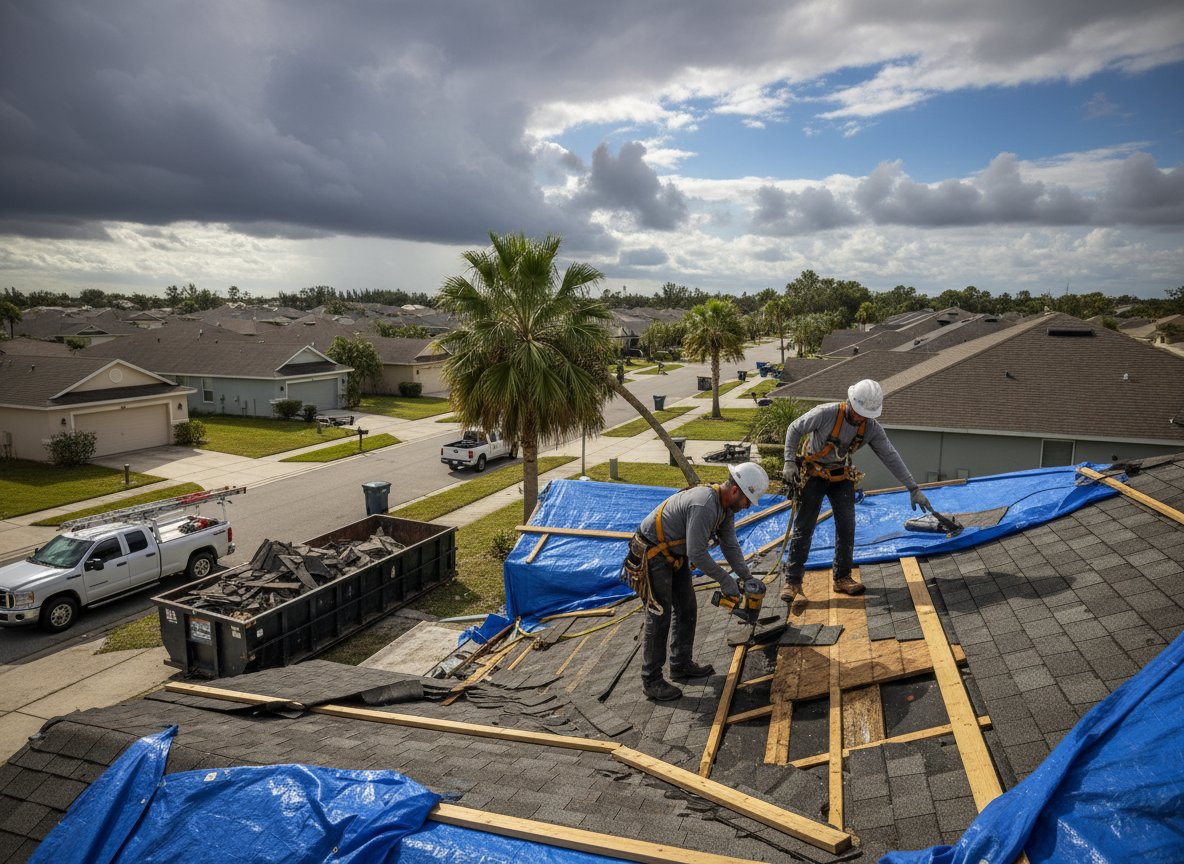
Roof leak repair is the mainstay, and in the older neighbourhoods it is a junction-by-junction exercise. Emergency roof repair and emergency roof tarping handle the limb through the deck and the storm-opened ridge. Storm and hurricane damage repair covers the sequence from making the roof safe through to the documentation an insurer will ask for.
Roof repair covers valleys, penetrations, chimney flashings and the localised failures that these roofs present. Roof replacement and roof installation take over where the shingle has reached the end of its life or the deck has softened, which is a common finding on the oldest houses. Shingle roofing is the default across most of the city, tile roofing appears on the Mediterranean-style houses and the newer southwest developments, and metal roofing suits the rural edges of the county and the properties that want a long service life. Flat roof repair and roof coating serve the student buildings and the commercial stock along the main corridors. Roof inspection is the starting point for all of it, particularly on a rental property where no one has looked at the roof in years.
How a Job Runs Here
The first conversation in Gainesville is usually about timing. The university calendar sets the rhythm of the rental market, and a roof repair on a student house is best done between tenancies rather than in the middle of a semester. For owner-occupied houses the constraint is the summer storm season, which makes the drier months the practical window for anything that leaves the roof open for a day.
The survey records the deck as carefully as the covering, because so much of this housing is old enough that the substrate is the real question. Photographs at every junction, an attic inspection where access exists, and a written scope that separates what must be replaced from what can be maintained. The permit is filed with the right jurisdiction, inspections follow, and the job closes with a walk and a photographic record.
Permits in the City and the County
Addresses inside the City of Gainesville are permitted by the city's building division through its online portal. Unincorporated Alachua County, which includes much of the ground around the city and the communities to the west and south, is permitted by the Alachua County Building Division. The two are separate applications, and the boundary is not always obvious from a mailing address, so it is worth confirming before a scope is priced. The Florida Building Code applies to both.
Within Ten Miles
The Duckpond and Pleasant Street districts north-east of downtown, University Heights and Golfview beside the campus, the student belt immediately around the university, the postwar streets to the west, Butler Plaza and the south-west corridors, and Haile Plantation out toward the county line. Each has its own era of roof and its own pattern of failure.
Calling About a Gainesville Roof
The address decides whether the city or the county permits the work. The neighbourhood decides what the roof is likely to be made of and how old the deck is. The tenancy, if there is one, decides when the work can happen. The office is at 4720 Millenia Blvd, Suite 175, Orlando, FL 32839, and Gainesville calls come to (407) 557-4529.
Around Gainesville
We regularly work near:
- 📍University of Florida
- 📍Duckpond
- 📍Pleasant Street Historic District
- 📍Paynes Prairie Preserve State Park
- 📍Depot Park
Roofing Company in Gainesville — Local Notes
- •City of Gainesville and Alachua County run separate permit applications
- •Inland storm damage arrives as wind and rain, not surge
- •Heavy tree canopy fills valleys and keeps shaded slopes damp