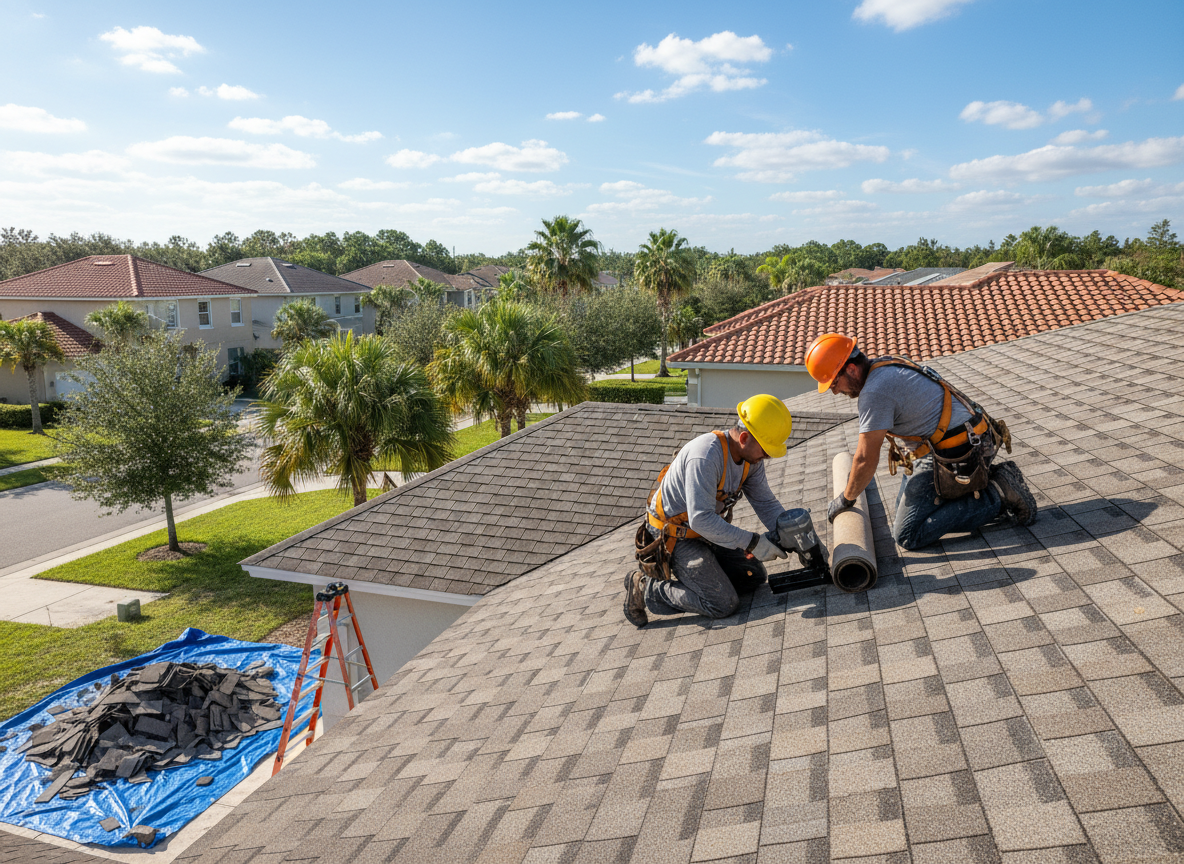
Fort Walton Beach incorporated in 1941 and grew up in the decades that followed, shaped by the air base to the north and the water on two sides. The city sits on the mainland side of the Santa Rosa Sound, with Choctawhatchee Bay to the north and the sound and Okaloosa Island to the south, and its residential streets are small, tight and largely postwar. That is the key to roofing here. This is not a city of new subdivisions on the edge; it is a city of modest houses built quickly between the late 1940s and the 1970s, many of them now on their third covering. Roof repair in Fort Walton Beach, FL is usually a decision about an old roof on an old deck rather than a decision about a new material.
The other local fact is the water. Fort Walton Beach is narrow — the distance from the bay shore to the sound shore is short — and a significant part of the city sits low. Storm surge and tidal flooding are part of the risk picture in a way they are not in Crestview, thirty-odd miles inland. A roof that is being replaced here is often being replaced on a building that has also had water at the floor, and the two problems are assessed separately.
The Postwar Roof Cycle
Most of the housing stock in Fort Walton Beach was built in a twenty-five year window after the Second World War, and it was built to a pattern: one storey, a small footprint, a hipped or low-gable roof, a carport, and a utility room or porch at the back under a shallower roof. The framing is often site-cut rather than engineered truss, the decking is often board rather than plywood, and the roof has usually been re-covered at least once, sometimes twice.
That history produces a specific set of questions. How many layers are on the roof now, and can another be added under the code? Is the decking under those layers sound, or has it been wetted repeatedly over decades? Are the flashings original, and is the chimney or the vent stack still properly flashed after the last re-cover? These are not abstract concerns. A third layer on a 1950s deck is a weight and moisture problem, and finding out later means doing the deck as well as the covering.
Newer development exists — along the eastern edge toward Mary Esther, and in pockets where older houses have been replaced — but it is not the norm. Most of the work here is on roofs that have a history.
Sound, Bay and the Flood Line
The geography is straightforward and it governs a lot. The Santa Rosa Sound separates the mainland from Okaloosa Island, and the Brooks Bridge carries the highway across it. Choctawhatchee Bay lies to the north, with Cinco Bayou cutting in between Fort Walton Beach and its neighbour of the same name. The city's shoreline is long relative to its area, and the land behind it is low.
For roofing, the consequence is exposure in two directions and a water table that stays high. A roof on the sound side takes salt spray on a windy day and wind-driven rain from the south; a roof on the bay side takes the northerly weather. Both are coastal exposures, and both punish the same details — the edge metal, the ridge, the penetrations, the wall junctions — while leaving the middle of the field alone.
The high water table matters for what happens after a leak. Water that gets into a wall or a ceiling here has nowhere to drain and takes longer to dry than inland, which is why a small roof leak in this city so often ends up as interior repair as well.
The Material Mix on an Older Street
Asphalt shingle dominates, as it does across most of the Panhandle's residential stock, and on the postwar houses it is usually the third covering or more. Metal appears on carports, porch roofs, utility additions and outbuildings, often as an exposed-fastener panel that has been there for decades, and on some houses as a full roof where the owner has replaced shingle with metal. Tile is uncommon on the older streets and appears mainly on newer construction and on a few larger waterfront houses.
Low-slope sections are more common than people expect, because the postwar pattern produced a lot of shallow roof over porches, carports and rear additions. These are the parts of a Fort Walton Beach roof that fail first: they hold water rather than shedding it, their seams and terminations take the strain, and they are frequently the last thing anyone looks at. On a roof with a shingle field in reasonable condition, the low-slope addition is often the actual source of the leak.
Opal, Ivan, Dennis and Sally
The western Panhandle has had a concentrated run of storms. Hurricane Opal came ashore near Pensacola Beach in October 1995. Hurricane Ivan made landfall near Gulf Shores in September 2004 and affected the whole of this coast. Hurricane Dennis came ashore on Santa Rosa Island near Navarre Beach in July 2005, close enough that Fort Walton Beach took its western circulation. Hurricane Sally followed in September 2020, a slow-moving storm that pushed water into the bays and sounds for an extended period.
The damage pattern on a town like this is consistent. Shingle lost at ridges, hips and rakes; edge metal bent or torn away; soffits and fascia pulled; carport and porch roofs lifted because they present an edge to the wind with nothing behind it; and water driven into wall junctions from an angle the roof was not designed to shed. After each event a wave of repairs followed, and the quality of those repairs varies. A survey today is often as much about reading the last repair as about assessing the original roof.
Work That Suits a Postwar House
The service list on this site is the menu; on a Fort Walton Beach house the survey usually narrows it fast. Water inside after rain means roof leak repair, traced back from the stain to the point of entry. A roof opened by wind or a limb means emergency roof tarping first to keep the building dry, then emergency roof repair where the opening closes in one visit, then storm and hurricane damage repair where the whole roof has to be recorded, sorted into old and new damage, and rebuilt.
The rest is a question of what sits under the covering. While the sheathing is sound and the covering has years in it, roof repair is the sensible spend. When there are layers to strip and timber to replace, roof replacement is the accurate description, and roof installation covers a building that never had a covering at all. Shingle roofing returns to most of the stock; metal roofing suits the carports, porch roofs and outbuildings that already carry it; tile roofing belongs on the newer and waterfront houses; flat roof repair and roof coating handle the shallow sections; and roof inspection is the step that separates one answer from another.
The Sequence of a Fort Walton Beach Job
It begins with the roof itself. Someone walks it where walking is safe, opens the attic if there is a hatch, photographs each slope, valley and penetration, and looks at the sheathing from underneath. On a house re-covered twice, the attic answers two questions the street cannot: how many layers are overhead, and whether the deck has been patched.
What follows is a scope on paper — removals, repairs, exclusions, specified products, and the assumptions about the timber. The application for permission is built from that scope, not from a phone description, and it names the covering's approval and the fastening pattern. Work then proceeds in the order the building department wants to see it, with the sheathing and underlayment inspected before anything closes over them, and the final inspection at the end. The handover is documentary: the signed inspection, the photographs taken while the roof was open, and a walk around the house.
Permission, Layers and the Code
Which office issues the permit depends on the address. Inside the city it is Fort Walton Beach; outside it, Okaloosa County; Cinco Bayou and Mary Esther run their own. Two queues, two sets of reviewers, and a check of the address before a start date is offered.
Okaloosa County sits outside the High-Velocity Hurricane Zone, which is confined to Miami-Dade and Broward, but the statewide wind provisions still govern design wind speed and fastening. The layer limit is the question that comes up most on this housing stock: how many coverings may stay, and what the sheathing must be before another goes on. Both are settled by inspection and by the code rather than by preference. Contract work normally begins with a notice of commencement on record.
An Older Roof and the Paperwork That Follows It
Fort Walton Beach houses change hands and change insurers, and on a roof that is on its third covering, both events tend to produce a question. An insurer wants to know how old the covering is, whether it has been maintained, and what is under it. A buyer wants to know whether the roof will need replacing in the first year. Neither question is answered by looking at the surface from the driveway, and neither is answered by assurance.
What answers them is the permit history — which shows when the covering was last replaced and under what product approval — together with a survey that records the condition of the deck, the underlayment, the flashings and the low-slope sections. On a postwar house the deck is the part that decides the answer, because a covering that looks tired over a sound deck is a different proposition from a covering that looks acceptable over sheathing that has been wet more than once.
That document is also what a scope is built from. A repair or a replacement planned from a written survey can be scoped line by line and inspected against the same list. One planned from a phone description cannot. It is the reason the survey comes before the scope is fixed in every job here, and the reason the photographs are kept with the file.
Salt on the Sound Side and the Metal Already There
The salt exposure in this city is not the same on every street. A house a few blocks from the Santa Rosa Sound takes spray on a windy day, and the metal on it — gutter hangers, vent stacks, the edge metal at the rakes, the fasteners holding a carport roof — corrodes faster than the same components twelve blocks inland. That is not a reason to avoid metal. It is a reason to know which metal is already there and how far it has gone.
On older houses the metal is often galvanised, and galvanising fails from the cut edges inward. A panel that looks sound in the field can have rust running back from every cut and every fastener, and the leak appears at the fastening rather than in the sheet. Where the metal is aluminium the corrosion story is different but the fastener problem is the same.
The practical answer is inspection rather than assumption: look at the fastening line, the cut edges and the terminations, and replace the components that have gone rather than sealing over them. It is simpler to do while a roof is open than to come back to.
Towns Within Ten Miles
Fort Walton Beach is the centre, and the ten-mile ring takes in Cinco Bayou immediately north, Ocean City and Wright to the northeast, Mary Esther to the east, Shalimar to the north, Okaloosa Island across the Brooks Bridge, and Destin to the east, with Niceville and Valparaiso across the bay. The housing changes quickly from one to the next and so does the permitting office, which is why the address is checked first.
What to Tell Us on the Phone
Give the address, since it sets the permit office. Say roughly how old the roof is and, if anyone remembers, how many times it has been covered. Point to where water is appearing inside and when it began, and send a photograph from the ground if you have one. Florida Roof Repair Pros works out of 4720 Millenia Blvd, Suite 175, Orlando, FL 32839, on (407) 557-4529.
Around Fort Walton Beach
We regularly work near:
- 📍Santa Rosa Sound and the Brooks Bridge
- 📍Okaloosa Island
- 📍Cinco Bayou
- 📍Choctawhatchee Bay
- 📍Fort Walton Beach Landing Park
Roof Repair in Fort Walton Beach — Local Notes
- •Incorporated in 1941; most housing is postwar
- •Many roofs are on their third covering
- •Low-slope carport and porch roofs fail first