Fort Myers is a river city that keeps forgetting it is one. The Caloosahatchee runs wide and slow past the end of the downtown streets, and the older neighbourhoods were laid out facing it — McGregor Boulevard running south under its own canopy, the river district packed into a few blocks behind the wharves. Then the city grew east and south across flat pine ground, and the newer half has no relationship with the water at all. A roof survey here starts with which half of that map the address sits on.
The housing stock splits along the same line. Downtown and the streets off First, Second and McGregor hold houses from the 1900s through the 1920s, when Fort Myers sold itself as a winter city and built bungalows with deep porches and low-pitch roofs. The postwar decades filled the grid with concrete-block ranches under shingle. From the 1980s onward the growth moved out along Daniels Parkway and Gladiolus Drive into gated communities under tile. Roof repair in Fort Myers, FL, means working on all three without pretending they are the same roof.
A River City with Two Histories
The 1920s left the most distinctive roofs in the city. The boom years produced houses with hipped roofs, wide eaves and a shallow pitch, and many still carry their original clay tile or an early standing-seam metal roof. Those roofs were built before air conditioning, so they ventilate through the eaves and the attic rather than through a ridge vent, and any later insulation work that closed those paths changed how the roof behaves.
The postwar city is the opposite: simple gable roofs over concrete block, built quickly and covered in asphalt shingle, with the soffit vents and the small attic space that came with that method. Both stocks are now old enough to be in their second or third covering, and both are common enough that a contractor working here should recognise which one is in front of them from the street.
The Bungalows on McGregor and Downtown
On the old streets the failure pattern is structural before it is waterproof. A hundred-year-old roof has usually been re-covered at least once, sometimes with a second layer laid over the first, and the added weight and trapped heat shorten the life of everything above the deck. Fascia and soffit boards soften where water has been running behind a gutter for years, and the roof-to-wall junction on a frame house is a different detail from the same junction on concrete block.
Clay tile on these houses is often original and often incomplete, because a broken piece from 1925 is not a piece anyone stocks. The repair therefore starts with an inventory: what is on the roof, what is missing, what can be salvaged. Where the tile is sound but the membrane beneath it is finished, the work is a lift-and-relay rather than a replacement, and the tile has to be handled as salvage rather than waste.
Shingle on the Postwar Grid
Most of the city's roofs are shingle, and most of those are on houses built between 1955 and 1985. The wear is sun-driven. South and west planes lose granules first, the mat dries and checks, and the first leak usually appears at a penetration rather than in the field — a plumbing vent, a swamp cooler collar that was capped over, an old antenna foot.
Attic ventilation is the variable that decides whether a 1970s shingle roof lasted twenty years or twelve. Many of these houses have had insulation blown in to the eaves, which is good for the house and bad for the roof if it blocked the soffit path. Without intake air, a ridge vent cannot draw, and the deck above it bakes. When a shingle roof in this part of town fails early, that is usually the reason, and it is worth checking before the next covering goes on.
What Ian Did to This River
Ian came ashore at Cayo Costa in September 2022 and drove surge up the Caloosahatchee into the middle of the city. That is the event most roofs here are now measured against, and its signature is different from a windstorm. Wind takes shingles, ridge caps and edge metal. Surge lifts the water table, fills the ground, and leaves the lower structure of a house soaked for days, which is what turns a roof replacement into a roof and ceiling replacement.
Charley in 2004 crossed Charlotte County to the north and still brought wind across Lee. Irma in 2017 crossed the whole peninsula. The practical consequence is a stock of roofs installed in waves — a 2005 cohort, a 2018 cohort, a 2023 cohort — and each of those waves is now at a different point in its service life. An address with a 2005 permit is a different conversation from one re-roofed after Ian.
Tile, Metal and the Waterfront Rebuilds
South of the river, the gated communities along Daniels Parkway and the older waterfront streets of Iona carry concrete tile, much of it from the 1980s and 1990s. The tile is usually fine; the underlayment under it is not. A tile roof installed then is now at the age where the membrane has reached the end of its life while the field still looks new from the street, and the only way to establish that is to open the roof at a valley and a hip.
Metal appears on the riverfront and on the rebuilds, and it is the covering that suits a house exposed to open water. Standing seam over a proper underlayment handles the rain volume and does not granulate, but its weak points are the fastenings, the terminations and the pans at a change of pitch. On a riverfront house those details are the whole specification.
Flat Roofs Downtown
The commercial blocks of the river district and the small professional buildings along Cleveland Avenue are flat-roofed, and those roofs fail by drainage rather than by covering. A membrane with three patches is usually a membrane that has lost its fall; water stands, the seams take the load, and the ceiling below stains at the same point every wet season.
Coating has a place on these roofs when the membrane is sound and the surface is tired, and it has no place on a ponding one. The distinction is a drainage survey, not a product choice: where the fall has been lost, re-sloping is the repair and coating is only the finish.
Where Water Gets In
On the old frame houses the entry is usually the wall junction or a chimney, where stucco and flashing have parted company. On the postwar ranches it is a vent collar, a valley, or the join to a carport roof. On the tile communities it is the membrane at a hip or a valley. On the flat commercial roofs it is a seam or a drain collar.
Water does not appear where it enters. In a single-storey ranch it may travel along a truss bottom chord for eight or ten feet before it stains a ceiling, and in a two-storey house it may come out at a first-floor wall. That is why the survey photographs the junctions and the penetrations rather than only the visible damage, and why a repair priced from a photograph of a ceiling stain is a guess.
The Work We Do Here
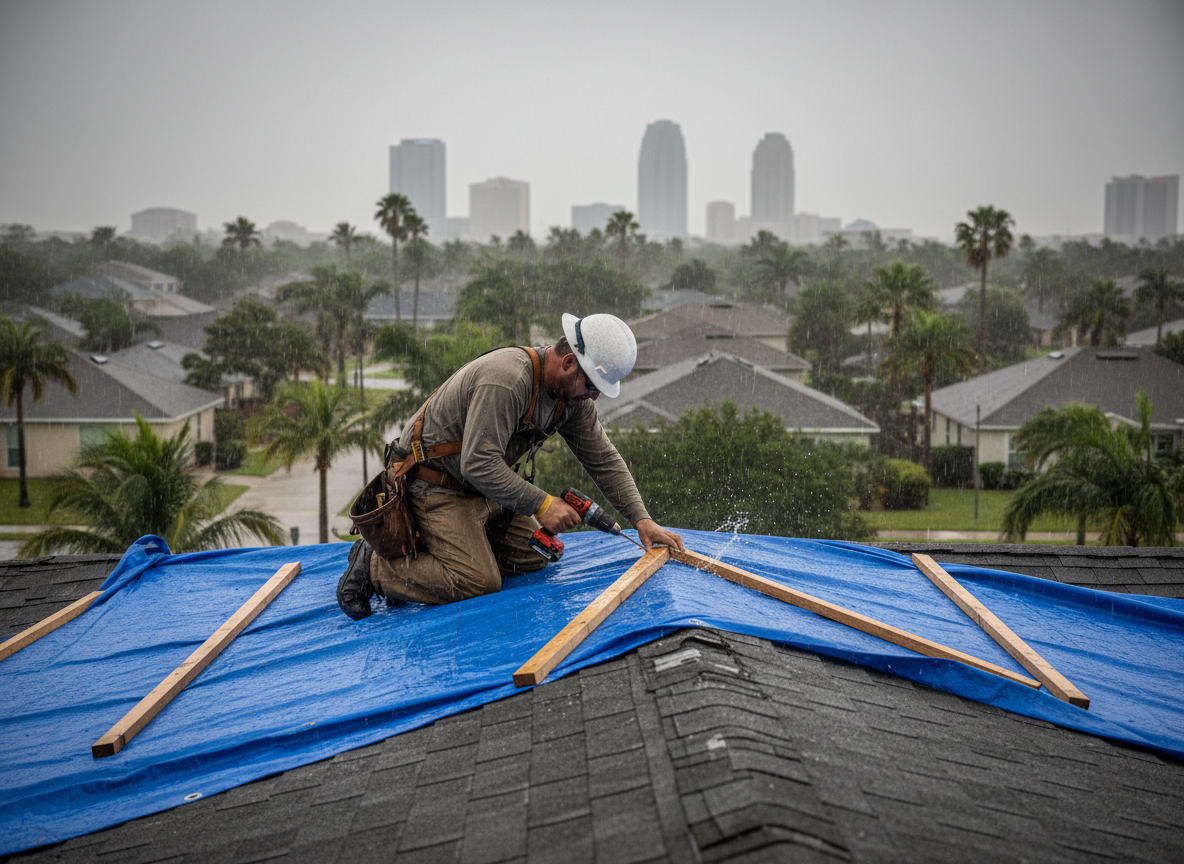
The services this city needs are the ones the site carries, applied to its own stock. Emergency roof repair and emergency roof tarping handle the nights when a limb is through the deck or a valley is running into a bedroom. Roof leak repair is the diagnostic trade: find the entry, open enough roof to confirm it, and close it properly. Storm and hurricane damage repair covers the sequence after an event — make safe, document, repair, and keep a file an insurer can follow.
Roof repair is the everyday work, and on a stock this old much of it is carpentry at the edges and flashings rather than covering. Roof replacement and roof installation are the planned version, where the covering conversation happens: shingle roofing for the postwar grid, tile roofing for the 1980s and 1990s communities and the old boom houses where the tile is worth keeping, metal roofing on the riverfront, flat roof repair and roof coating on the downtown blocks and the lanai sections. Roof inspection ties it together, and on a pre-purchase or an insurance letter it is the only part of the list that produces a document rather than a repair.
How a Fort Myers Job Is Run
The survey comes first, and it is deliberately physical: ladder, roof where it can be walked, attic from below, camera at every junction. On an old house the attic tells you more than the roof does, because a hundred years of repairs, additions and re-covers is visible from underneath in a way it is not from above.
The written scope follows. It separates what is replaced from what is repaired, names the underlayment and fastening method, states what is assumed about the deck, and says what is excluded. On a tile roof it sets the order of work so the membrane is opened, photographed and closed in one sequence. That document is what goes to the permit desk, and it is what the job is measured against at the end.
Permits are filed before work starts and inspections are booked to the jurisdiction's schedule. The close-out is a walk of the property with the owner — ridges, edges, terminations, drains and cleanup — plus the photographs of anything now hidden. On a house that has been re-roofed more than once, that file is also the record of what was found underneath, which is the thing the next owner will want.
Permits: City and County
Addresses inside the City of Fort Myers are permitted by the city's building department. Unincorporated Lee County — North Fort Myers, Tice, Gateway, San Carlos Park and the communities south of the city — goes to Lee County's building and permitting services. Fort Myers Beach and Sanibel are separate jurisdictions with their own offices, and Estero and Bonita Springs run theirs.
Lee County sits outside the High-Velocity Hurricane Zone, which applies in Broward and Miami-Dade, so the zone's extra underlayment rules do not apply. The Florida Building Code's wind provisions do, and the coastal strip of the county falls within the wind-borne debris region, which puts product approval and opening protection into a replacement permit near the water. On a riverfront or barrier-island property the design wind speed for the site is part of the specification.
Within Ten Miles
North Fort Myers across the river, McGregor and Iona to the south, Page Park and Pine Manor inside the city's southern edge, Tice to the east, Gateway and the Daniels Parkway corridor further out, and Cape Coral across the Caloosahatchee. Each has its own permit desk or none, its own era of roof, and its own exposure to the river.
Calling About a Fort Myers Roof
Four things make the first visit useful: the address, because it decides the permit office; the covering, or a photograph of it; the age of the roof or the date of the last permit; and what the roof is doing now, whether that is a leak, a storm claim or a plan. The office is at 4720 Millenia Blvd, Suite 175, Orlando, FL 32839, and the number for Fort Myers work is (407) 557-4529.
Around Fort Myers
We regularly work near:
- 📍Edison and Ford Winter Estates
- 📍Downtown River District
- 📍McGregor Boulevard
- 📍Caloosahatchee River
- 📍Centennial Park
Roofing Company in Fort Myers — Local Notes
- •City of Fort Myers and Lee County run separate permit desks
- •Ian pushed Caloosahatchee surge into the city in September 2022
- •Most shingle stock dates from the 1955-1985 postwar build-out