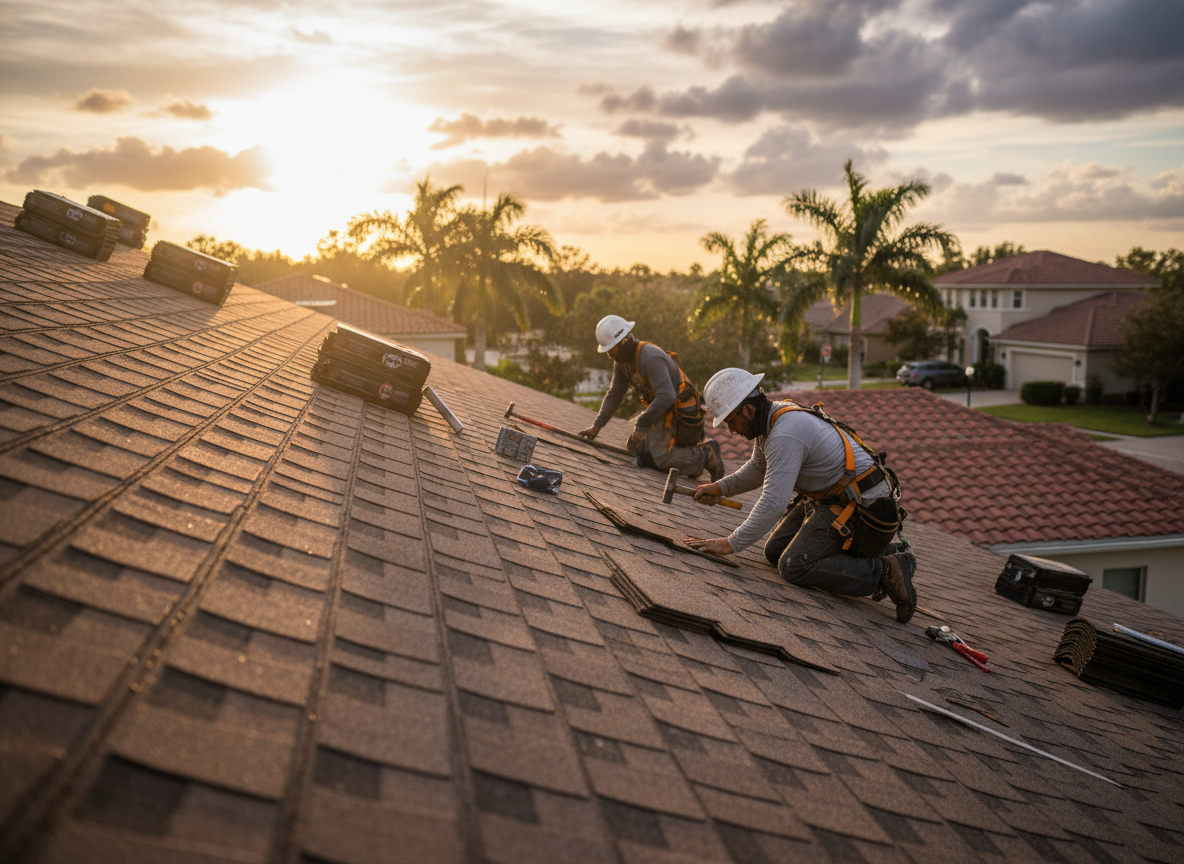
Fort Lauderdale roofs are exposed in a way that inland roofs are not. The canal system puts water behind most of the older neighbourhoods, the Intracoastal splits the city, and the ocean sits a bridge ride east, so a roof here faces open water on at least one side and sometimes three. That exposure decides the salt load on every fixing, the humidity that never quite leaves an attic, and how a roof edge behaves when wind arrives across a canal rather than over a neighbouring roof. It also means the same hurricane-zone specification applies to a 1920s house in Sailboat Bend and a membrane deck on Las Olas.
Diagnosis comes before installation in this city, because the stock is so varied. Barrel tile from the boom years, built-up and membrane roofs on the mid-century apartments and the commercial strip, shingle across the western subdivisions, metal on a minority of houses. Each fails in its own way and is traced in its own way. Florida Roof Repair Pros covers Fort Lauderdale from Orlando; (407) 557-4529 is the number that reaches it.
Three Belts of Roof Stock
The first belt follows the river and the canals. Sailboat Bend, Riverside Park, Colee Hammock and the streets off Las Olas carry 1920s and 1930s houses, many of them Mediterranean Revival or Mission style, with barrel tile over a masonry deck. Those roofs have been replaced at least once and often twice, and the tile still on them is frequently original. The constraint on a house of that age is not the tile. It is what the roof sits on, and whether the last replacement was detailed the way the original was.
The second belt runs north and east of downtown: Coral Ridge, Victoria Park, Poinsettia Heights, the streets around Bayview. This is 1950s and 1960s ranch housing and low apartment buildings, mixing shingle, tile and flat roofs, with a flat section over a carport, a Florida room or a rear addition on a large share of them. Those flat sections are where two systems meet, and where the flashing has the least room to work.
The third belt is vertical. Downtown, along the beach and through the newer corridors, the buildings are taller and the roofs are membranes over concrete decks with tapered insulation, parapets, mechanical equipment and a drainage system that has to function on a building where the roof is also the ceiling of the top floor. A leak up there is a building-management problem before it becomes a roofing one, and the sequence of who calls whom is different.
What Open Water Does to a Roof
Salt arrives off the water and stays. It does not attack the tile or the shingle; it attacks the metal that holds the roof together and closes it at the edges — fastenings, valley and hip flashings, drip edge, vent collars, scupper liners. That is why a canal-front roof fails at its hips and terminations while the field still looks presentable.
Humidity comes second. An attic here is damp for most of the year, and a roof that cannot ventilate holds that moisture against the deck. Blocked soffit intake is common on houses that have been re-landscaped or re-insulated, and the symptoms read as a leak without being one: condensation staining along the ridge, rusted fasteners, sheathing that softens from inside. That is why the survey opens the attic rather than only walking the roof.
Wind comes third, and it arrives differently on a canal. A roof facing open water has no shelter from the buildings opposite, so the edge takes the full load, and the edge is where a roof begins to fail. Lifted edge metal, a separated rake, a parapet coping that has worked loose: small areas, large consequences, because once driven water is behind the flashing it is inside the wall assembly rather than on the roof.
Where the Water Enters
On tile roofs the answer is the underlayment. Tile sheds the bulk of the rain and absorbs the sun; the waterproof layer is the membrane beneath it, and on a roof from the 1950s to the 1980s that membrane is usually finished while the tile field still photographs well. Water gets past the tile in wind-driven rain, reaches the deck, tracks along it, and appears inside somewhere unrelated to the tile that let it in.
Tile roofs leak at the membrane in a valley, a hip or a wall junction. Flat roofs leak at the parapet, the scupper or a seam. Shingle roofs leak at a boot, a ridge cap or the join to a flat porch. On all three, stucco is part of the story, since a crack above a flashing leads straight into the wall.
Drainage on a Canal-Front Property
Water has to leave a roof, and in this city the route it takes matters more than most owners realise. A flat roof that drains to a scupper at a seawall wall, a tile roof that discharges onto a lower flat section, a gutter that empties against a stucco wall: each of those is a design decision that was made decades ago and is rarely revisited until it fails. When a scupper silts, water stands against the parapet and the seam takes the strain. When a downspout discharges at the base of a wall, the wall stays damp and the stucco cracks.
A survey therefore follows the water rather than only looking at the surface. Where does it leave the roof, is the outlet clear, is the discharge point away from the wall, and does a lower roof receive water it was never designed to take. Those questions cost nothing to answer during an inspection and a great deal to ignore for another season.
The Storm Record Here
Wilma is the storm this county's roofs are dated against: it crossed from the Gulf in October 2005 and did some of its worst damage in Broward. Irma in 2017 brought wind and rain up the peninsula. Andrew, far to the south in 1992, produced the code that governs here now.
Solving a Canal-Front Roof
Water on a property like this has three ways in: down, sideways and up. Down through a membrane or an underlayment that has expired. Sideways behind a flashing or through a stucco crack. Up from a scupper that has silted and a parapet that now holds water against the wall. The survey tests all three, because a repair aimed at the wrong one will not last a season.
The calls follow that pattern. A stain after a squall on a tile house is the underlayment. Water at a ceiling under a flat roof is usually the perimeter or the drainage. A damp patch that appears in the cool months and dries in summer is ventilation, not a leak, and treating it as one wastes money.
Storm work is separate. After wind, the sequence is to close what is open, photograph everything before it is disturbed, and then scope the permanent repair. On a canal-front property that record also notes the condition of the edge, because the edge is what failed.
The Order a Job Is Solved In
First the roof is read: planes walked, attic or plenum entered, parapets and edges examined, drainage tested, and the exposure of any side facing open water noted. Photographs accompany each of those, because the survey's value is that somebody who was not there can use it.
Then the scope. What comes off, what goes back, which underlayment and fastening, what is assumed about the deck, what is excluded — and on a flat roof, how the perimeter will be fixed. In the hurricane zone that document is the permit application, with the approved assembly named inside it.
Permits are filed before work begins. Inspections follow the jurisdiction's stages: deck and underlayment while open, then the finished roof. On a commercial or association building the same file goes to the board.
At the end the owner holds the inspection record, images of everything now covered, and a walk of the property covering flashings, scuppers, terminations and cleanup.
The Permit Desk, and the Second Question
Inside Fort Lauderdale the permit comes from the city's building services, while unincorporated parcels and the other Broward municipalities are handled separately. Review time and the inspection schedule belong to whichever desk takes the file, so the address is settled first and the date offered afterwards.
The second question is the code. In Broward the hurricane zone chapter applies on top of the Florida Building Code: design wind speed at the site, approved covering, fastening schedule, underlayment specification, and on a flat roof the method of perimeter attachment. Those five items are what the application is really about.
When Insurance Asks
Renewals in this city usually ask for a roof age, and the answer is rarely the age of the house. A 1950s Coral Ridge house may carry a roof from 2006; a 1990s house west of the interstate may still be on its original covering. The permit record settles it, and a dated inspection covers the cases where the record is thin.
That inspection is also the argument. It can support a repair where a replacement is being pushed, and it can support a replacement where a buyer or an insurer is doubtful. On a canal-front property it records the salt damage at the fixings, which is the part nobody sees and the part that decides how much life is left.
Along the Canals and Inland
Wilton Manors and Oakland Park are the immediate northern neighbours, Lauderdale-by-the-Sea and the beach communities lie northeast, Dania Beach is south, and Plantation, Davie, Sunrise and Lauderdale Lakes are west. Pompano Beach is a short drive up the coast. The beach communities share this stock; the inland ones are newer and less exposed.
Fort Lauderdale's roof stock also carries a record of water rather than wind. The 1926 hurricane came ashore south of here and pushed a surge through the New River and the canals, and the city has been managing water ever since, with a drainage system that depends on pumps and a building pattern that puts a great deal of low, flat roof close to it. That matters at roof level in a specific way: when the drains and scuppers on a flat section block, water stands, and standing water finds every lap and seam it can. On the canal-front streets the wind crosses open water with nothing to slow it, so edges, parapet copings and the fastening at the perimeter take more load than the middle of the field ever will.
What to Have Ready
The address decides the permit desk. What covers the roof — tile, shingle or a flat membrane — decides how the first visit is planned. A photograph from the ground helps if the answer is obvious. The last permit date is worth finding, and on a canal-front property it is worth saying which side of the house faces the water. The office is on (407) 557-4529, at 4720 Millenia Blvd, Suite 175, Orlando, FL 32839.
Around Fort Lauderdale
We regularly work near:
- 📍Las Olas Boulevard
- 📍Fort Lauderdale Beach
- 📍New River and the Riverwalk
- 📍Bonnet House Museum and Gardens
- 📍Port Everglades
Roofing Company in Fort Lauderdale — Local Notes
- •City of Fort Lauderdale permits its own addresses
- •Broward County: High-Velocity Hurricane Zone
- •Canal-front exposure and salt load on every fixing