Fernandina Beach is the last town on Florida's Atlantic coast before the state line, and it sits on a barrier island with salt marsh on one side and open ocean on the other. That position explains the roof stock, the corrosion and the weather. It does not explain the paperwork, which is the part that surprises people most. A roof on this island is an exterior change to a building in a locally designated historic district, and the review of that change runs before the building permit rather than alongside it. Roof repair in Fernandina Beach, FL, is therefore a sequence: approval first, permit second, work third, and a final inspection by the same preservation staff who approved it.
The island is Amelia Island, roughly eighteen square miles of dune, pine and salt marsh, with the Amelia River and its marshes to the west and the Atlantic to the east. Egan's Creek runs through the middle ground and floods the low streets in a surge. The town occupies the northern part of the island, and the ground it stands on is only a few feet above the water on either side of it.
Two Towns in One: Old Town and the 1857 Grid
Fernandina was founded by the Spanish in 1811 and platted in the grid the Law of the Indies prescribed, with a plaza at the centre and a fort between the plaza and the harbour. That settlement is now called Old Town, at the north end of the island, and the street pattern and the plaza survive as a state historic site.
In the 1850s the town moved a mile south to meet the railroad that David Yulee was building across the state, and the new town was platted in 1857 on a grid of larger blocks with a park at its centre. Centre Street, the waterfront and the commercial core belong to that second town. For a roofer the distinction matters, because the two districts have different ages, different guidelines and different roof geometries, and an address in one is not treated like an address in the other.
The Victorian Roof Stock
The downtown historic district covers around fifty blocks, and several hundred buildings within it predate the late 1920s. The result is one of the denser collections of Victorian and Queen Anne housing in Florida, and it is a hard roof stock to survey quickly. These are houses with turrets, bay windows, wraparound porches and steep gables, often under a single roof that changes pitch and direction four or five times in the course of one elevation.
Every one of those changes is a valley, a hip, a wall junction or a change of plane, and each needs its own flashing detail. The original covering on most of these houses was metal, in standing seam on the grander ones and in five-vee crimp on the smaller ones, and a good number still carry it under later layers or have been restored to it. Porch roofs are shallow and meet the main roof at short valleys. Dormers interrupt the slope. Chimneys, some no longer used, sit on the ridge with flashing that has been patched for a century.
Metal, Salt and Fasteners
Salt attacks metal and leaves shingle alone, which shapes every roof decision on this island. The covering may be sound while the drip edge has rusted through, the vent collars have corroded, the valley metal has perforated and every exposed fastener has lost its washer. On a house a few streets from the water those parts can be finished while the field above them still looks new.
The practical consequence is that a coastal roof is judged at its terminations before its surface. Fasteners in stainless or a coated product, flashings that do not put two dissimilar metals in contact, and replacement rather than reuse of anything already corroding are the specification that lasts here. Reusing an old drip edge because it is still attached is the most common way a new roof on this island begins to fail in its first few years.
Wind-Driven Rain and the Nor'easter
The exposure comes from two directions. Atlantic weather arrives from the east and south-east, and the winter nor'easter sits offshore and drives rain at the north and east elevations for a day or more. A roof that has handled a summer thunderstorm has not been tested by either. The entry point in a long blow is almost always a wall junction, a soffit, a dormer cheek or a porch tie-in rather than the field.
Hurricane Matthew in October 2016 passed close enough to do the most damage this town had seen in decades, and it did it to the waterfront rather than to the rooftops. The marina and docks were wrecked, ocean piers were damaged beyond repair, and trees came down across the island. The historic houses, by and large, came through. Irma the following year pushed water up the rivers and flooded low ground again. In both events the roofs that failed were the ones whose flashings were already tired.
Shingle, Tile and the Condominium Stock
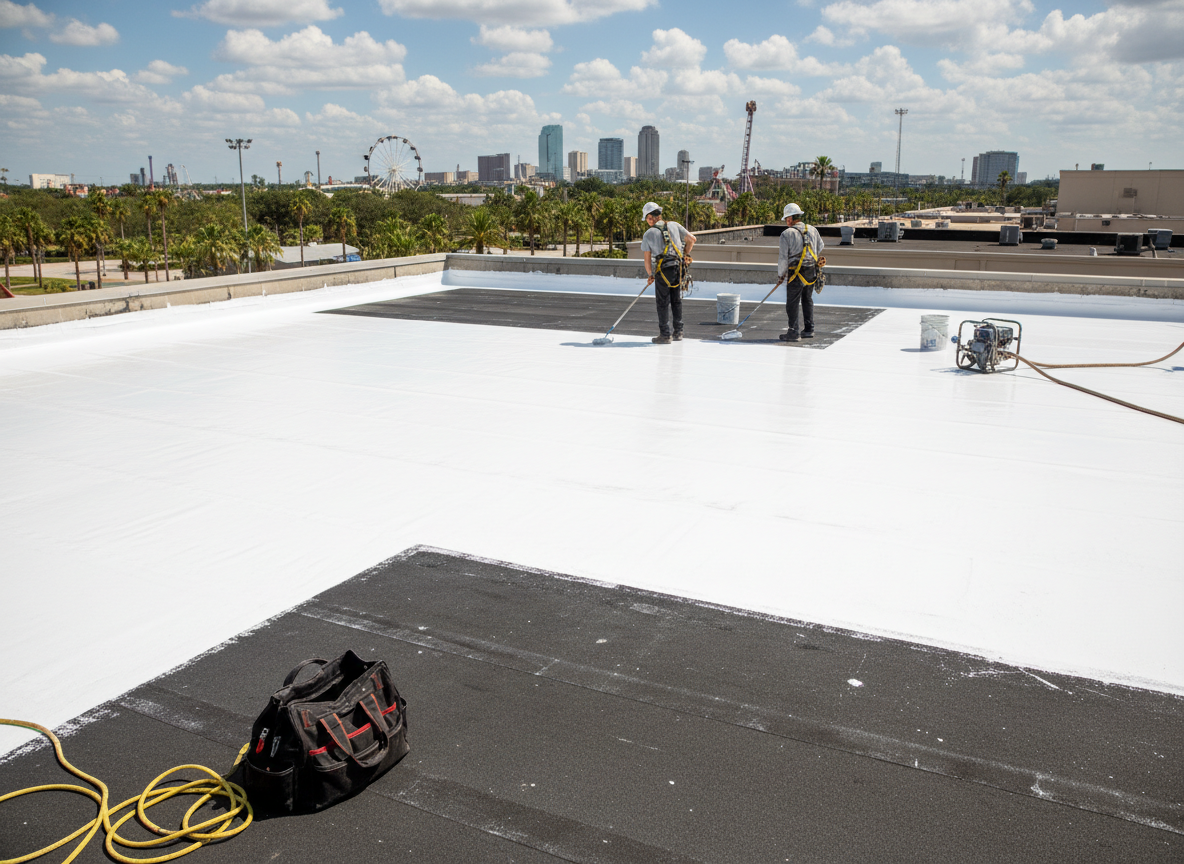
Away from the historic districts the island has a second roof stock: mid-century cottages, the villas and low-rise buildings of the southern plantations, and the condominium blocks along the beach. Shingle dominates the houses, tile appears where the architecture called for it, and the condominium buildings are low-slope or flat roofs over occupied space, with the membrane, the drains, the parapets and the rooftop equipment doing the work that a pitched roof does with gravity.
Those flat roofs fail at the terminations and the drainage, not in the middle of the field. A blocked drain or a failed scupper turns a flat roof into a pond in a single afternoon, and a pond finds the oldest lap. Coating extends the life of a sound membrane; it does not rescue a roof that is holding water.
The Review Sequence Before the Work
Fernandina Beach has two local historic districts and a redevelopment area, and the Historic District Council administers design review within them. Any exterior work needs a certificate of approval before a building permit is issued, and replacing roofing is named explicitly among the works that require it. The council applies guidelines based on the Secretary of the Interior's Standards for Rehabilitation, which is why a proposal is judged on material, profile, texture and visible detail rather than on whether the new roof would perform.
Two routes exist. Work that does not change the appearance of the building, or that is repair and maintenance, can often be handled at staff level, which takes a matter of days. Anything that goes before the full council needs an application filed well in advance of a monthly meeting, and the city publishes a long lead time for that. At the end, the same staff review the finished work against the certificate as part of the final inspection. A roof installed without approval is a roof that has to be argued about after the fact.
The Services Available Here
The trade list on this site applies on the island, and the local emphasis is unusual. Roof leak repair is investigative work here, because a leak that appears in a first-floor ceiling may have entered at a dormer two storeys up and travelled along a wall. Emergency roof repair and emergency roof tarping matter after a blow has opened a plane or a limb has come down. Storm and hurricane damage repair carries the job from making the building watertight to the record an insurer will want.
Roof repair covers the flashings, valleys, fasteners and edge details that these roofs actually fail at. Roof replacement and roof installation are approval questions as much as construction ones, since the visible material has to be accepted before it can be ordered. Shingle roofing serves the cottages and the newer streets, metal roofing suits the Victorian houses whose original covering was metal and the owners who want the longest service life in salt air, and tile roofing appears on the Mediterranean and Spanish-influenced buildings. Flat roof repair and roof coating serve the condominium and commercial stock. Roof inspection is the visit that establishes both what the roof needs and what the district will permit, and on this island those two answers have to agree before anything is ordered.
How a Fernandina Beach Job Runs
The first step is establishing the district and the review route, because the answer changes the timetable. An address in Old Town may need a different approach from one on the 1857 grid, and a repair that does not change the appearance of the building may need no council appearance at all. That conversation happens before a scope is written, not after.
The survey then records the roof plane, the attic, and photographs at every turret, dormer, valley, porch and chimney. On a metal roof the seams, fasteners and coatings are examined by hand. On a flat roof the drainage is watched. The written scope sets out what is replaced, what is retained, which flashings and fasteners are specified, what is assumed about the deck, and what is excluded, because on a house of this age the deck and the framing are the unknowns.
The approval is filed, the permit follows it, inspections run to the stages the work needs, and the job closes with a walk over the finished roof and a photographic record of every detail now covered, taken for the owner and for the review that follows.
Permits: City Hall, and the County Inland
Every address on Amelia Island inside the city limits is permitted by the City of Fernandina Beach's building department, and exterior work in the historic districts also needs the certificate of approval described above. Inland Nassau County, which includes Yulee and Callahan, is permitted separately by the county building department, and the two processes are not interchangeable.
The Florida Building Code applies to both, and the island sits outside the High-Velocity Hurricane Zone, though the wind provisions and the product approval system govern every covering installed. On a barrier island the product approval matters more than the paperwork suggests, because the fastening pattern in the approval is what holds the roof on.
Within Ten Miles
Old Town at the north end, Amelia City and American Beach along the ocean side, the Amelia Island Plantation ground to the south, Nassauville and Yulee across the marsh on the mainland, and Talbot Island beyond the state park. Each has its own exposure and, on the mainland, its own permit desk.
Calling About a Fernandina Beach Roof
Three questions shape the job: whether the address is in a historic district and which one, whether the roof is pitched or flat, and how much of the original metal or shingle is still underneath the current covering. The first sets the timetable, the second sets the survey and the third sets the cost of doing it properly. The office is at 4720 Millenia Blvd, Suite 175, Orlando, FL 32839, and Fernandina Beach calls come to (407) 557-4529.
Around Fernandina Beach
We regularly work near:
- 📍Centre Street
- 📍Fernandina Beach Historic District
- 📍Old Town Fernandina
- 📍Fort Clinch State Park
- 📍Egan's Creek
Roofing Company in Fernandina Beach — Local Notes
- •Replacing roofing needs a certificate of approval before the building permit is issued
- •Two historic districts, Old Town and the 1857 downtown grid, with different guidelines
- •Nassau County permits Yulee and Callahan; the city permits the island