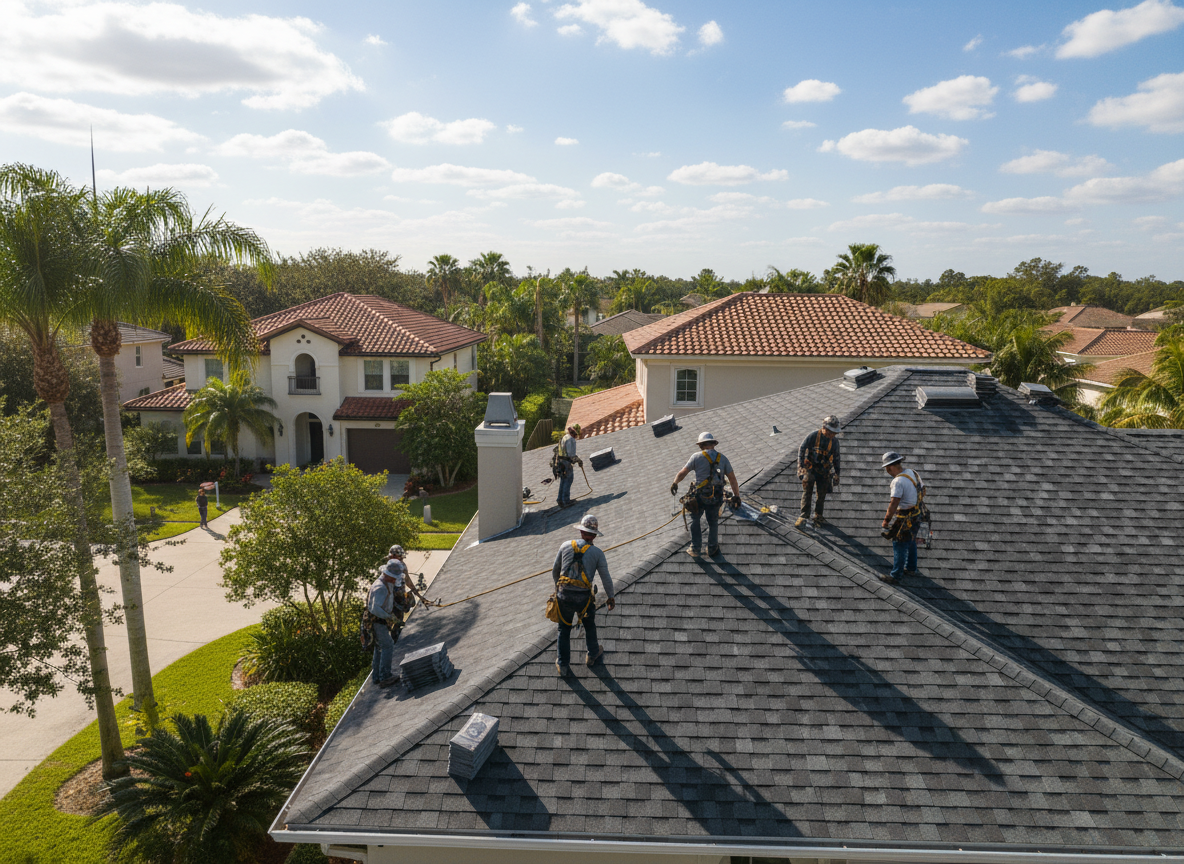
Estero is the newest city in this batch and one of the youngest in Florida. It was unincorporated Lee County ground until the village was incorporated at the end of 2014, and almost everything standing here was built before the government that now permits it existed. That makes it unusual: a municipality with a short institutional memory and a housing stock that is mostly the product of two decades of gated development.
The stock follows the roads. Along US 41 and the Estero River there are older houses and small commercial buildings from the 1970s and 1980s. Behind them, from the 1990s onward, the gated communities arrived — Pelican Sound, Grandezza, West Bay Club and the rest — under concrete tile, built around golf courses and preserves. Roof repair in Estero, FL, is therefore mostly a conversation about a tile roof from the late 1990s, the membrane beneath it, and the association that has an opinion about both.
A Village With a Short History
Estero's incorporation created a building and permitting service where the county had been, and that service now reviews residential roofing inside the village boundary. Outside the boundary, on the unincorporated ground that still uses an Estero address, Lee County reviews it. The distinction matters on a street where the village line runs between two houses.
Because the village is young, its records begin in 2015. A roof installed in 1999 is documented in the county's files rather than the village's, and that is worth knowing when an insurer or a buyer asks for a permit history. It is one reason the survey here starts with the house rather than the paperwork.
The Gated Communities and Their Tile
The communities that define Estero were built between the mid-1990s and the late 2000s, and almost all of them are under concrete tile. From the street those roofs still look close to new. Underneath, the story is different: a membrane installed in 1998 or 2004 is now at or past the end of its service life, and the tile above it has been hiding that fact for years.
The first evidence is usually interior — a stain after a storm from a particular direction, a damp patch at a hip, a musty smell in a room with a high ceiling. Opening the roof at a valley and a hip junction is the only way to grade the membrane. On these roofs the tile is nearly always worth keeping, and the work is a lift-and-relay over new underlayment rather than a replacement of the covering.
Associations Before Permits
In a gated community the covering, the colour, the tile profile and sometimes the contractor are all subject to the association before they are subject to the village. That is not a formality. A tile that has been ordered and then refused is the most avoidable delay in the whole job, and it happens most often in communities like these, where architectural review is thorough and the approved palette is narrow.
The practical sequence is therefore association first, permit second, material third. Where a roof is being repaired rather than replaced, the association may still want to know, because a visible change of colour on one elevation is exactly what architectural review exists to prevent.
Estero Bay and the Water
Estero sits above Estero Bay, and the bay is the reason the ground here is low and the water table is high. The Estero River runs through the older part of the village to the bay, and the preserves around it hold water in the wet season. A roof that discharges onto saturated ground keeps the wall and the foundation damp long after the rain has stopped, which is a drainage question as much as a roofing one.
Ian came ashore at Cayo Costa in September 2022 and drove surge into Estero Bay, and the water reached streets and communities that had not flooded before. Irma in 2017 and Charley in 2004 are the earlier markers. On the bay side the surge is the local risk; a roof over a house that took water may look intact while the deck and insulation below it are wet.
Older Estero Along the Trail
Along US 41 and the river the stock is older and more mixed: small houses from the 1970s and 1980s, some commercial buildings, and a scatter of properties that predate the communities behind them. Those roofs are usually shingle, often on a second covering, and their failures are the familiar ones — a valley, a vent boot, a wall junction, a carport transition.
On these houses the deck is the unknown. A roof that has been re-covered rather than replaced may sit on a deck that was never inspected, and the soft spot shows up when the old covering comes off. That is why the scope on an older Estero house names what is assumed about the deck rather than treating it as a given.
Flat Roofs and Commercial
The commercial centres along the corridor and the clubhouses inside the communities carry flat and low-slope roofs, and those fail by drainage. Ponding is the question, and a membrane that has been patched several times is usually one that has lost its fall. Coating extends a sound surface and does not rescue a ponding one.
On a clubhouse or a commercial building the work is usually planned rather than urgent, which is an advantage: the drainage survey can be done in the dry season and the repair scheduled before the summer. That is the opposite of how a residential roof usually gets fixed, and it produces a better result.
Salt and the Western Edge
West of the interstate, toward the bay, the salt load rises. It attacks the metal rather than the tile: drip edge, valley metal, hip and ridge flashings, vent collars, the fixings on a metal panel, the frames of pool enclosures. Those parts fail under a field that still looks sound, and in a community of similar houses they tend to fail at the same age across the whole street.
The specification follows. Stainless or coated fastenings, compatible metals wherever water runs from one to another, and flashings replaced rather than reused where they have corroded. On a house a mile from the bay that is a smaller factor than on the islands, but it is not zero, and it is the difference between a roof that reaches its expected life and one that does not.
Where Water Gets In
The entry points are consistent across the village: a valley, a hip on a tile roof, a wall junction where stucco has cracked, a plumbing boot, a skylight curb, and the join between the main roof and a lanai. On the older houses add a carport transition and a second-layer deck that was never inspected.
Water travels before it appears, and in a house with a high ceiling and a tile roof the stain may show a long way from the entry. The survey photographs the junctions rather than the stain, and the repair is priced from what is found there.
The Services Available Here
The work comes from the site's own list, applied to this stock. Roof leak repair is the diagnostic core, and on a tile roof it is careful work. Emergency roof repair and emergency roof tarping cover the night a storm opens a roof and water is running. Storm and hurricane damage repair handles the documented sequence afterwards: make safe, photograph, repair, and keep a file an insurer or an association can follow.
Roof repair is the everyday trade. Roof replacement and roof installation handle the end of a 1990s tile membrane or a layered shingle roof on the older streets. Shingle roofing covers the Trail corridor and the older houses. Tile roofing covers the gated communities, almost always as underlayment replacement beneath tile that is kept. Metal roofing suits the waterfront and the rebuilds. Flat roof repair and roof coating cover the clubhouses and the commercial centres. Roof inspection is the visit that starts all of it, and in a community with architectural review it is also the document the board will ask for.
How an Estero Job Runs
The first visit is a survey: ladder, roof where it can be walked, attic where there is one, camera at every junction. On a tile roof the field is opened at a valley and a hip so the membrane can be seen rather than assumed. On an older house the deck is checked where the evidence points.
Then the written scope, which separates replacement from repair, names the underlayment and fastening method, records what is assumed about the deck, and lists exclusions. In a gated community the scope goes to the association before the material is ordered, and the approval is recorded with the job.
The permit is filed with the village before work starts, and inspections follow the village's stages. The close-out is a walk with the owner covering ridges, edges, terminations and cleanup, plus photographs of what is now covered up. In a community of similar roofs those photographs are useful to the neighbours as well, because the same membrane is aging at the same rate on every house on the street.
Village and County
Addresses inside the Village of Estero are permitted by the village's building and permitting services. Unincorporated ground that still uses an Estero address is permitted by Lee County, and Bonita Springs to the south is its own city. Fort Myers Beach and Sanibel are separate jurisdictions with their own offices.
The Florida Building Code applies beneath the local permit. Lee County is outside the High-Velocity Hurricane Zone, which covers Broward and Miami-Dade, so the zone's extra underlayment chapter does not reach here. The wind provisions do, and the coastal part of the county is in the wind-borne debris region, which brings product approval and opening protection into a replacement permit near the water.
Within Ten Miles
Bonita Springs to the south, San Carlos Park and Three Oaks to the north, Miromar Lakes and the corridor along the interstate, Coconut Point within the village, and Fort Myers Beach across the bay to the west. Each has its own permit desk or none, and the exposure changes as you move toward the water.
Calling About an Estero Roof
The address settles whether the village or the county permits the work, and the community settles whether the association sees it first. The covering and its age decide whether this is a repair or a replacement conversation, and on a tile roof from the 1990s the answer is usually the membrane. The office is at 4720 Millenia Blvd, Suite 175, Orlando, FL 32839, and Estero calls come to (407) 557-4529.
Around Estero
We regularly work near:
- 📍Koreshan State Historic Site
- 📍Estero Bay Preserve State Park
- 📍Estero River
- 📍Florida Gulf Coast University
- 📍Coconut Point
Roofing Company in Estero — Local Notes
- •Village of Estero permits inside its boundary; Lee County outside it
- •Most housing was built before the village incorporated in 2014
- •Association architectural review usually precedes the village permit