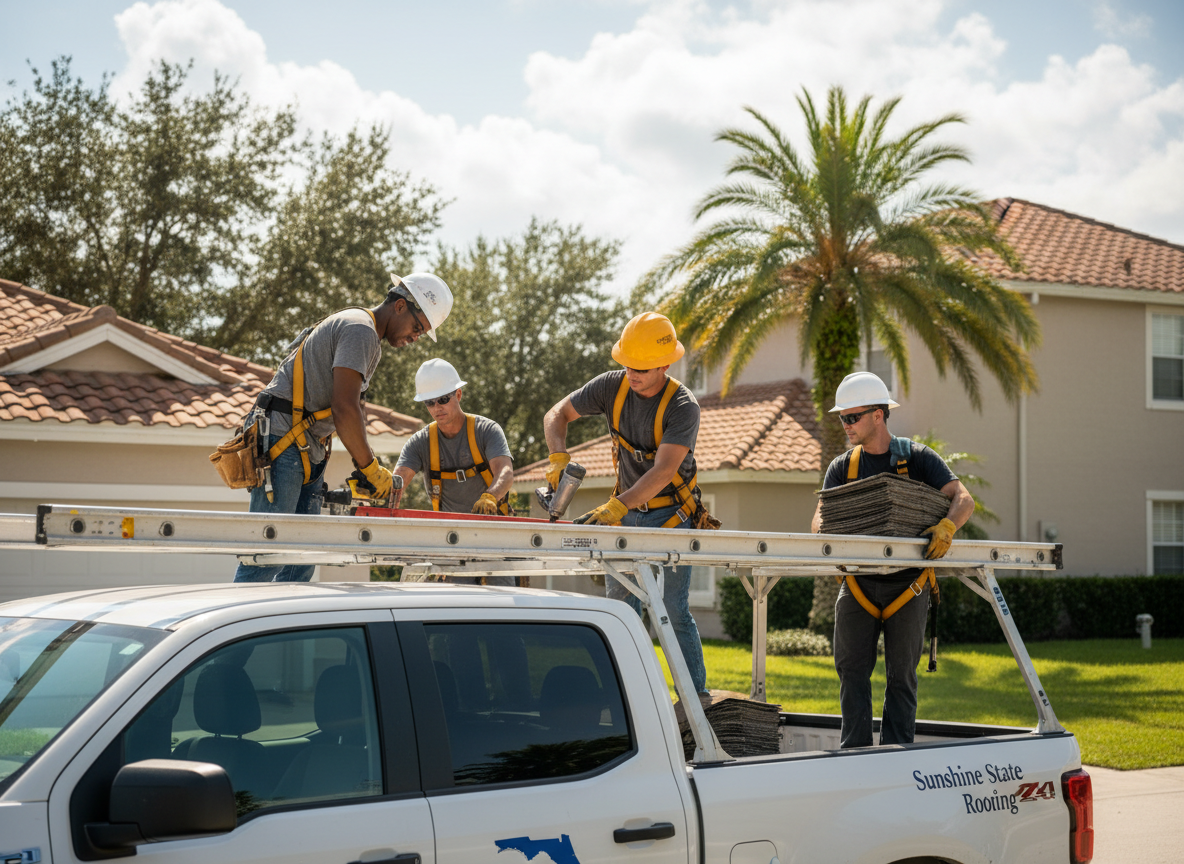
Destin is a resort city on a narrow strip of the Emerald Coast, incorporated only in 1984 and built almost entirely since the 1970s. It sits on a peninsula with the Gulf on one side and Choctawhatchee Bay on the other, joined to the mainland at the east end and closed at the west by East Pass, where the harbour and the jetties sit. Very little of what stands there predates the tourist economy, which is the first thing that separates roofing here from roofing in Pensacola or Tallahassee. There are no nineteenth-century houses to reason about. Roof repair in Destin, FL is a question about salt, wind-driven rain, and a building stock designed for visitors rather than for permanence.
That changes the conversation in practical ways. A family house, a rental duplex and a six-storey condominium on the beachfront can sit within a few hundred metres of each other, and each has a different roof assembly, a different decision-maker and a different definition of a successful repair. On a house the question is usually whether the covering can last another storm season. On a condominium it is usually whether the roof assembly as a whole is still performing, which is a question for the association and its budget rather than for one owner.
Two Exposures Instead of One
Most Florida coastal towns face the Gulf and take their weather from that direction. Destin faces both ways. The Gulf side takes the direct wind and the salt spray; the bay side takes a different pattern, with choppier, shorter-period waves and wind-driven rain arriving from the north during a frontal system or the back side of a storm. A roof on the bay side is not sheltered — it is exposed to a different vector.
That matters because water intrusion is directional. A flashing that sheds perfectly in a southerly gale can be the one that leaks in a northerly blow, and a roof that has been repaired only on the Gulf-facing slopes may have an untouched weakness on the other side. When a survey is done here, both exposures are photographed and both are assessed, because the wind does not only come from the beach.
Condominium, Rental House, Family Home
The condominium stock is the most visible. The beachfront towers are mostly concrete frame with low-slope roofs — membrane or a coated assembly over a structural deck — and their problems are the problems of low-slope roofs everywhere, intensified by salt: seam failures, ponding where a drain sits slightly high, blistering where moisture has been trapped in the assembly, and corrosion at every metal edge and penetration. Below the roofline there is usually a mechanical space or a top-floor unit, and water that gets in does not stay in one place.
Behind the towers the stock is mostly 1980s to 2000s residential: single-family houses and small multi-family buildings under asphalt shingle or concrete tile, with metal on a visible minority, particularly on newer and higher-end construction. Roof pitches are often steeper than in inland Florida, because the architecture here borrows from coastal styles and because a steep roof sheds the volume of rain a Gulf storm delivers. Steep pitches look impressive and are harder to walk, which is one reason surveys here rely as much on photography as on foot traffic.
The third group is the older village fabric near the harbour and along the bayou streets, where small cottages and fishing-era buildings survive among the newer development. These are the roofs most likely to have been added to, patched and re-covered rather than replaced, and they are the ones where a repair has to be designed around what is already there.
Salt, Fasteners and the Metal Question
Salt is the defining material problem on this coast. It attacks the cut edges of metal, the fasteners, the flashings, the vents and the gutters, and it does so at a rate that surprises people who have moved from inland Florida. On a metal roof, the practical question is rarely the panel and almost always the fastener and washer: an exposed-fastener roof at the beach can have sound sheets and a line of failed washers, and the leak appears at the fastening line rather than in the field.
On a tile roof, the tiles are usually fine and the underlayment is the part that has aged. That is not a reason to assume a tile roof is without problems — it is a reason to inspect what is under it, and to understand that replacing a tile roof means lifting and re-laying the tile, not replacing it. On shingle, salt is less of a direct factor than heat and humidity, but the flashings and vents around a shingle roof are still metal, and they are still the first thing to corrode.
The habit that follows is simple: on this coast, metal components are specified for the exposure and checked at every inspection, and a repair that reuses corroded flashing to save a step is a repair that will be back.
What the Storms Have Done Here
Destin has been through the same sequence as the rest of this coast. Hurricane Opal came ashore near Pensacola Beach in October 1995 and affected this stretch of the Emerald Coast. Hurricane Ivan made landfall near Gulf Shores in September 2004, and Hurricane Dennis followed in July 2005, coming ashore on Santa Rosa Island near Navarre Beach. Hurricane Sally made landfall in September 2020 and moved slowly, driving water and wind across the western Panhandle for an extended period.
The damage pattern on a resort coast differs from inland. Covering lost at ridges, hips and edges; soffits and fascia pulled; balcony and parapet details opened; and water driven into wall junctions from an angle the roof was not shedding. On the low-slope roofs of the condominium stock, the failure is often at a perimeter termination or a drain rather than in the middle of the field, because that is where the wind gets a grip.
Matching the Work to the Building in Destin
The site's service list applies here, but the building decides which part of it is relevant. A condominium needs membrane work at seams, drains and perimeter terminations; a house needs the covering, the flashings and the attic checked. Water inside after a storm means roof leak repair, and the answer starts at the entry point. A roof left open means emergency roof tarping to keep the units dry, with emergency roof repair where the opening can be closed in one visit, and storm and hurricane damage repair where the whole roof has to be documented and rebuilt.
Beyond that the material and the deck settle it. Roof repair is right while the covering has life; roof replacement is right when the assembly has reached the end of its service life; roof installation covers new or never-covered buildings. Shingle roofing, tile roofing and metal roofing are the residential options, flat roof repair and roof coating carry the condominium and commercial stock, and roof inspection is the service that produces a document an owner or an association can act on.
Rental Turnover and What a Roof Has to Survive
A large share of the housing in Destin is occupied by visitors rather than owners, and that changes the maintenance cycle in a way that is worth understanding before a roof is scoped. A house that is let through the season is looked at by a cleaner between guests, not by an owner with a ladder, and a stain on a ceiling is reported as a complaint rather than inspected as a symptom. By the time the roof is examined, the leak may have been running for several tenancies.
The practical consequence is that roofs here are often further along than the interior suggests. Water that has been entering for a season has usually travelled, and the first fix is to find the entry point rather than to repaint the ceiling. It also means the survey photographs matter more than usual: a document showing the roof condition at a point in time is the thing an owner can act on between seasons, and the thing that prevents a small repair becoming a mid-season emergency with the unit occupied.
For a condominium the same logic runs through the association rather than the owner, but the timing problem is identical. A roof cannot be opened when the building is full, so the work is planned for the shoulder season, and the scope has to be specific enough that it can be completed in the window available.
What a Destin Job Looks Like From the Inside
The first visit produces a survey, not a number. Roofs are walked where the surface and pitch allow, photographed from ladders and edges where they do not, and examined from the attic or plenum where there is access. On a low-slope building the survey also looks at drains, scuppers and ponding, because those decide more about a membrane roof's life than the membrane itself.
A written scope follows: what comes off, what goes back, what is excluded, the products named, and the protection plan for the building while the roof is open. Permits are applied for before the first delivery, and the work follows the city's inspection sequence. At the end there is an inspection record, a photographic record of what was covered up, and a walk with the owner or the association's representative.
Permits, Code and the Association Layer
Building work here is governed by the Florida Building Code, and the permitting office depends on where the property sits: Destin issues permits for addresses inside the city, Okaloosa County for the unincorporated corridor outside it. Being on a barrier peninsula raises the bar on paper even though the High-Velocity Hurricane Zone — the stricter Miami-Dade and Broward regime — stops well short of here. Design wind speed and exposure category are demanding at this location, the covering needs a current product approval, and the fastening schedule has to match it. Fasteners and flashings also have to survive salt, which the code states as a minimum and the coast enforces as a fact.
On a condominium there is a second approval, and it is not optional: the association's board or manager signs off the scope and the schedule. That decision sets when the roof can be opened and how long it can stay open, which in turn shapes the sequence of work. On contract work the notice of commencement is recorded before the first day on site.
Sealants, Vents and the Small Parts That Fail First
On a beachfront building the parts that fail are rarely the ones in the middle of the roof. Sealant at a termination, a vent boot, a pipe collar, a balcony post flashing, a gutter bracket: small components, small areas, and the places water actually enters. Sun and salt attack sealant faster than anything else on a roof, and a bead of sealant that was sound at installation can be brittle within a few seasons here.
That is why a Destin survey spends time on the perimeter and the penetrations rather than only on the field. It is also why repairs here are judged on what was replaced rather than on what was sealed. A joint that is re-sealed without the underlying flashing being checked is a repair with a date on it, and the date is usually sooner than the owner expects.
Vents deserve a mention of their own. Ridge vents and soffit intakes on a coastal house work hard, and when either is blocked the attic stays hot and damp at the same time. That combination ages the deck from below while the sun ages the covering from above, and no covering survives it for its full service life.
Where We Work Around Destin
The city is the centre, and the ten-mile ring around it takes in Crystal Beach and Henderson Beach inside Destin, Miramar Beach and Sandestin to the east, Fort Walton Beach, Shalimar and Mary Esther to the west, and Niceville and Valparaiso across the Mid-Bay Bridge. Housing differs from street to street, the permit office differs with the address, and the planning does not: survey, scope, permit, work, sign-off.
Asking About a Destin Roof
Have the address ready, because the city and the county permit separately. Then the covering and its age, any permit history, and where water is showing inside. On a rental, tell us when the next guests arrive; on a condominium, the manager's contact saves a week of correspondence. Florida Roof Repair Pros is on (407) 557-4529, with the office at 4720 Millenia Blvd, Suite 175, Orlando, FL 32839.
Around Destin
We regularly work near:
- 📍Destin Harbor and East Pass
- 📍Henderson Beach State Park
- 📍Crystal Beach
- 📍Choctawhatchee Bay
- 📍Mid-Bay Bridge to Niceville
Roof Repair in Destin — Local Notes
- •Incorporated in 1984; almost all building stock post-dates the 1970s
- •Two exposures: Gulf to the south, Choctawhatchee Bay to the north
- •Salt corrosion drives metal and fastener work