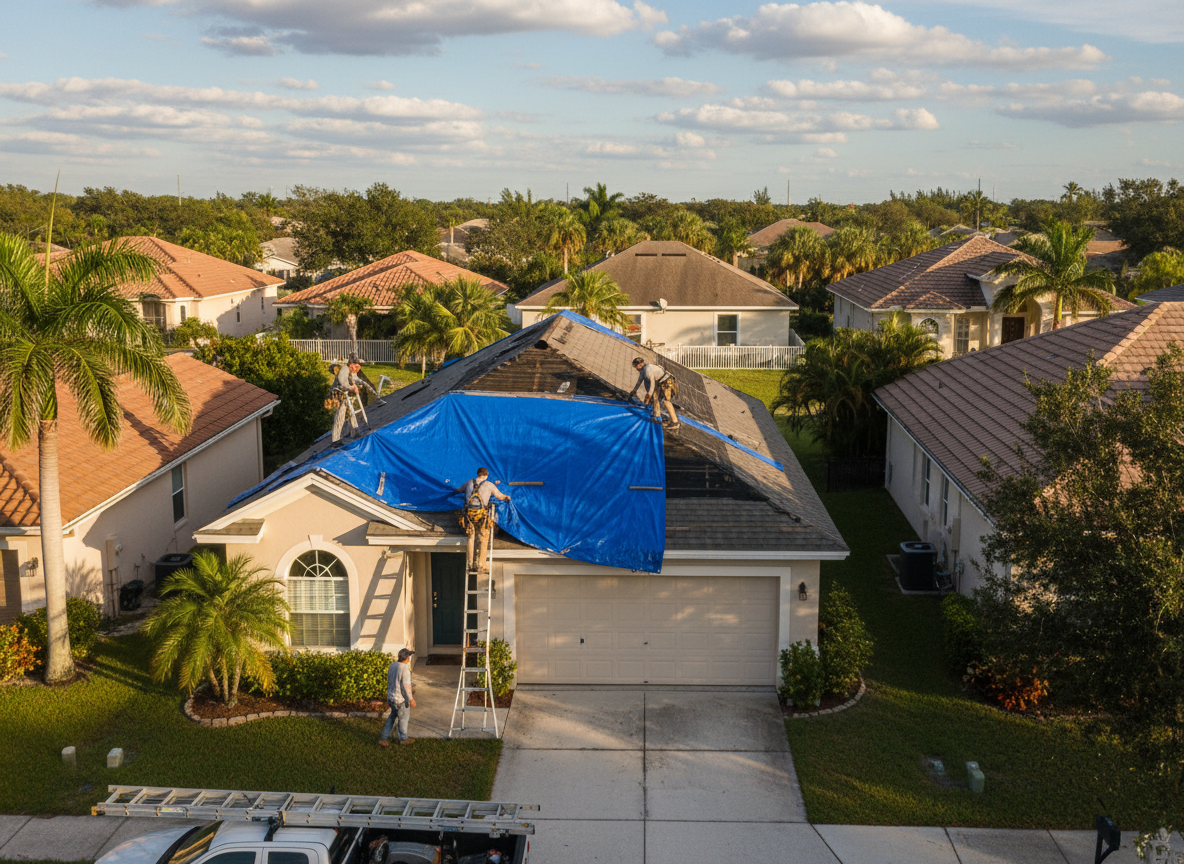
Delray Beach is a small city with a long memory, and the roofs are the clearest record of it. Atlantic Avenue runs from a designated historic district to the ocean in about a mile, and the buildings along it went up mostly in the first three decades of the twentieth century: masonry walls, shallow roofs, parapets on the commercial blocks, barrel tile on the houses behind them. A few miles west the city becomes something else entirely — 1970s and 1980s subdivisions and active-adult communities under concrete tile and shingle, sharing nothing with the downtown except a council. Roof repair in Delray Beach, FL begins with a location and an era, because those two facts predict almost everything else.
Incorporated in 1911, Delray grew first as a farming town around the pineapple and tomato trade and then as a winter resort, and both economies left buildings behind. It is in Palm Beach County, north of the High-Velocity Hurricane Zone that takes in Broward and Miami-Dade, so the zone's extra chapter on underlayment systems and product approval does not apply — while the code's wind provisions do, as they do everywhere in the state. The Atlantic is close enough that salt reaches everything east of the Intracoastal. Florida Roof Repair Pros works this city from an office in Orlando; the line for Delray work is (407) 557-4529.
Downtown: Roofs Behind Parapets
The commercial blocks along Atlantic Avenue are one and two storeys with flat roofs behind parapets, and those roofs were never designed to be looked at. They carry the equipment, the access hatch and the drainage for the building, and their waterproofing has been patched, coated and re-covered for the better part of a century. They fail where flat roofs always fail — at the parapet, at the scupper, at a seam — with one complication that is specific to a downtown: the buildings are attached to each other.
An attached block means a shared party wall and, frequently, a shared roof plane or a step from one roof level to the next. Water does not respect a property line. A parapet flashing that fails on one building can put water into the wall of the one next door, and a re-roof that raises or lowers the finished surface can change how water drains across the boundary. On these blocks the survey has to establish where the roof planes actually divide, not where the deeds say the lot does.
What the Historic Review Adds
Atlantic Avenue and the streets around it sit inside a historic district, and that puts a second question in front of the building permit. The building department asks whether the assembly is compliant: design wind speed, product approval, fastening schedule, underlayment specification. A historic review asks what the finished roof will look like from the street, which on a visible slope can reach the profile of the tile, the colour of the covering, and whether a change is apparent at all.
The two need to be settled in the right order. A permit issued for a roof that the appearance review then refuses is a job that stops with material already delivered, and on a small downtown building there is nowhere to store it. Establishing both before anything is ordered is the whole of the discipline on a historic property, and it applies to a rear slope nobody sees as much as to a front one, because the review often covers what is visible from a public way in any direction.
The Beachside Metal
Between the downtown and the ocean the stock changes. There are houses and small buildings from the 1920s through the 1960s, and a share of them carry metal roofs — standing seam on the newer work, and older formed panels on some of the historic structures. Metal is a genuinely good choice within sight of the salt, because the failure mode is different: it does not granulate or rot, and its problems concentrate at the fasteners, the terminations and the pan details rather than across the field.
Upkeep is still part of owning one. Screws work loose, their washers harden and split, sealant at a termination loses its elasticity, and a panel that has been walked across can trap water against a rib. Near the coast the fixings corrode long before the pan does, which makes them the first thing to examine. A coating can extend the life of metal that is still sound; it will not compensate for fasteners that are already failing.
West Delray: Tile and Shingle
West of the Intracoastal and out past the interstate, the city is late-century. Subdivisions and active-adult communities from the 1970s and 1980s, concrete tile on a large share of them, architectural shingle on others, with the same villa and zero-lot-line geometry that appears across this part of the county. Those tile fields are now at the age where the underlayment is the question. The tile looks fine, the roof may never have leaked, and the membrane beneath it is at or past the end of its service life.
Water usually announces itself after a storm with an easterly component, when rain is driven under the tile rather than falling straight down, and by then the membrane below has been losing its integrity for years. The only way to know how far it has gone is to lift tile at a valley and at a hip junction. A villa adds a complication: some planes are shared, so a repair on one unit can physically sit above a neighbour's ceiling.
Shingle and Ventilation
Shingle roofs in west Delray carry a heat burden the eastern half of the city never sees. Full sun on a low pitch, a shallow attic beneath it, and a mat that hardens year by year: the south and west planes usually show it first, with granules in the gutter and a surface that feels like coarse paper. By the time the shingle looks tired, the felt beneath it has often been finished for years.
Air is the other half of that story. A ridge vent can only pull what the soffits let in, and soffits here are easily blocked by insulation pushed to the eaves, by paint, or by a screen nobody has cleaned since the house was built. When intake closes, the attic stops exchanging air, the deck runs hotter, and the shingle above it ages faster than the calendar suggests. The same condition leaves condensation on the sheathing in the cooler months, which is often mistaken for a leak.
Salt, Wind and the Record
Salt arrives on the onshore breeze and settles on everything east of the Intracoastal. It does not eat tile or shingle; it eats the metal that holds them down and closes them up — nails and screws, valley and hip flashings, drip edge, vent collars, the liners in a scupper. That is why a beachside roof in this city can look intact across the field while its hips and terminations are already failing.
The storms that matter here have names and dates. Wilma came across from the Gulf in October 2005 and left much of Palm Beach County re-roofing over the following year, which is why so many local roofs are now around twenty years old. Frances and Jeanne struck Hutchinson Island to the north in 2004 and drove rain across this coast for days. Older still, the 1928 hurricane reshaped the whole region's building stock. Each of those events left a layer of roof behind it.
How Water Gets In
Downtown the water arrives at the parapet first, then the scupper, then a seam at the low point. On the beachside metal it arrives at a fastener or a termination. In west Delray it arrives through the underlayment at a valley, a hip or a wall junction, and on the shingle streets through a boot, a ridge cap or the flashing where a pitched plane meets a flat porch.
Water travels before it appears. On an attached downtown block it can cross a property line; on a villa it can surface in one unit from an entry point above another; on a flat roof it can run several metres before finding a ceiling. A repair that seals the visible mark without establishing the entry point will be back with the next storm.
The Jobs This City Generates
Leak calls dominate, and on a downtown block the first question is not what failed but whose roof failed. On a villa it is whether the plane in question is shared. On a 1980s tile field it is whether the membrane has quietly expired. Each of those is answered on the roof rather than on the phone, and the answer decides whether the work is a patch, a sectional repair or a full covering.
Storms produce a different kind of job: a lifted edge, a limb through a deck, a panel torn at a termination, water inside a wall before anyone has had a chance to look. The first response is to stop water entering — a tarp over an opening, a temporary closure that will hold through the next afternoon storm — and only then to scope the permanent repair. In a county where insurers ask for evidence, the photographs taken on that first visit are worth as much as the repair itself.
Coverings follow the neighbourhood. Downtown it is flat work: membrane, coating, flashing at the parapet. At the beach it is metal, with the fastenings treated as the wearable part. West of the interstate it is concrete tile over a membrane, or architectural shingle where the street was built later. Nobody sensible proposes a covering before the deck has been seen, and on a shared roof nobody sensible proposes one before the boundary has been agreed.
The Order of Work
A Delray job starts with a walk of the roof and a read of what is under it. On a downtown building that means opening a section at the parapet and at a drain so the layers can be counted. On a tile field it means lifting enough to see the membrane. On a villa it means marking where one owner's roof ends and the next begins. Photographs are taken at each of those points, because the value of a survey is that somebody who was not there can read it later.
The scope that follows is written, not spoken. It separates replacement from repair, names the underlayment and the fastening method, records what is assumed about the deck, and states what is excluded. On a historic property it also describes the finished appearance, since that is what the district will judge. Any approval the district requires is obtained before material is ordered, and the building permit is filed before anyone goes up.
Inspections then fall where the jurisdiction puts them. On a tile roof that usually means the underlayment is seen before the field goes back down, which is the only moment the waterproofing is visible and the moment worth photographing. The final inspection follows completion, and the file closes with it.
What the owner receives at the end is a record: the signed-off inspection, images of everything that is now hidden, and a walk of the property covering flashings, scuppers, edges and cleanup. On a shared or commercial roof that record is what settles the next conversation, whether it is with an association, a buyer or an insurer.
Approvals, and Who Grants Them
The City of Delray Beach issues the building permit for addresses inside the municipality. Unincorporated Palm Beach County addresses go to the county, and the other towns in the county issue their own. Because the historic district sits inside the city, a property on or near Atlantic Avenue may need both the building permit and a separate approval of how the roof will look — two processes, two sets of questions, and neither one substitutes for the other.
The code behind the building permit is the Florida Building Code. North of the hurricane zone, its wind provisions apply without the zone's additional requirements, so the design wind speed for the site, the approval for the covering and the fastening schedule are the substance of the application. On a flat roof, the detail that gets the most attention is how the assembly is fixed at the perimeter, because that is where a parapet either holds or lifts.
Nearby, and How Work There Differs
Highland Beach, Gulf Stream and Briny Breezes sit along the barrier island to the north; Boynton Beach lies beyond them, and Boca Raton begins south of the county line. Inland, west Delray runs into the western edges of both. Each has its own permit desk and its own mix of roofs — the island towns are almost entirely coastal stock, while the inland communities are the same late-century tile and shingle as here.
What to Say When You Call
Give the address first, because it decides who issues the permit. Then say where the building stands: downtown, at the beach, or west of the interstate. If it is a downtown block, mention whether it shares a wall or a roof plane with the building next door. If it is a villa, name the community, since the association's rules and the responsibility for a shared plane both matter. A photograph from the ground and the date of the last roof permit complete the picture. The office is at 4720 Millenia Blvd, Suite 175, Orlando, FL 32839, and Delray Beach calls come to (407) 557-4529.
Around Delray Beach
We regularly work near:
- 📍Atlantic Avenue
- 📍Delray Beach Municipal Beach
- 📍Pineapple Grove Arts District
- 📍Morikami Museum and Japanese Gardens
- 📍Wakodahatchee Wetlands
Roofing Company in Delray Beach — Local Notes
- •City of Delray Beach permits its own addresses
- •Palm Beach County is outside the High-Velocity Hurricane Zone
- •Historic district review is separate from the building permit